Double Whammy: BMC HR Case Management and MyIT Service Broker

By Dick Stark

The RightStar marketing team has been busy. Last Friday we hosted a RightStar Lunch and Learn on Remedy HR Case Management and the previous Wednesday presented MyIT Service Broker to an audience of Webinar attendees. BMC has been busy too. Both products are good examples of how BMC offers digital transformation with innovative new solutions.

Got Catalog Sprawl? That’s BMC’s tagline for MyIT Service Broker (SB), a “single pane of glass,” for organizations with multiple service portals. According to PMG, 71% of companies run up to five service catalogs concurrently and 95% of IT people said a consolidated service app store would make the organization more effective. I know that personally, I’d like to see a service broker for the various portals I access: bank, credit card, paystub, healthcare, to name a few. It’s difficult enough just to try to remember all the passwords for each one.

And catalog sprawl is real. Last week we met with a large insurance company. Before the visit, they emailed, “Our DevOps movement has created a lot of service catalog sprawl. My team supports the enterprise service catalog MyIT/ Remedy. And now the application development teams have also created their own custom built service catalogs. The question we have is how do we stitch all these different tools and processes together?” The answer, of course, MyIT SB.

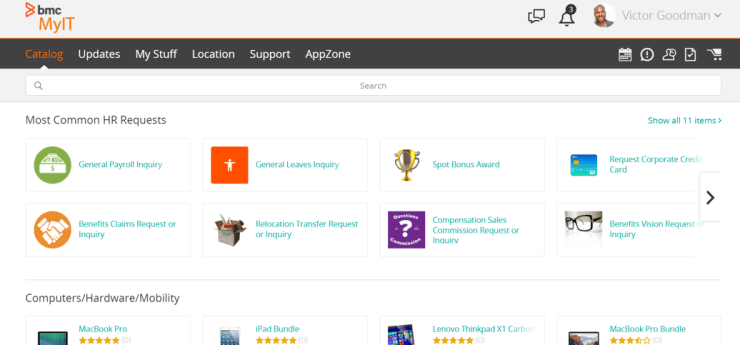
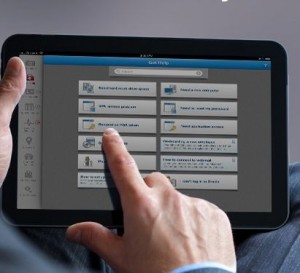
MyIT SB has a modern iTunes-like app store interface. It combines:

  • On-boarding services and people
  • Managing services and people
  • Delivering services to people
  • Tracking services and people

The good news is that one of our government customers just purchased MyIT SB and MyIT SB is a major reason whythey stuck with Remedy, rather than switch to a competitor. They were hooked by the Amazon like user interface and desperately needed to digitize about 75 paper based service requests from multiple sources.

HR Case Management. In case you missed our Lunch n Learn,we presented BMC’s new HR Case Management (CM) Solution. Based on the Remedy platform, HR CM creates a unified HR experience for employees. Today’s employees expect a digitally savvy workplace and a modern HR service Desk.
BMC HR Case

What HR CM is not is an HR Information System like PeopleSoft or Workday. Most enterprises have some type of HRIS system already, but most don’t handle the HR approval process very well, using a combination of forms, emails, spreadsheets and phone calls. Often the process doesn’t work, is inefficient, and can be a bad experience for the employee.

HR CM delivers a next-generation service center solution. It transforms HR into the digital era with best-practice templates and workflows and a mobile, digital workplace app that makes the whole workforce more productive. Focused on workflow, it provides the mechanism to standardize and optimise the process by handing to the right staff members at the right time.

The conclusion: MyIT SB and HR CM offer companies a means of digital transformation. Of course, organization should always seek first to understand what the user needs before jumping into the modernization process.
Posted in BMC, Digital Engerprise Management (DEM, RightStar, Uncategorized | Tagged , , , , | Leave a comment

A Tale of Two Service Catalogs

MyIT Service Request

By Dick Stark

Last week RightStar presented a webinar, “How to Create a Service Catalog using Best Practices.” At the beginning of the webinar I briefly described two recent customer service catalog go lives. Both were highly successful and deserve recognition, thanks to the great work of RightStar systems consultants. Here’s additional information.

The first is a hospital that provides primary, specialty and emergency care throughout Central Virginia through a network of clinics as well as a main hospital that has more than 500 beds. The hospital has been a Remedy customer since version 2, meaning they have run Remedy on their service desk for more than 15 years. Last December, RightStar helped them upgrade to Remedy V9 and in February began a Service Catalog/MyIT project to replace SRM, eventually supporting 22,000 users. The June 2 go-live also included a roll-out of Smart IT and Smart Reporting

Over 50 Service Request Definition requirements were gathered and fully built by RightStar, then User Acceptance Tested and approved by the hospital for use within MyIT, which was rebranded as MyHIT. Examples of service request types built include Facilities, reports and documentation, medical and custom application assistance, HR/Finance/Supply Chain, Network, mobile app, training, and email.

RightStar and the hospital followed a detailed project plan focused on rapid development of SRDs and branding which allowed the project to go-live over a three-month period.

RightStar L1 support also played a key role in supporting questions and requests during the development cycle, which allowed the RightStar consultant(s) to stay focused on quality communication, configuration and development efforts to ensure a successful go-live experience.

Since go-live, there have been no technical issues reported and no complaints by users, and feedback has been positive across the board. Absolutely no go-live support has been required by RightStar so far.

The second, a government agency, ensures that millions of Americans have adequate health insurance. RightStar has worked with this agency since last summer. We began with a Remedy 8 upgrade project and started an SRM version 8 Service Catalog project in January. This service catalog did not include the MyIT front-end.

There, RightStar replaced an end-of-life facility management application with about 70 new service requests to create work order tickets in Remedy. Service examples included: handyman, grounds and parking lot, conferences/meetings, and elevator issues. Now there are thousands of end-users hitting the Service Catalog portal and about 80 support users working the tickets in Remedy.

RightStar participated in an agile project which went from design to go-live in less than four months. As a result of extensive testing, go-live support consisted only of changes to workflow rules and SRDs. The customer is very satisfied with the rapid roll-out and will continue to work with RightStar on future projects such as a Remedy 9 upgrade planned for later this year.

Posted in BMC, Business Management, Remedy, RightStar, Uncategorized | Tagged , , , , , , , , , , , | Leave a comment

RightStar’s Atlassian Advisory Services

Atlassian Continuous Loop

By Dick Stark

What do most new Atlassian RightStar customers have in common? Answer: Atlassian Advisory Services. Anyone on RightStar Atlassian team can perform this assessment. Here’s what they do.

RightStar offers DevOps solutions to assist companies to drive down costs, enhance the customer experience and improve operational processes. Our objective is to assist organizations to move quickly towards a more DevOps centered IT culture. DevOps organizations experience increased competitive advantages, enabling faster time to market, increased customer satisfaction, and employee productivity.  Why?  Because technology has become the dominate value creation process and an increasingly important means of customer satisfaction.

Many large organizations have implemented a wide variety of DevOps processes and tools from organizations such as IBM, Microsoft, HP, and Atlassian. Although DevOps standards are not yet as mature as ITSM’s ITIL framework, DevOps domain capabilities center around the following:

  • Test Management
  • Requirements Management
  • Application Performance Management
  • Build Management
  • Project Management
  • Defect and Issue Management
  • Change and Configuration Management
  • IT Governance

RightStar provides DevOps advisory services focused on four primary areas within IT: culture, organization, processes and tools. Since there are no prescribed DevOps patterns and practices, implementations vary.  Although there is currently a move towards DevOps standardization, RightStar relies on its experience with other organizations and previous best practice experience.

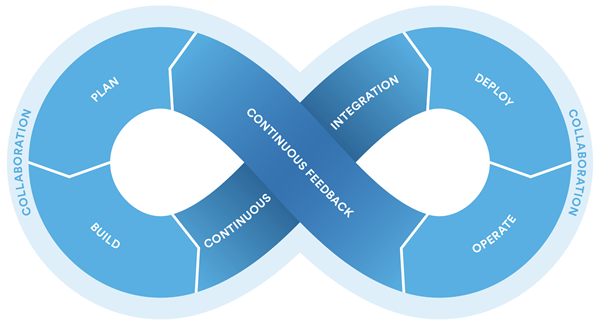
Additionally, RightStar advisory services for a DevOps rollout is based upon the following phases of the software development lifecycle.

  • Plan. Requirements, resource management, capacity planning and assigning levels of effort based on either Story points or hours to complete a task
  • Build. Staging the code in an automated way, have automated peer reviews for good coding practices, collaborating with the teams to deliver information accurately and efficiently.
  • Continuous Integration. Defined branching and merging, automated testing based on defined branches, and traceability
  • Deployment. Use an automation tool or tools to help with deployment
  • Operate. Server monitoring and application performance monitoring should be automated
  • Continuous Feedback. Better products through user feedback

Surveys show that customers that begin with up-front advisory services have a much better overall implementation experience, which reinforces the importance of this RightStar consulting offering.

Posted in Atlassian, DevOps, Uncategorized | Tagged , , , , | Leave a comment

Report from the Atlassian Federal Symposium

By Dick Stark

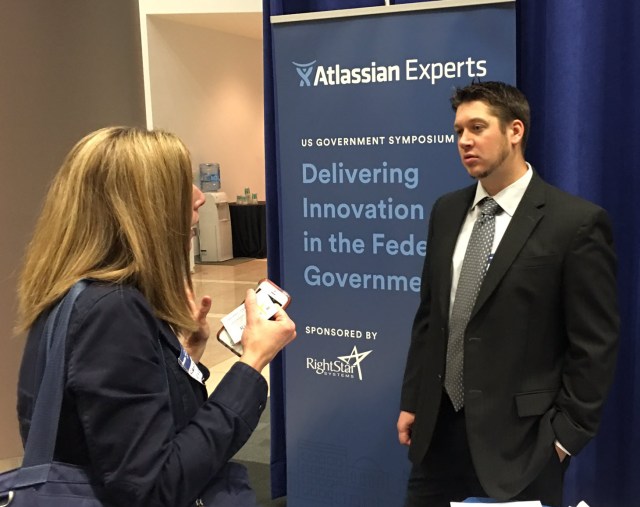
On Tuesday, May 10, RightStar exhibited at the Atlassian Federal Symposium, “Delivering Innovation in the Federal Government.” I also sat on a panel that addressed DevOps and Agile Government. Atlassian had a good turnout with more than 120 attendees. Here is a short summary of the two government presenters.

2016-05-Atlassian Federal Symposium

The Atlassian Federal Symposium

Tony Pham, Principal Consultant, US Department of Homeland Security, discussed how the Customs and Border Protection (CBP) modernized international trade and security by going agile. Tony said “CBP is fully committed to agile government using the Atlassian suite for software development, project management, collaboration, and continuous integration.” Tony discussed the use of JIRA, Confluence, Bitbucket, Bamboo, FishEye, Clover, SourceTree, JIRA Service Desk and HipChat, for the entire software development lifecycle.

CBP is big on metrics and Tony presented pages of reports pulled directly from JIRA. He started with a chart that tracked project status and earned value (e.g., 17 days remaining until go-live). He also showed charts that tracked risks, deficiencies, specific training projects, and project performance. Tony even mentioned how he set up dependency tracking in Confluence and JIRA. He then concluded with a final a real-time dashboard tracking team project performance. Tony summarized with a graphic on how Atlassian provides traceability from “A to Z.”

Next up, James Hunt from Vistronix presented, “Going from 0 to 60 in 5 Years.” He is a government contractor managing a very large Atlassian implementation for a significant DOD agency. He described how the agency grew from just a few JIRA users in 2010 to more than 65,000 today. According to James, prior to 2013, JIRA usage was isolated and siloed by the various teams. In 2013, James merged two systems into one and added 8000 users to the system, taking the agency to a total of 12,000.

By 2014, the agency was up to 27,000 JIRA users and began using JIRA Service Desk for incident management. By, 2015, the number hit 60,000. At that time, James added knowledge management and Kanban boards to the service desk. What was most incredible is that despite the growth, the entire system was supported with a team of only five administrators.

By 2016, 65,000 users across 1500 groups were on-board. Current statistics included:

  • JIRA Projects:             800
  • JIRA issues:                 613,000
  • Bitbucket repos:        2000
  • Spaces                           1700
  • Bamboo Plans             300

Other JIRA features included: detailed forms, allowing teams to pick what they need to know, a live knowledge base with current documentation, a Confluence overarching reference page, project templates showing Scrum workflow, and a daily support Kanban board with critical to-do’s.

What does this mean? Atlassian is ready for the big time. Its products do scale to support very large enterprises with minimal support and administration, and without having to pay an “arm and a leg.” The end result is faster development projects and very happy customers.

Posted in Atlassian, DevOps, RightStar, Uncategorized | Tagged , , , | Leave a comment

Report from BMC’s Sales Kick-Off Meeting


By Dick Stark

BMC began its FY17 on April 1 and held its annual sales kick-off meeting last week in Las Vegas. It was a great start to BMC’s new fiscal year.

CEO Bob Beauchamp opened with a “state of the union” report.  BMC is in year three of its “re-invention.” Year 1 was design, year 2, build and year 3, run. Although numbers weren’t disclosed, Bob said everything is going per plan (they haven’t disclosed numbers to their investors, and therefore can’t disclose until later this month). He did report significant y/y growth in the following categories:

  • Remedy
  • My IT
  • Discovery
  • TrueSight

Bob also reported that the DEM (Digital Enterprise Management) vision is going well and that marketing and pipeline numbers are way up. Robin Purohit, President ESO unit discussed new products such as Remedy 9.5 Innovation Studio. He also presented BMC product strategy in a new format.

BMC’s Jeff Hess, VP of Customer Sat and Presales discussed engagement excellence. BMC studies show that customers are more engaged when an assessment, is performed first. An implementation without an assessment does not rate nearly as high. So, BMC has really upgraded its assessment tools. The end deliverable is a high-tech document with lots of pictures, charts and graphs. There is even a custom video to be delivered.

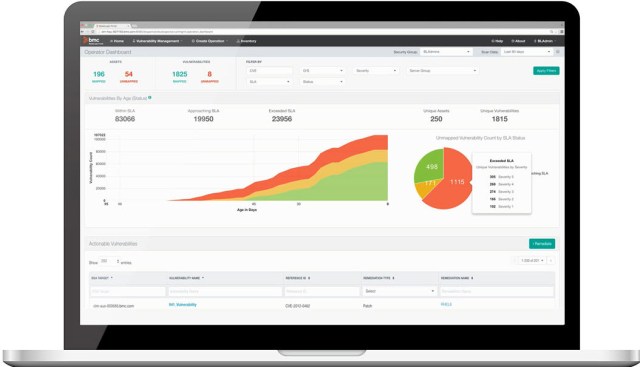
The most interesting new development is the SecOps offering from the DCA group, aka BladeLogic Threat Director. Because of the interest around Security, the strategy is to go for a share of the multi-billion cybersecurity space. BladeLogic now has a security dashboard to report on scanned servers, remediate critical threats, and block attacks.

BMC Threat Director

BMC’s customer goal is to give its customers an exponential advantage in the digital economy by enabling and managing digital transformation. With innovative products like Remedy 9.5, Service Broker, Smart IT, and MyIT, BMC is well ahead of its competitors. At RightStar, we look forward to an excellent BMC FY17.

Posted in BMC, Digital Engerprise Management (DEM, Remedy, RightStar | Tagged , , , , , | Leave a comment

Remedy 9 Success Stories

Remedy 9

By Dick Stark

Remedy 9 is helping BMC win against ServiceNow based in part on its innovative MyIT, Smart IT and Smart Reporting components:

Smart IT replaces the current user interface with one that is more like Facebook–more collaborative, designed for mobile first. It is a persona-based approach with specific roles such as first and second line techs, field support techs, and service desk manager.

MyIT empowers end-users to ensure they always have access to the right technology and support services, no matter where they are, all from one easy to use smartphone app.

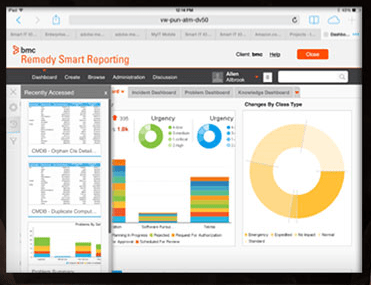
Smart Reporting, like reporting in Salesforce, enables users to build custom reports with ease. Even better, users can share, follow, and comment on graphs and charts to get the whole team engaged in making better decisions.

MyIT Service Broker is a consolidator of services catalogs from multiple source, providing users with a single self-service app for all their business needs. MyIT Service Broker lets organizations aggregate and manage, deliver and track hardware, software, and services from multiple cloud-based and on-premises sources in a modern service app store.

Medical Center. A large medical center went live with Remedy 9 in December and is piloting MyIT to replace SRM, eventually supporting 14,000 users. They also have big plans for Smart IT and Smart Reporting.

University. A local university went live with v9 in early January. They are not using Smart IT, but will roll out MyIT and Smart IT in the near future.

A large Civilian Agency. A division of a large civilian agency is still under construction but plans to go live with Smart IT, MyIT and Smart Reporting this summer. Lots of interest around Smart IT.

Civilian Agency. A long time RightStar customer went live in January with v9 and rolls out Smart IT to a non-IT Financial group on Monday. RightStar helped build the knowledge base.

Another long-time Civilian Agency will go-live in April with v9 with Incident and Knowledge Management only. Smart IT and Smart Reporting will follow in later phases.

A DOD Agency. A new agency created to provide consolidated IT services will go live in June with Smart IT, Smart Reporting, and MyIT installed, but limited functionality. Later phases will provide more functionality.

A Fortune 10.. This bank is a RightStar BMC redirect moving to v9 this summer. MyIT will eventually support 105,000 users. To prepare for this rollout, RightStar has already completed the MyIT Architectural design.

A Civilian Agency. This agency recently made the decision to standardize on Remedy, in part based upon the strength of MyIT Service Broker. Catalog sprawl is a current issue as they have multiple “hard” and “soft” existing service catalogs. Their objective is to bring everyone together under one roof. One significant objective is to significantly reduce the delays that new employees and contractors face getting new hardware and software provisioned.


Posted in BMC, Business Management, Remedy, RightStar, ServiceNow, Uncategorized | Tagged , , , , | Leave a comment

Is Agile Government an Oxymoron?

By Dick Stark

The needle has hardly moved since the COBOL days. Projects are taking longer, have less success, over-run to a greater extent. Meanwhile citizens are ill served. What is needed is not making things more agile, but simplifying the whole ponderous, error prone process where a majority of stakeholders consistently favor more process complexity, slower speed in the name of quality, and never penalize the wizards who preside over this domain.

      –Reader comment in response to Steve Kelman’s FCW article, “What’s happening in agile,” March 15, 2016.

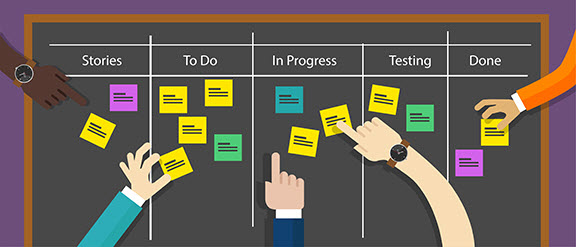
Kanbahn Chart

Is agile Government an oxymoron? The above reader certainly thinks so. Although I don’t have specific data that shows the Government is any worse than the private sector, several failed or poor projects come to mind: Lockheed’s botched $170M 2001 FBI modernization project, and CGI’s removal from its $678M 2013 Obamacare website contract. The failed FBI project is often cited as a case study for agile development over the traditional waterfall approach. It’s more difficult, however, to pinpoint blame with the CGI project. Most reports examine CGI’s difficult task of integrating its back-end development efforts with another vendor’s front-end software interface. Without a good way of testing software end-to-end, software debugging is more challenging and time consuming. With tight project release deadlines looming, inadequate software testing resulted in software that was released too early.

According to Steve Kelman’s recent article, the Government is making significant progress in in agile software development processes. Kelman specifically referenced the work of Mark Schwartz, CIO at US Citizen and Immigration services (USCIS), one of the leaders in the government’s move towards agile. Specifically, Schwartz is a proponent of continuous delivery as a way to shorten the software development life cycle by automating the delivery process (think Atlassian toolset) and making software releases smaller and more frequent (think Amazon). Smaller faster releases enable users to quickly test, and the developers to quickly fix any issues. The larger and more complex the release, the more likely that multiple and more complex defects will be discovered.

Schwartz says that his plan for USCIS is to go 100% agile “cold turkey.” This means that all his new IT projects will offer continuous releases. This requires automation and effective control processes to roll-back to a previous version if necessary.

Think of the implications for our work with large ITSM deployment projects. For example, rather than have a Phase 1 delivery stretching over six to nine months and promising integrated incident, problem, change, and asset management, why not do incident in three weeks, followed by change management three weeks after that? Of course, some of these modules are closely integrated meaning that care must be taken to separate each release.

In a new DOD agile ITSM Remedy project just underway, RightStar is using Agile / Scrum tools to meet the tight timeframes imposed by the customer. In addition to compiling an expert deployment team, RightStar is utilizing excellent DevOps practices for success such as collaboration, project transparency, better workflow, and improved communication. The overriding objective: meet the customer’s tight timeframes and show that both rapid Remedy deployments and agile government development projects are definitely NOT oxymoron’s.

Posted in DevOps, ITSM, Uncategorized | Tagged , , , , , | Leave a comment

Using Agile to Ignite Your ITSM Projects

By Dick Stark

Last Wednesday, Sam Wood and I presented a webinar entitled, “Using Agile to Ignite Your ITSM projects.” We discussed the advantages of using Agile as the framework for Remedy ITSM implementations. Sam should know. He implemented Remedy and ServiceNow at his previous job in an Agile fashion with the Atlassian tools and will be using Agile/Scrum techniques on his new project which is just underway.

Agile Methodology

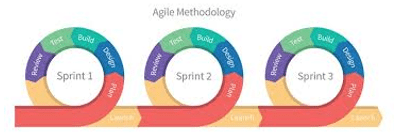
Sam opened by describing Agile as the methodology and Scrum as the framework for rapid deployment of projects. Scrum takes its name from Rugby where the team works closely together for project success. Scrum uses an adaptive, self-correcting approach. BMC Smart IT is a good example of rapid software development using Scrum. Smart IT went from an idea to a shipping product within approximately seven months. By contrast, most of RightStar’s implementation projects use the waterfall, or Gant chart approach. That is, finish step one and then move on to step two. Sam’s new project has specific deadlines and Scrum offers the best way to keep the project on-time. Here are several reasons why.

Sprint Review or Sprint Demo. Our stakeholders often do not get to see the results of their ITSM project until the UAT portion of the project—with sometimes disappointing results. One of our Remedy consultants used a Scrum approach to project delivery on a customer project. He shared his results in short sprints. This iterative feedback worked well as the users participated in frequent demo sessions and our consultant received constant feedback. The result was a project delivered on-time and within budget.

Daily Stand-up or Daily Scrum. Each day at the same time, for no more than 15 minutes, the team and Scrum Master meet and answer three questions:

  • What did you do yesterday to help the team finish the Sprint?
  • What will you do today to help the team finish the Sprint?
  • Is there any obstacle blocking you or the team from achieving the Sprint Goal?

Any RightStar project with more than one consultant should begin with a Daily Scrum. In this way, all RightStar team members know exactly where everything is and what to do.

Make Work Visible. The most common way to do this is to create a Scrum Board with three columns: To Do, Doing, Done. As I’ve said many times before, when we start projects make sure that everyone on both the customer team and project team have a clear, documented understanding of two primary things: What we are going to do, and how do we know when we are done.

Sprint Retrospective. After the team has shown that they’ve accomplished and completed the project, the team can review what went right, what could have gone better, and what can be made better in the next Sprint.

Posted in Atlassian, DevOps, ITSM | Tagged , , , , , , | Leave a comment

DevOps is the Bimodal Bridge

Atlassian Expert Logo

By Dick Stark

Last week bmc emailed its customer base a Gartner Reprint entitled, DevOps is the Bimodal Bridge. Like ITIL of ten years ago, DevOps is starting to get a lot of attention and Gartner customers are asking what to do with DevOps. The Gartner authors, Cameron Haight and George Spafford (co-author of the Phoenix Project), explain that DevOps is actually a bridge between the two IT bimodal approaches.

I googled bimodal IT and discovered that Gartner defines it as, “The practice of managing two separate, coherent modes of IT delivery, one focused on stability and the other on agility. Mode 1 is traditional and sequential, emphasizing safety and accuracy. Mode 2 is exploratory and nonlinear, emphasizing agility and speed.” Organizations like FaceBook, known for rapid and agile development fall into the Mode 2 camp, while more traditional “ITIL” or “Waterfall” based development shops are Mode 1.

Interestingly, the Gartner reprint predicted that by 2020, at least 80% of the practices identified with DevOps and Mode 2 will be adopted by traditional Mode 1 groups, up from less than 10% today. This is an amazing prediction that really highlights the growth of DevOps in the coming months and years. Of course, DevOps is the “bridge to Mode 2” by assisting the more traditional organization to adopt practices and processes of DevOps.

This is why HDI, Pink Elephant, and the ITSMF conferences all have DevOps tracks and why those sessions are so crowded. I’m reminded of the interest in ITIL from 10 years ago and the surprise when users discovered that ITIL was a framework only, and the actual implementation was left mostly up to the practitioner. Of course, ITSM tool set vendors built “ITIL in a box,” (and achieved ITIL toolset certifications) by converting that framework into a prescriptive process, e.g., bmc Service Management Process Module (SMPM). DevOps implementations however, vary widely since there are no general prescribed patterns and practices.

A good example of this is change management. Common feedback from organizations that have implemented a formal change process, along with a new toolset is that the new change process is bulky, cumbersome and slow. While formal change process may prevent outages caused by rogue developers, it does little to improve speed and agility. As a result, DevOps has emerged as a quick fix to the “Mode 1 blues.” The Gartner report recommends more preapproved changes and automation wherever possible. In some cases, traditional CABs are not required, due to the time lag for approvals. Gartner also recommended to “pre-approve low risk standard changes.”

The good news is that RightStar already sells DevOps advisory services and the Atlassian toolset to Mode 2 organizations. Atlassian offers solutions for team success: collaboration, project transparency, better workflow, and improved communication–by using products such as JIRA, Bitbucket, and Confluence. This means that the combination of DevOps processes and Atlassian DevOps toolsets can provide a bridge for Mode 1 organizations moving to Mode 2. RightStar, too, is the bimodal bridge to Mode 2.

Posted in Atlassian, DevOps, ITSM, Uncategorized | Tagged , , , , , , , , | 2 Comments

Report form BMC’s Exchange Federal

BMC engage logo

BMC’s annual Federal user group conference, Exchange, was held last Tuesday at the Ronald Regan Building in Washington, DC. Attendance was up this year with approximately 400 customers, partners, and BMC employees in attendance. In the afternoon we presented, The Art of Linking ADDM and CMDB to Application Performance Management to a good sized crowd. Here is a short Exchange 2015 update.

Paul Appleby, BMC Executive VP, Worldwide Sales and Marketing, opened with a quote from Tony Scott, CIO of the US Federal Government, “The Federal Government is going through a transformative time as it turns to a more digital mode.” Fortunately, BMC has stuck its toe deep into the Digital Service Management (DSM) waters and is assisting government agencies to drive down costs, enhance the customer experience and improve operational processes. With 64% of agencies reporting they do not have enough resources to maintain current systems, BMC, with new products like MyIT and Smart IT is well positioned for DSM success.

Dan Streetman, BMC Senior VP, Worldwide Strategic Sales and Operations acted as the host for Exchange. Dan recently joined BMC from Salesforce, and is now responsible for the Channel, Sales Operations, and Inside Sales. He is also the temporary VP of BMC’s Federal Region. He brings a tremendous amount of energy and enthusiasm to his new position.

Keynote speakers included Dr. David Bray, CIO, FCC, and Richard McKinney, CIO Department of Transportation. Richard spoke about his success with the Technology Business Council (TBM) and his efforts to create an IT cost taxonomy and show the value of IT. At DOT he has worked hard to accurately track service costing by setting up cost pools and assigning costs and chargebacks. How else can an organization truly know whether IT is actually creating value.

In the afternoon, Robin Purohit, BMC President, Service Support Business, updated the audience on:

  • ServiceBroker, a storefront for any employee or customer facing on-premise or cloud services.
  • BMC HR, a comprehensive HR app with an extensive mobile component.
  • ADDM, which on February 23 will now be known as BMC Discovery. The new version now maps 80% of an organizations applications with 80% accuracy in 15 minutes.

Deloitte and DISA had previously won the BMC Customer Success Story of the year for excellence with ITSM and BladeLogic Server Automation (along with closed loop change management). Deloitte’s session described how they transformed DISA from an organization of independent silos to a single enterprise standard using Remedy as the application centerpiece, all with less than 5% customization.

If you missed BMC Exchange Federal, BMC’s annual user group conference, Engage 2016 will be held September 6-9, 2016 in Las Vegas. See you there!

Posted in BMC, Business Management, RightStar, Technology Trends, Uncategorized | Tagged , , , , , , , , , , | Leave a comment