IT Service Management in the Cloud

By Dick Stark

Last Thursday, I attended a panel discussion sponsored by the National Capital Area itSMF user group.  The topic: IT Service Management in the Cloud. Paul Alberti, from FEMA’s Office of the CIO, led  the discussion with representatives from BMC, ServiceNow, and Cherwell. This impressive group discussed service management SaaS solutions for government agencies. Katie Tierney, BMC ITSM Strategist reported that according to Gartner, 75% of service management implementations will be in the cloud by 2015. Here is a summary of the sessions.

BMC. Katie opened with a story about her search for a new car.  While she’d really like to have a new Shelby GT, her family requirements dictated a more practical SUV. “One size does not fit all,” said Katie, “and organizations shouldn’t have to be forced to shoe-horn Remedy into a place it doesn’t fit.” Choice matters, so BMC offers Private Cloud and Public Cloud solutions, e.g., Remedy-on-Demand (RoD), and Remedyforce.

Remedyforce is built on the Salesforce force.com platform (Salesforce, a technology cloud giant where more than 125 million users processes a billion transactions per day.) Remedyforce is scalable and secure, supporting FISMA moderate with multiple ATO’s. ATO means authority to proceed. A government agency can grant ATO based upon compliance with the FISMA security framework.

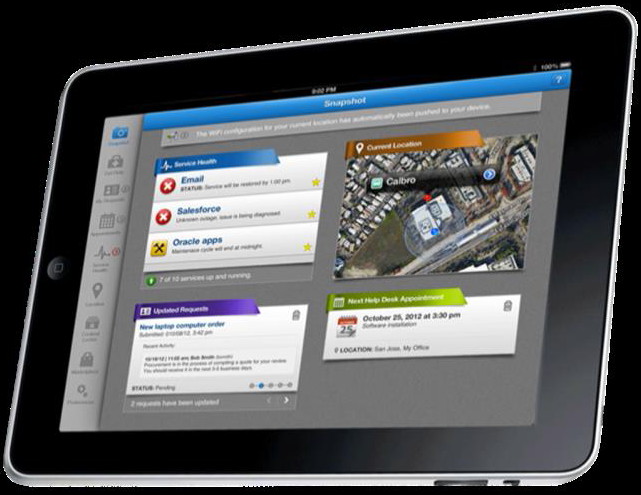
RoD is offered for private or public clouds.  For example, CSC is hosting RoD at DHS as a private cloud rollout. Katie closed with a short overview of MyIT which BMC invented to improve the end-user’s IT experience.

Cherwell. Michael Santos, Solution Consultant pointed out Cherwell is one of the top three ITSM SaaS solutions in the world and is the youngest of all companies in the Gartner Service Support management Tools quadrant. They are a private company with about 150 employees. Michael said that Cherwell Service management (CSM) is the only ITSM solution that provides an enterprise-level application development platform at a mid-market price without programming resources. CSM is available in a SaaS and on-premise version.

ServiceNow (SNOW). Doug Ligenfelter, Federal Sales Director described progress at agencies such as GSA, NIH, DOE, NIST, and Walter Reed. Doug is making “hay” now with some Remedy accounts running old versions.  Due to the “recession” hitting the government, he is showing cost saving by moving off legacy Remedy and onto the SNOW platform.

SNOW is growing rapidly with $243M in sales in FY2012.  They now offer 26 applications on a single platform with no acquisitions.  All development work has been organic. Doug was most proud of the progress made towards security compliance. He said that ServiceNow is the only ITSM solution with a GSA issued and administered Government wide FISMA moderate ATO. Doug made no bones about ServiceNow’s single-tenancy approach.  Each customer has a dedicated virtual server()which allows for unique personalizations by account.

SNOW is the up-and-comer and is winning against BMC—a monumental wake-up call. But, there is hope as Remedyforce gets better and better.  And even more exciting, FootPrints v12 will be released before the end of the year, with a hosted offering by RightStar and Rackspace!
Posted in BMC, ITSM, Technology Trends | Tagged , , , , , , | Leave a comment

RightStar’s Practical Remedy Exam

By Dick Stark

We attended an “orals” this week held at a local government agency.  We teamed with an 8(a) company to compete for Remedy implementation and consulting work for this very large Remedy account. The oral competition included a presentation followed by a practical exam. That exam contained three impromptu questions:

(1)   How would you deal with disparate groups consolidating their service desks into one? Describe how to ensure their data is segregated. What are the risks and benefits?

(2)   Describe how you would upgrade to Remedy v8.1.2?  How much experience do you have and what is the technical approach?

(3)   How would you roll out an enterprise version of Remedy Change Management to all?  What are the risks and how do you get the users to embrace the new system?

We had 15 minutes to prepare and 30 minutes to present.  What would you do?  Here is a brief summary of our response.

(1) I opened with a few assumptions about value points: improve IT management and governance, reduce the cost of IT, and consolidate IT operations and resources. Consolidating service centers is a terrific way to return value back to their organization due to savings in hardware, software, maintenance, and support costs.

We followed with a technical discussion about Remedy multi-tenancy—how to set this up, what to watch out for, and technical considerations.  Overall, Remedy multi-tenancy is a win/win, as more and more agencies consolidate into a single system that supports multiple organizations.

(2) Next we addressed our experience with Remedy 8 upgrades: 844th, House of Reps, Department of Treasury, George Washington University, and starting on Monday, USDA. Version 8 is a solid release with significant performance and usability improvements. I stressed the success we’ve had with each upgrade.

We then discussed our typical upgrade process: fresh install, followed by a data migration. We mentioned this is not the process BMC recommends, but our process was documented and presented in the Remedy WWRUG conference held last year in San Francisco (and it works!)

(3) For Change Management, I related our experience with National Academy of Science (NAS), where we performed a design and roll-out of only the Remedy Change application. A risk of NAS, and others is user adoption.  I quoted from management guru, Dan Heath, “resistance to change is often a lack of clarity.”  Then I discussed the role we played in making sure the users where trained and excited about the new system.

I also pointed out the importance of Change, especially integrated Change, Incident, and Problem Management.  I also related the INSCOM story of closed loop change management; when an unknown asset is discovered on the network, a check is performed to ensure that a change request was in place for that new asset.  If not, an alarm sounds. Other benefits are significant: risk mitigation due to fewer outages, better security, and improved efficiency.

The end result: improved customer satisfaction and lowered overall costs.  We’ll find out in August how we fared. Win, lose or draw, we certainly aced the exam and gave the agency some good ideas about effective service management.

Posted in BMC, ITSM, Remedy | Tagged , , , , , , | Leave a comment

RightStar’s New FootPrints MSP Offering

By Dick Stark

RightStar has officially enter the Managed Service Provider (MSP) business, offering FootPrints in a managed service, or hosted model, rather than on the customer’s own premises. Why would a customer do this, rather than move to a SaaS offering like Remedyforce?

Since Remedyforce is BMC’s primary SaaS based service management solution, FootPrints is only offered from BMC in an on-premise version. Thus, for those customers inclined to cloud based solutions, and favoring FootPrints over Remedyforce, RightStar’s offering fills a gap that BMC cannot counter.  Additionally, due to the complexity of setting up a large Asset Core implementation requiring multiple servers and Linux expertise, a managed service offering makes sense.  The obvious question: is this a good value based upon the hosting charges compared to a similar on-premise implementation?

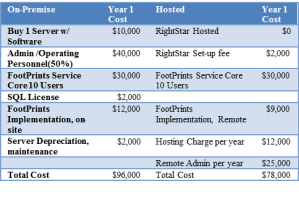
Because IT budgets are so tight, it is often only those projects with a well-documented ROI and hard dollar savings that get approved. An MSP approach offers immediate savings as illustrated below:

Table 1 MSP

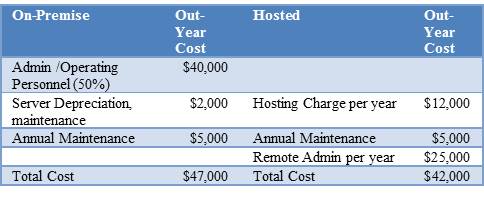
The comparison is between the first year cost of a new FootPrints on-Premise system versus a identical hosted system.  The savings are even more significant when considering the reduction in annual upgrade costs.  Of course, the on-premise cost will go down in subsequent years, but the yearly savings is still significant:

Table 2 MSP

BMC also offers a term license for FootPrints customers that is paid annually. This would reduce the Year 1 cost in this example to $58,000 from $78,000.

How is RightStar able to pull this off?  Not by piggybacking on one of our servers in our HQ computer room, but by partnering with Rackspace, one of the world’s largest hosting providers. Rackspace maintains nine world-wide data centers, each of which is engineered with fully redundant connectivity, power and air conditioning to avoid any single point of failure. Rackspace guarantees 100% uptime, provides backup, disaster recovery options, virtualization management, and employs multiple levels of security.

RightStar’s mission is to return value back to our customers in terms of the investment they make in BSM products and services. Now, as an MSP, RightStar offers affordable and predictable costs with access to a deeper pool of FootPrints experts. The result: a rapid ROI and significant hard dollar savings.

Posted in BMC, FootPrints, RightStar | Tagged , , , , , , , , | Leave a comment

ScanStar Breaks New Ground

By Brett Winston

Q. What new barcode solution offers an innovative and cost effective way for FootPrints and Remedyforce users to receive, inventory, and reconcile discoverable and non-discoverable configuration items?

A. ScanStar, RightStar’s second-generation barcode product for the BMC SMB service management offerings, FootPrints and Remedyforce.

ScanStar

BMC, during a FootPrints version 11.6 update webinar this past week announced that through RightStar, barcode scanning for Service Core is finally available. And likewise, ScanStar now supports Remedyforce, BMC’s SaaS solution for similar cost and time-saving functionality.

Among the many advantages that ScanStar provides– accurate and consistent data entry is one benefit that our existing customers are thrilled about.  In fact, one of our current ScanStar users at a global biopharmaceutical company is using ScanStar right on her desktop PC!  Instead of using the standard Remedyforce interface for asset data entry and updates she has determined that running ScanStar in a Windows Mobile emulator is much faster for updating their CI’s. Of course, she can use the scanner to enter common equipment information, scan 50 tags, then create 50 CI’s with greater accuracy and many times faster than she could if she had to key in everything manually.

The ease of customization has provided great benefit to one of our federal government customers as well.  During the onboarding process (four hours of implementation and configuration services are included in each ScanStar sale), our customer realized that she had twelve additional Remedyforce attributes that had to be available to her scanner users.    Instead of having to spend additional time customizing the application specifically for them, we were able to drag and drop her fields right on to the scanner forms and had three custom screens ready in a matter of minutes!

RightStar has a host of features lined up for inclusion in the coming months.  We already have the ability to capture signatures  in the FootPrints version and signature capture for Remedyforce is not far behind.  Another big feature is underway – a Purchase Request module, that will work with both Salesforce and Remedyforce.  Once complete, we will tie ScanStar into that module to provide our customers even greater flexibility to create and track CIs in the CMDB.

Barcodes continue to change size, design, and gain new uses, but they will always be very important to configuration and asset management. I’m excited about the innovative ways our customers use ScanStar to manage their assets and improve the speed of data entry. I look forward to new solutions and additional customer success stories.

Posted in RightStar, ScanStar | Tagged , , , , , , , | Leave a comment

RightAnswers vs. Google

By Dick Stark

On Thursday, RightStar and RightAnswers hosted a webinar, Search Engines vs. Knowledge Management, the Case for KM. To some extent, RightAnswers competes with Google both from a user and support agent perspective.  Really, who hasn’t used Google to solve a problem or find an answer?

boxing gloves

The webinar winner?  RightAnswers, because they offer a knowledge management process that search engines, like Google can’t compete with.  According to Gartner, “Knowledge management is a business process that formalizes the management and use of an enterprise’s intellectual assets.  KM promotes a collaborative and integrative approach to the creation, capture, organization, access and use of information assets, including the tacit, uncaptured knowledge of people.”  Here are several examples that RightAnswers discussed during the webinar:

  • Google does very well when searching for general information, but more specific Google requests do not often yield good results.  For example, a search for “Ohio State University,” yields lots of information.  A Search for “Ohio State basketball team,” still gets good information.  But, a search for “where are the majority of shots taken from?” gets little to no results.  A RightAnswers KM search for a specific solution that is already shared and documented, yields the most accurate and fastest results.
  • Most answers found on the internet are generic. KM is more efficient and ideal for information that is not easily found on Google. This could include organization-specific information not found on the web. And users can search for solutions that resolve related incidents and link those solutions to ITSM service desk software.
  • Knowledge should be managed. Through a KM system, solutions can be tracked for continuous improvement, needs can be assessed and addressed, and usage can be measured and corrective actions taken.
  • Knowledge should be standardized. Accuracy of a Google answer cannot be easily verified.  Do you believe everything you pull off the web? With a KM system, users get answers from a “sanctioned” source.

In reality, users will search anywhere. End users are not concerned with source or company standards.  They just want results quickly.  Likewise, support agents also browse online and create knowledge articles based on web results. Fortunately, Google and RightAnswers can co-exist and service desks should promote the value of KM and search engine integration.

As long as users choose internet search engines, the service desk won’t be aware of certain issues, and will not create solutions.  Lack of shared solutions, means that problem management (and continuous improvement) won’t always happen. Additionally, this makes it more challenging to maintain SLA’s leading to missed expectations.

One thing is certain: IT is becoming more and not less complex so continuous service desk process and technology improvements will return tremendous value to the organization. An effective KM  process that relies on both Google and a KM tool such as RightAnswers  is an effective way to reduce costs and increase agent and employee productivity.

Posted in Business Management, RightStar, Technology Trends | Tagged , , , | Leave a comment

The New Digital Age

By Dick Stark

“I just want to say one word to you. Just one word: Plastics.”

–Career advice given to Dustin Hoffman in the movie, “The Graduate”

If Ben Braddock (played by Dustin Hoffman) were to graduate in 2013 instead of 1967, that one word would be security.  Well, maybe two words, cyber-security. At least that’s the message from Eric Schmidt and Jared Cohen in their new book, The New Digital Age, which was recently released. Eric Schmidt is Google’s executive chairman (and former chief executive) and Jared Cohen is director of Google Ideas, and a foreign-relations expert.

The book is meant to explore the ways in which technology and diplomacy will intersect. It covers international law, censorship, terrorism, especially cyber-terrorism, and war. To be fair, the book is not all about foreign policy and politics.  It does provide a glimpse of the future, and the authors allow you to draw your own conclusions. Here are a few takeaways.

Future wars will be fought with Drones and Robots. By now, everyone has heard of the role Drones have played in the taking down of Osama bin Laden.  Drones will only get faster, smaller, and more efficient, and soon both sides will be using them.  It is likely that local law enforcement will use Drones for surveillance and monitoring of traffic offenses. Although a recent Internet hoax offered tacos via Drone delivery, it won’t be much longer before that hoax becomes reality. War-grade robots have already been placed into service by the Army in Iraq, and a robot was placed into service recently to look under the cover of a boat to capture the Boston Marathon bomber.

Cars that drive themselves are only years from becoming reality. Four states: Florida, Nevada, California, and Texas have already passed driverless car legislation. So far, Google has driven more than 300,000 autonomous driving miles with no incidents. Imagine the impact this could have on truck and bus drivers in the not too distant future.

Google Glass is a wearable video camera that uses voice commands to connect to the internet for features such as directions and social networking. Google is targeting a late 2013 release date.

Crowd-Sourcing/Analytics/Big Data. The Boston Marathon bombing illustrated how technology works to scan through millions of pictures to identify and track the “needle in a haystack” bombers. Thanks to advances in technology, the bombers were captured and identified in less than a week.

So how, does this “new digital age,” benefit Service Management?  Knowledge Management is getting better and more accurate. Crowd sourcing, or perhaps the use of social networking such as LinkedIn, or BMC Communities may become the best source of problem or incident management fixes. MyIT, or similar apps may be common on all smart phones and tablets. Of course, companies may create their own communities/social network with the goal to involve the service desk team. The end result will be faster incident and problem management.

Posted in BMC, Technology Trends | Tagged , , , , , , | Leave a comment

I’m All-In!

By Dick Stark
“We are the Viet Cong. We are going to march 50 miles in truck tire sandals on a bowl of rice, and we’ll sleep in a tree and get up the next morning and do it again. This is an all-in commitment.”
–Tucker Carlson, The Daily Caller, commenting on the work ethic of his team
The theme of BMC’s sales kick-off meeting held this week in Las Vegas is “All-In,” and I’m happy to report that RightStar is all-in as well. BMC invited its top Solution Providers, Global Systems Integrations (like Accenture), and Technology Alliance partners (like nlyte) to attend a cocktail party Monday night to meet with BMC sales reps. I’m optimistic about BMC (and RightStar). Here’s why.
The demise of Remedy/BSM is greatly exaggerated. I met Thursday with a long-time Fortune 500 SDE customer to discuss a BSM implementation to include Remedy, and the entire Service Assurance/Automation suite—BPPM, Entuity, EUEM, and ADDM. They are “all-in,” having just made a significant investment in this software. They spent several months researching the best solution set including HP, CA, and ServiceNow, before settling on BMC. This is a strong testament that BMC is still the technology and market share leader in this space.
The FootPrints pipeline looks stronger than ever. Twelve months, and four FootPrints certified consultants later, RightStar is well positioned for mid-market success. Version 12 which will be released later this year is a significant improvement which will help guarantee continued business. And, RightStar has made a decision to offer FootPrints in a hosted version, meaning that RightStar will officially become a managed service provider (think cloud integrator). A cloud integrator is like a systems integrator with the general tasks of selecting and implementing heterogeneous computing environments in a cloud-to-premise deployment.
Remedy v8 is greatly improved over v7.604. We have two v8 success stories—House of Reps and US Treasury, and we have several other v8 implementations in the works. Competition with ServiceNow has forced BMC to focus on what matters most—ease of use and upgradability, meaning Remedy will only get better.
RightStar is the #1 Remedyforce partner. With more than 80 Remedyforce implementations under our belt, RightStar has more experience than anyone else, including BMC. Additionally we’ve just started a new project at a major consumer electronics company, a significant (200+ seat) account.
MyIT. As I discussed last week, BMC can still innovate. MyIT is now shipping and as one of two partners that can sell and implement MyIT, it won’t be long before we find an opportunity or two.
Our people. I’m very proud of what we’ve been able to accomplish: increasing service revenue in a tough economy, more focus on training certifications and continuous improvement, project management excellence, and “unreasonable customer service.”
I’m all-in. What about you?

Posted in BMC, FootPrints, ITSM, Remedy, RemedyForce | Tagged , , , , , , | 1 Comment

MyIT: Empowering Your End-Users

MyIT trimmed

By Dick Stark

“I’d rather not try our help desk.  I can get what I want from Google.”

Sound familiar?  A customer confided this to me after attempting to access her service desk’s automated knowledge base. Oftentimes, the experience that the end-user receives from contacting the help desk is slow or unresponsive, and occasionally the fix is just plain wrong. And who hasn’t used Google to find an answer or solve an IT problem?

Welcome to the world of “Big Data,” formerly known as the world wide web, where facts, products, conversations, videos, fixes, opinions, surveys are at our finger tips, 24 x7 on iPhones, iPads, or for those of us slower to adapt, on our desktops and laptops. “An extraordinary knowledge revolution (is) sweeping, almost invisibly, through business, academia, government, health care, and everyday life,” says Rick Smolan, co-creator of a new book, The Human Face of Big Data.  Service Desks must not only keep up, but deliver the type of customer experience that we’ve come to expect in this era of Big Data. Fortunately, BMC has kept up. BMC has released a new product, MyIT, which ships this month and is available as an iPhone and iPad app for Remedy users.

MyIT empowers your end-users to ensure they always have access to the right technology and support services, no matter where they are–all from one easy to use app. With MyIT end-users can:

  • get easy access to knowledge and receive important information and updates from IT,
  • schedule an appointment with an expert, and raise new service requests with just a couple of taps, and
  • help provide faster, more personalized assistance because MyIT knows who and where they are.

Whether IT departments are ready or not, it’s a BYOD world, with mobile devices such as iPhones and iPads proliferating throughout most organizations. iPads are quickly replacing notebooks, and even pen and paper. Additionally, employees expect an excellent customer experience whether from a bank, on-line retailer, or restaurant, and expect the same thing from their IT department.  The good news is that unlike Google, MyIT is purpose-built to transform the end-user experience, making them and the service desk much more productive.

Even better, the service desk does not need to be Six Sigma, ITIL, COBIT, HDI, Pink, or any other popular certification. MyIT installs quickly and RightStar is one of two BMC North American partners certified and ready to go.

The beauty of MyIT is its simplicity.  In our overly complicated service management world, this is a welcome addition.  Without question, MyIT will empower your end-users.

Posted in BMC, FootPrints, ITSM, Remedy, RemedyForce | Tagged , , , , , , | 1 Comment

Masters Running: It’s all Downhill from Here

RocknRoll2013trim

By Dick Stark

“If you had to pick one thing to make people healthier as they age, it would be aerobic exercise.”

– James Fries, MD, Stanford University School of Medicine

The annual Cherry Blossom Ten Mile Run was run last Sunday in Washington DC.  For me, this marks the beginning of spring, and even though the cherry blossoms were late bloomers this year, it was a spectacular day for a race.

I’ve realized for some time now that my best running times were behind me, but this year was different–I beat last year’s time by more than 30 seconds, something I hadn’t been able to do for a number of years. And that gives me hope, or at least something to look forward to and a good reason to begin training now for next year.  Can I beat back time for two years in a row?  Why not??

After more than 20 years of Cherry Blossoms, I still get excited about running down Independence Avenue, past the Lincoln Memorial and then over the Memorial Bridge, before winding past the Tidal Basin and then back home to the Washington Monument. There have been some changes over the years—like having 4,000 runners to now more than 17,000.  And where do all those fast runners come from?  (One doesn’t just get out of bed and decide to run that morning. To run 10 miles requires some preparation.)  Also, why so many young people?  My age group, men 55-59, had 365 finishers.  My daughter’s age group, women 25-29, had 2,807 finishers.  (Yes, she beat me again this year.)

At least I can take some comfort in knowing that running into old age is good for you. According to researchers at Stanford University, running slows the aging clock. That study followed runners over the age of 50 for 20 years and compared them to a similar group of non-runners. It found that elderly runners have fewer disabilities, a longer span of active life and are half as likely as aging non-runners to die early deaths.

Unfortunately, the passing of years does affect performance. In 2009, the American College of Sports Medicine published a depressing litany of time’s tolls: declining VO2 max, reduced strength, increased body fat, reduced lactic acid clearance, declining bone density and more. Not to mention heart disease, arthritis and declining mental acuity. Hmmm, I’ll keep on running as long as I can….

Posted in Business Management, RightStar | Tagged , , , , | Leave a comment

Connect to Your Customers in a Whole New Way

By Dick Stark

Last week, I attended a salesforce seminar in Washington DC, Connect to Your Customers in a Whole New Way.  The keynote speaker was  Mark Benioff, Chairman and CEO, salesforce.com. It was a standing room only affair– think Dreamforce, but on a much smaller scale.  The message: become a customer connected/trusted/focused company. Salesforce will show you how.

Thanks to our Remedyforce experience, RightStar is a salesforce consulting partner. Additionally, internally, we’ve used salesforce’s sales force automation software ever since we started RightStar. And, we will soon become a salesforce ISV partner, as our own product group is developing a purchasing app for the force.com platform.

Mark Benioff began the keynote by proclaiming that change is pervasive and not only are we in the midst of a customer revolution, but also:

  • Social revolution: 4B social users world-wide;
  • Mobile revolution: 1.7B touch devices shipped in 2012;
  • Big Data revolution: 450B business transactions per year by 2020;
  • Community revolution: think of Chatter or crowdsourcing to collaborate and solve problems;
  • Apps revolution: every company should become an Apps company;
  • Cloud revolution: $111B industry in 2012; and
  • Trust revolution: era of customer trust and privacy.

Throughout the morning, Mark used testimonials from several customers: Department of State, Blue Cross Blue Shield of Rhode Island, Obama for America, and Rosetta Stone to show how they have adopted the customer company philosophy, and how they have transformed the way they sell, service, and market. Here are a few examples:

Become an App Company. In case you haven’t noticed, Coca-Cola’s old vending machines are being replaced with new “Freestyle” vending machines that mixes up to 125 different flavors. Coke built a salesforce app to manage these machines and connect/socialize the users to each other to compare their flavor experiences.

Create Communities. The Obama campaign used salesforce and Chatter to make every connection (and vote) matter.  By using social media to connect with constituents they could identify experts (or volunteers) to resolve issues faster, especially in the days leading up to the election.

Service customers everywhere. The salesforce Service Cloud delivers a seamless customer experience.  By connecting through social media, the web, email, or even the old fashioned way—phoning in, Service Cloud connects everyone on every channel.

Conspicuously absent was any mention of Remedyforce, which connects internal customers (employees) to IT.  Connecting the “Internet of things” together can be complicated and someone will undoubtedly need some help along the way.  Even better is  BMC’s MyIT which ships later this month.  But more on that later….

Posted in BMC, Business Management, RemedyForce | Tagged , , , , | Leave a comment