IF IT is the Business, then Remedy Innovation Suite is the Tool

By Dick Stark

Innovation Suite

Last week, RightStar attended and helped sponsor, the Service Management and Automation conference in Las Vegas. (When BMC moved from its Engage annual user group conference, to regional Exchange one-day conferences, this created an opportunity for a BMC training partner, Tools, Technology, and Training (T3) to organize and host their own annual conference.) Many of the attendees were RightStar customers, and RightStar also had three presenters at the show.

Key takeaways:

  • Remedy is continuing to improve. V9 SP4 should be out before the end of the year. It will include:
    • Smart IT configurable fields to better help drive smart IT user adoption. (most requested new feature)
    • Zero Downtime Upgrades. Administrators can now rollout everything—Windows and Unix executables, etc. And everything can be rolled back later, with no loss of data, if any snag is hit along the way.
    • Auto Deployment of Packages. The install process is moving from installers to deployable packages for automated deployment and synchronization of server groups.
  • BMC’s new Innovation Suite, offers an easy to use digital workflow platform for developers, partners and customers. Innovation Suite is designed for rapid application development, which is what everyone wants in today’s agile software environment.

At the conference Terence Chesire, VP Product Management, DSM demoed a BMC “Smart Facilities” app that has been tested to support 700 million CI’s. In today’s rapidly changing and competitive environment, companies must organize their business to meet specific and unique requirements. Software must be agile and easy to develop and modify. Out-of-the box products that often require extreme configuration to meet specific needs, don’t work well in this environment.

That’s why BMC’s Innovation Suite is such a good fit and complimentary platform for Remedy. And this is where the difference between Remedy and ServiceNow is most obvious. A lot of ServiceNow customers, using Java scripting, spend a significant amount of time customizing ServiceNow’s many “out-of -the box” modules to meet specific needs.

When it comes time to upgrade, most of the “customizations,” will not upgrade without a “fight,” leading to long upgrade times and high cost, exactly what ServiceNow used previously as a weapon to convince customers to move away from the old Remedy.

Now, Remedy, with its Zero Downtime Upgrades, offers a much lower operational cost, and its Innovation Suite, offers rapid application development of specific apps, like HR or Facilities to meet customer needs. For example, just what does ServiceNow offer for HR or Facilities? There are so many ways of developing an HR or Facility system, that ServiceNow’s HR or Facility modules must be impossibly general, or come with way too many confusing templates. HR or Facility software must do whatever the company needs it to do. That is different for every company, and why Innovation Suite is a much better solution.

But, it’s not just HR or Facility software. Nowadays, IT runs the business. And should the business run on off-the shelf software? The power of tools like Remedy Innovation Suite is that it allows businesses to be run the way they need to be run.
Posted in BMC, Business Management, DevOps, Digital Engerprise Management (DEM, RightStar, Uncategorized | Tagged , , , , | Leave a comment

How to Run IT Support the DevOps Way

By Dick Stark

Last Wednesday, RightStar led a Webinar, “How to Run IT Support the DevOps Way.” We discussed how adding DevOps principles to IT support processes dramatically improves service quality, team morale, problem solving, and business productivity. We ended the webinar with several examples of how other organizations have successfully integrated DevOps into their workflows. It was an excellent event.

Coincidently, earlier in the week, the BMC Communities site posted a podcast, entitled, “Is ITIL Still Relevant in a DevOps World?” in which Robert Stroud, Principal Analyst at Forrester opened with a discussion he had with a CIO of a Fortune 100 company: ‘We’ve actually terminated our total investment in ITIL. There will be no more ITIL courses approved in this company. If somebody mentions the word ITIL, they’re looking for a job.” Robert went on to say, “So fundamentally, there’s a rapid change going on, and we can go through our data which shows that people who are doing DevOps have this misnomer or this proposition that traditional ITIL doesn’t work with DevOps. Let’s think about this traditional change that’s happening – we’ve got a change that’s going to production, and as it goes into production, we’ve got 32 approvals, and development developed the code in a week, and it takes me 12 weeks to go through the change management approval cycle. This is a real use case. And this is what’s annoying the living daylights out of people right now, it’s that ITIL’s just not relevant.”

JIRA

Of course, ITIL is still relevant in a DevOps world and we presented several examples during the webinar. For instance, Change Management, a very basic ITIL principal, matters now more than ever. It is not uncommon for Change Management software systems to be purchased and implemented after weeks of discussion and thousands of dollars of consulting costs. Often, the regular CAB meetings are abandoned and users stop using the system complaining that it is cumbersome and slow to use. The culprit is typically a poor change implementation. The 32 required approvals mentioned earlier lacks any semblance of common sense.

Effective Change Management processes recognize that there are different risks associated with different type of changes and that those changes are all handled differently. Urgent, or emergency changes typically allow all approvals to be performed after the fact. Standard changes are often low risk changes that follow a standard approval process, but can be pre-approved. By linking the change ticket, e.g., Remedy, to a planning tool, e.g., JIRA, the results will be automatically recorded and visible to everyone in the organization (traceability). This helps bridge the gap between the auditors and the DevOps team. By ensuring the right controls are in place, Change Management becomes an important component of the DevOps process. The end result: better traceability, reliability, and security of systems and data.

Posted in Atlassian, DevOps, Remedy, Uncategorized | Tagged , , , , | Leave a comment

Is Your Service Desk Ready for AI?

Cognitive Service ManagementBy Dick Stark

I just finished a new non-fiction best seller, Life 3.0, Being Human in the Age of Artifical Intelligence by Mark Tegmark, an MIT professor and expert in this space. It is an excellent, comprehesive book that covers, the past, present and future of AI, including topics such as machine learning, weapons, future scenarios, and consciousness. “Life 3.0,” by the way hasn’t arrived yet. It is the stage when AI will merge with humanity and allow us to evolve our “own software and hardware, without having to wait for it to gradually evolve over generations.” And Life 3.0 will arrive sooner than many think possible.

AI is clearly at the innovation stage for those early adopters willing to take a chance on new technology. According to Gartner, most of the largest 200 companies will integrate AI into their systems in 2018, and a September 12, 2017 MeriTalk article predicts that Government agencies are expected to include AI applications on their budget wish lists for FY 2018. What does this mean and how can large organizations us AI? Whit Andrews, a Gartner analyst provided three likely scenarios:

  • One in three organizations will link AI to customer engagement applications
  • Three in 10 will integrate AI into call center service and support processes.
  • One in four will integrate AI into digital marketing operations.

Customer support and service is clearly a good fit for the use of AI on a service desk.

As I mentioned in a previous post, another BMC partner is offering a Remedy AI solution from Next IT, an AI company focused on virtual agents, or chatbots. Next IT offers virtual agent technology to enable better communication between companies and their customers and prospective customers. And just yesterday at Exchange NY, BMC rolled out its AI offering or Cognitive Service Management (CSM) to its customers.

CSM encompasses predicative intelligence, virtual agents, and a digital workplace chatbot. Built on top of the Remedy Innovation Suite, a customer can connect with either a live or virtual agent using any type of messaging such as chat or voice. The beauty of the Innovation Suite is that it allows developers or customers to incorporate cognitive services into complex custom processes and workflows. IBM’s Watson is the “brains” behind the scenes. The objective: provide a rapid and excellent response, with an impressive ROI, by removing the human interaction. It’s not clear when CSM will start shipping from BMC, but early next year is likely.

Where’s ServiceNow? My guess is that BMC is well ahead of ServiceNow, thanks to its head start in its Digital Workplace technology (MyIT and Smart IT) and its Innovation Suite platform. Although ServiceNow bought Qlue, a virtual agent technology startup, BMC should easily retain its innovation advantage with its Cognitive Service Management offerings.

Posted in Digital Engerprise Management (DEM, Remedy, ServiceNow, Technology Trends, Uncategorized | Tagged , , , , , , , , | Leave a comment

Remedy User Group Report

By Dick Stark

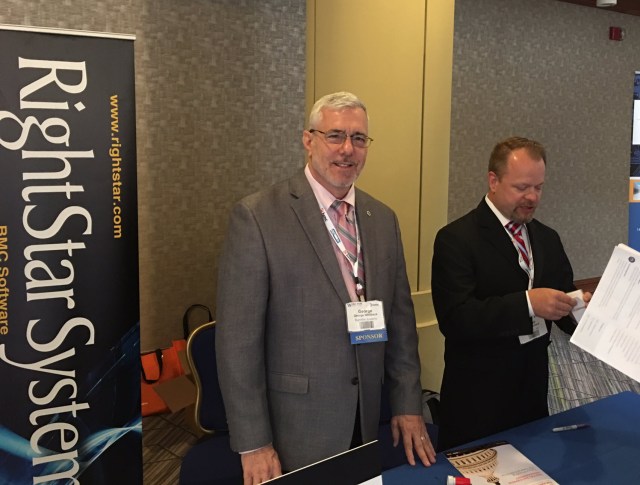
Last week RightStar held its fifth annual Remedy User Group Meeting at the GSA Regional Office Building in Washington, DC. BMC discussed new Remedy features like Smart IT as well as the Remedy Roadmap. It was a very good event.

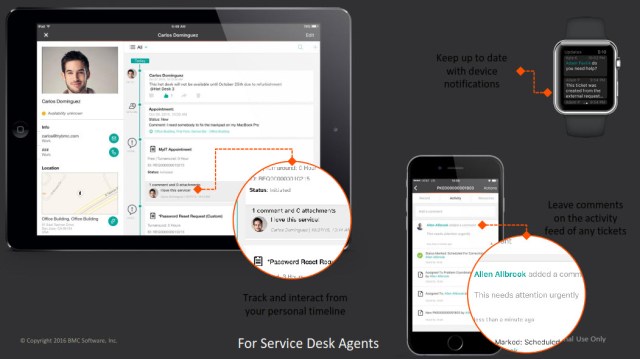
Smart IT for service desk agents

Smart IT for Service Desk Agents

BMC began by discussing the digital imperative for ITSM, now DSM, and the impact that it has on IT. Digital businesses deploy digital services (like Remedy 9.1) and the shift to digital is intensifying, with Gartner predicting 44% total IT budget spend in 2018. Like the ITIL mantra of cheaper, better faster, digital IT leaders look for operational efficiency, customer and employee engagement, and business agility.

Remedy 9.1 is not “your father’s Oldsmobile;” it is a new vastly improved product with a new look and much improved functionality, especially with Smart IT, MyIT and Smart Reporting. A long time RightStar local customer stood up and said, “We absolutely love Remedy 9.1, especially Smart IT. It is the best product that we’ve ever received from BMC. It has been fabulous. Right out of the box it was easy to use.”

So, what does the customer like so much about Remedy 9.1? The persona-based-UX, along with better access to knowledge articles, assets, and other records with automatic contextual insights, allows agents to solve tickets faster. Better process improvements greatly simplify the change management process, especially the unified change calendar and automated collision detection. New asset management, along with BMC Discovery allows user to track and manage physical, virtual, and cloud assets. And, self-service allows instant access on every device to everything you need to be more productive at work. Smart Reporting has a drag and drop report creation and offers a much improved search capability.

Next up was “ask the expert,” RightStar’s “expert” with more than ten years of BMC and RightStar experience explained how easy it is to use BMC’s new Single Sign-on, which supports SDPA, Kerberos, CAC/PIV, and SAML. His favorite Remedy module: Change Management, because it is powerful and simple for users. His least favorite: SRM, but he agrees that the new MyIT interface is much improved.

So, what does the future look like? According to Gartner, most of the largest 200 companies will integrate AI into their systems. Known as Cognitive Service Management, this encompasses predicative intelligence, virtual agents, and chatbots. In other words, users will have a digital conversation with a chatbot that will provide answers and “self-healing,” This result is a “shift-left” on the service desk, reducing the number of agents (and cost), and improving the user experience. The end result: the future looks bright for BMC and its Remedy customers.


Posted in BMC, Digital Engerprise Management (DEM, Remedy, RightStar, Uncategorized | Tagged , , , , , | Leave a comment

Atlassian Summit Summary

By Dick Stark

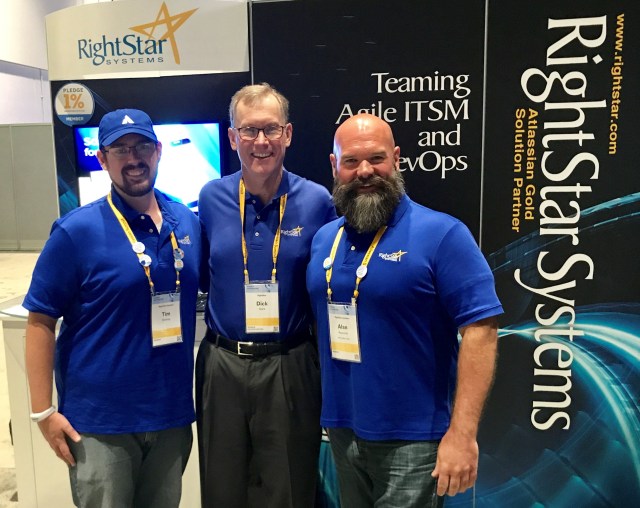
Atlassian held its annual world wide conference last week in San Jose with RightStar there in full force. Team RightStar at Summit 2017 It was a very good show with more than 3000 attendees. We also received a large number of new leads for our just announced ScanStar barcode scanning for Jira/Insight which is now completing beta.
The Summit is an annual event where Atlassian shares its plans with its partners and customers. There are tracks for training, new product announcements and updates. It is an opportunity for customers to come and meet partners and Atlassian employees to exchange ideas and collaborate. Atlassian is growing with $630M in annual revenue, and more than 90,000 unique customers.

What’s New? The two big announcements this year—Stride and Trello. Stride is “HipChat on Steroids,” and according to Atlassian co-founder Mike Cannon-Brooks is a “Slack Killer.” Slack, the productivity and chat tool is one of the hottest products on the market for tech workers. It’s a mainstream tool among tech companies like Airbnb, Pinterest, and eBay. Atlassian has been using Stride as their sole communication tool internally for several months. The Stride early access program is available now, with full rollout in 2018.

In early 2017, Trello was acquired by Atlassian. Like, Jira, Trello is a productivity platform for developers, or anyone who wants to work collaboratively and get more done. Mike Cannon-Brookes commented, “Trello is a more dynamic way to drive discussions, track follow-ups, and manage work at home or in the office.” And the best news, Trello is free to organizations of under 100.

ShipIt. Atlassian held a 48 hour ShipIt day among five employee development teams during the conference. Updates were reported constantly. ShipIt, also known as a hackathon, stems from Atlassian’s strong belief in teamwork (not the idea of the lone genius). ShipIt consists of planning—plan dates, announce and tell stories, find your teams aka pitch it; event—remember time is ticking, have fun, get energized—eat and drink; and presentations—give it all you got, voting, celebrations, winners announced, get onto a product roadmap and plan for the next ShipIt. ShipIt is not necessarily just for IT projects. Legend has it that Jira Service Desk was born from a ShipIt team consisting of Atlassian co-founders Scott and Mike.

The winning ShipIt team actually developed a full meeting voice recorder in Stride, so that no one need worry about ever missing a meeting again! We remain excited about the Atlassian potential ahead and look forward to an even better 2018!

Posted in Atlassian, DevOps, Uncategorized | Tagged , , , , , | Leave a comment

What is the Future of Your Service Desk?

2017 Gartner Hpye Chart

By Dick Stark

Last week RightStar was asked to answer a question for an RFI, “Please describe your views on industry trends and developments that you are expecting to take place in the next 12 to 18 months.” My answer was the standard answer that one might hear from BMC or ServiceNow: ITSM products are being enhanced and developed with context-aware capabilities, as well as better front-end UIs for business users, via IT self-service for request management and knowledge management and other channels such as IT support, live chat, walk-up support and virtual support agents.

BMC is rumored to be investigating adding AI front-ends, such as those offered by Next IT to allow for virtual answers to complex questions, along with the right solutions and outcomes. Indeed, ServiceNow in May bought Qlue, a virtual agent technology startup that enables better communication between companies and their customers and prospective customers. It combines customers and agents for the most expedient solution, with either virtual or live agents, from any platform including messaging or voice. But is this really the near future? What is hype and what is reality?

AI is clearly at the innovation stage for those early adopters willing to take a chance on new technology. See the just published Gartner 2017 Hype Cycle, above. Just beyond the innovation trigger is customer experience, with BMC offerings like MyIT/Smart IT and Digital Workplace clearly in that camp. Cloud, Mobile and Social are on the upswing, or slope of enlightenment.

Most of RightStar’s customers have barely moved beyond basic incident/problem/change, and configuration management. While virtual agent technology may offer an attractive, ROI, I can’t see virtual agents making much progress anytime soon. Here are some more near-term future ideas for improvement.

Digital Transformation. Although this is a broad category, it is important to begin somewhere. What are employees most pressing needs? At a large government agency, it was the digitization of 45 pages of manual PDF forms. Now, thanks to RightStar’s consulting effort, the agency, using BMC’s Digital Workplace (formerly MyIT Service Broker), now has a new service catalog to request products such as cell phones, laptops and VPN services, while providing a modern easy-to-use Amazon, look and feel. This system will soon expand to include employee on-and off-boarding.

Knowledge Management. KM projects are often quick and produce a significant ROI. For example, at another government agency, RightStar was involved in an agency wide knowledge project to ensure that employees, not just IT employees have a knowledge system to provide specific support for departmental issues. The objective is to “shift-left” by reducing calls to the service desk and making people more efficient.

Posted in BMC, Digital Engerprise Management (DEM, RightStar, ServiceNow, Uncategorized | Tagged , , , , , , , , , , , | Leave a comment

Enable Blind Spot Detection with BCM

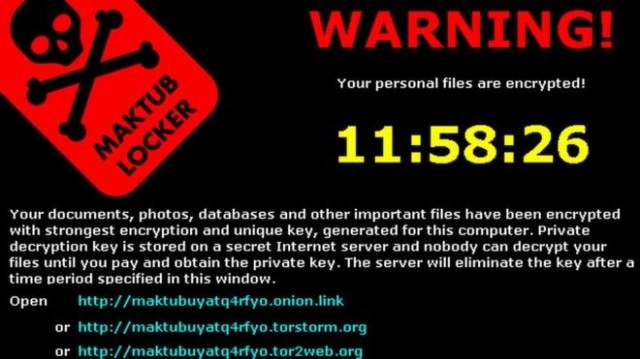
WannaCry

By Dick Stark

Last week RightStar presented a live webcast, “Securing Your IT Assets Using BCM.” We discussed how BMC Client Management (BCM) can help easily secure your technology endpoints, maintain software compliance, and keep data safe from outages and viruses such as malware.

I just finished a terrific new book, American, Kingpin, by Nick Bilton. It is the story of Texas born Eagle Scout, Ross Ulbricht, who began the first Dark Web website to sell any and all things illegal such as drugs, guns, and malware. Known as the Silk Road, the website soon became the Amazon of the underworld with sales of nearly $1B by the time it site was shut down by the FBI. Since there is no honor among thieves, Ross had regular fights with hackers, many who demanded large ransom payments to unlock servers or stop attacks. Since Ross was a businessman he soon learned that it was far better to pay the ransom and restore service, rather than fight.

About two months ago, the largest malware attack ever was launched, infecting more than 200,000 computers. Known as WannaCry, it targeted computers running the Microsoft Windows operating system by encrypting data and demanding ransom payments in Bitcoin (about $300 to $600 per machine).

The virus spread through a Microsoft vulnerability in its operating system that the NSA first discovered but used it to create an exploit for its own offensive work, rather than report it to Microsoft. Microsoft discovered and fixed this on March 14, 2017 and released patches for all Windows versions at that time. However, many Windows users had not installed the patches two months later when WannaCry was released. In both of the above examples, having BCM enabled would have allowed the organizations that were impacted to have either previously patched the machines, or at a minimum, detect the blind spots and patch accordingly.

BCM, formerly FootPrints Asset Core, is tightly integrated with both FootPrints and Remedyforce. It provides a single unified console to centralize the lifecycle management of all client devices, audit their hardware and software inventory, push patches, and deploy software to them whether they’re on a LAN or over the Internet. Modules include: Software License, Event, Financial Asset, Power, and Device management.

During the webinar, we discussed Patch Management and Policy Compliance (Audit). The level of effort for BCM Patch is significantly less than Microsoft SCCM, and more like WSUS, Windows Server Update Services, a Microsoft program that enables administrators to manage the distribution of updates and hotfixes released for Microsoft products in a corporate environment. (BCM Patch works for lots of different products such as Mac and Linux.)

A big problem is keeping software titles up to date with the latest version. Patching does not guarantee the software is updated to the latest full version. BCM quickly can group all devices needing latest release updates and deploy to ensure compliance and security.

Of course, BCM comes with an Audit or Compliance module to ensure that customers are well prepared for PCI, SOX, HIPPA and other compliance audits. BCM even supports SCAP, a multi-purpose framework of specifications that supports automated configuration, vulnerability and patch checking, and security measurement.

Posted in BMC, Digital Engerprise Management (DEM, FootPrints, ITSM, RemedyForce, Uncategorized | Tagged , , , | Leave a comment

What in the World is SIAM?

By Dick Stark

Last week I attended an itSMF webinar, “Introducing SIAM (Service Integration and Management).” I tuned in because SIAM was new to me and I wanted to learn more. SIAM is an adaption of ITIL that focuses on managing the delivery of multiple suppliers. It is not a framework or process. SIAM is a service capability and set of practices that build on and compliment ITIL. Is SIAM something that we should be aware of, and how can SIAM help RightStar better meet the needs of our customers?

SIAM Component Model:

SIAM Component Model

Although SIAM is relatively new and fast evolving, I hadn’t heard of it until last Wednesday. Yes, there is a 240-page Body of Knowledge that goes along with it, and a consortium of organizations that have helped roll this out. EXIN is even starting to offer an accreditation program, and IT consultancies like Scopism, which helped developed the body of knowledge, now offer SIAM training classes. I’m not sure this is something we all need—a new set of books to read and classes and certifications to consume. Yet, there is a growing need for the SIAM approach due to organizations that wish to use multiple suppliers to deliver integrated services, the increasing complexity of the IT value network, supply chain, and service provider characteristics.

When learning about SIAM what struck me was the similarity of the Federal Systems Integrator (Beltway Bandit) Community. Over the years, RightStar has been a subcontractor many times to organizations like GDIT, CSRA, CACI, and Leidos on very large, potentially multi-billion-dollar IT contracts. In all cases each Prime contractor uses multiple disaggregated suppliers or subcontractors that are focused in a particular IT area—infrastructure, desktop services, help desk, security and so on. And as a result of being part of the proposal process, I have observed that each SI has its own SI methodology that is explicitly detailed to include enterprise architecture, supply chain, project portfolio management, risk and quality management, ITIL process, integration, KPIs, and service catalogs, to name a few. What I’ve observed is how similar each SI’s methodology is to each other’s, yet there is no standard, hence the need for SIAM. In sum, SIAM can be used to provide a single point of visibility and control for service management and the delivery of all services provided by suppliers. It is all about end-to-end accountability for the performance of IT services to the users, coordinating delivery, integration and interoperability across multiple services and suppliers and providing the necessary governance on behalf of the business.

What’s in it for RightStar partners BMC or Atlassian? Both offer extensible platforms that provide end‑to‑end service management, analytics, and accountability for all services. With toolsets like Remedy 9 or Digital Workplace, or JIRA Software or Portfolio, customers can benchmark service delivery performance, hold suppliers accountable to KPIs and provide the communication and incentives for suppliers to better work together.

Posted in Atlassian, BMC, Business Management, ITSM, Uncategorized | Tagged , , , , , | Leave a comment

Report from BMC Exchange Federal

Federal Exchange 2017BMC’s annual Federal user group conference, Exchange, was held this on June 7 at the Marriott Wardman Park in Washington, DC. Attendance was up this year with more than 400 customers, partners, and BMC employees in attendance RightStar and BMC presented, Increasing Employee Productivity with a Digital Workplace Initiative, to a room full of attendees. Here is a short Exchange 2017 update.

Dan Streetman, BMC Senior VP, Worldwide Strategic Sales and Operations acted as the host for Exchange and opened with talk about the digitalization of government. He cited several examples of government done well, like real time earthquake information from the Department of the Interior, prospective driver crash and inspection information from the Department of Transportation, and a “bug bounty program set up by the Pentagon.

Dan looked at service innovation using a new graphic, borrowing from DevOps:

Federal Exchange 2017 Service Innovation

The objective of any mature service desk is to “shift left” or reduce the calls to the service desk through self-help, improved knowledge or problem management, and better workflow or AI tools. And BMC has the right tools to truly innovate the service desk: Monitoring tools, like TrueSight; Policy tools like BladeLogic (Threat Director), Automation tools like Atrium Orchestrator, and Workflow tools like Remedy with Smart IT.

Keynote speakers included Margaret Graves, Deputy CIO, White House OMB, and Don Rucker, MD, National Coordinator for Health IT. Margaret spoke about modernizing government and mentioned that agencies today need better collaboration and used USCIS / Department of State as an example of the need for interagency communication. Modern IT can help. Don Rucker then described the progress that has been made in medical IT, especially electronic medical records, and discussed several government success stories.

RightStar’s session detailed the progress at DOJ we have made in replacing a paper catalog system housed on SharePoint with BMC’s MyIT Service Broker.

The old manual system was based on PDF and Excel spreadsheets that the requestor filled out and submitted. This system had no audit trail or tracking mechanism, and no way to report on the outcome of the request and associated cost.

The new system has a modern “Amazon-like” interface that makes it faster and easier for DOJ users to access IT services. The trial system is now live and DOJ is looking to roll this out to all.

Posted in BMC, Digital Engerprise Management (DEM, ITSM, RightStar, Uncategorized | Tagged , , , | Leave a comment

IT Modernization with BMC’s MyIT

MyIT Service BrokerBy Dick Stark

“People won’t hate government if it works and if it serves them well. Digitalization starts us down that path.”

—Tony Scott, Former Federal Government CIO

A week ago, RightStar went live with BMC’s MyIT Service Broker at a large civilian agency. The project digitized 45 pages of manual PDF forms, and built a Service Catalog, to request products such as cell phones, laptops and VPN services, while providing a modern easy-to-use Amazon, look and feel. This system will soon expand to include employee on-and off-boarding.

Meanwhile, another RightStar team is working on a similar project with another large civilian agency to provide essential IT products and services to its employees. The agency has begun demoing this to its “customers” with the feedback often, “you finally get it.” (Because MyIT is such an improvement over the older SRM product it is sometimes mistaken for a competitive product.) Eventually this service will be rolled out to mobile users as well. The short-term impact is that Remedy is not “going anywhere” with the government electing to continue to stick with Remedy due to the value provided through IT modernization.

IT modernization is a top priority for most government agencies as they race to replace aging legacy systems. Just last week, the OMB asked Congress for $228 million for the central fund, known as the IT Modernization Fund (ITMF), to act as a first-year proof of concept for how agencies would submit business cases and the ITMF board would decide which projects to award funding.

Quoted on the Federal News Radio Website this week, a Federal OMB official stated, “Programs that cost in the $3 million to $5 million range such as migrating email to the cloud or help desk consolidation, would provide enough samples for the fund to impact agency missions, and for the administration to understand how the business case process works This creates a strong incentive for agencies to come up with modernization proposals that have a high return or investment, as well as those that focus on common platforms or cloud services.”

Ironically, last week’s lead FCW article, “Failure to Digitize,” described the ongoing effort to modernize the H-1B Visa process at the US Customs and immigration (USCIS). This effort, which began more than ten years ago, and is now four years behind schedule, has cost USCIS more than $2.3B, according to FCW. The Washington Post provided even more detail, quoting a former USCIS union representative, “You’re going on 11 years into this project, they only have one form, and we’re still a paper based agency.” In fact, the agency’s application H-1B application process averages 60 pages and is currently processed entirely on paper.

This project ranks “right up there” with other government infamous projects, Lockheed’s, botched $170M 2001 FBI modernization project, and CGI’s removal from its $678M 2013 Obamacare website development contract. Who or what to blame? The FBI project is often cited as a case study for agile development over the traditional waterfall approach. And now the USCIS can blame waterfall as well. Similarly, CGI’s failure was its inability to adequately test software end-to-end.

But of course, the ITMF is not looking to sponsor such large humongous projects. Rather, quick wins, like a new agency wide service catalog that goes live in months instead of years and provides a rapid return on investment and real business value.

Posted in BMC, Digital Engerprise Management (DEM, Remedy, RightStar, Technology Trends, Uncategorized | Tagged , , , , , , , | Leave a comment