
BMC FootPrints Asset Core vs. ADDM

By Dick Stark

On Wednesday, RightStar presented a webinar, “Take a Walk Through FootPrints Asset Management.” Not to be confused with the prior week’s topic, BMC’s Application and Dependency Mapping (ADDM).  When should we sell one over the other?  Or more importantly why will a customer buy one over the other? Will both ADDM and Asset Core work together, and whatever happened to BMC Client Automation (BCA), which BMC was pushing just several years ago?

Asset Core

Asset Core is part of the FootPrints family and integrated tightly with Service Core, and recently, Remedyforce. It is a multifunction asset management suite consisting of discovery and inventory, OS and application deployment, policy compliance, software license, financial asset, patch, remote, power, event, device, and migration management. Asset Core differs from ADDM in several key areas:

  • Dependency mapping, the relationship between applications and the infrastructure, is not provided, however topology and connectivity mapping are.
  • Power management, the ability to shut down workstations at night to conserve power, is a native application. ADDM uses tables to look up and calculate theoretical power usage and savings.
  • Asset Core now integrates with the Atrium CMDB, as well as FootPrints Service Core and Remedyforce.
  • ScanStar, RightStar’s barcode scanner for physical inventory and receiving applications only works with Service Core. Asset Core will be supported at a later date.
  • Discovery and software license management is Asset Core’s primary function.  ADDM’s primary function is discovery and application dependency mapping.

A simple rule of thumb is that ADDM is for Remedy users (larger enterprises) and Asset Core is for FootPrints and Remedyforce users (mid-market organization). However, given BCA’s near end-of-life status, consider Asset Core for Remedy users as well.  A much larger enterprise might use ADDM for server discovery and mapping, and Asset Core for patch management or software distribution.

According to a RightStar Asset Core consultant, Asset Core usage varies considerably among customers.  “Asset Core really pays off among customers facing software license challenges. For example, software like WinZip and Ad-Aware might be free for home usage, but not on company networks.  The cost of a software audit will often far exceed the cost of the installing Asset Core.” Patch management is another huge time saver, especially if a company has poor processes in this area.

Given that several of the Asset Core competitors are fading (Altiris was purchased by Symantec, and BigFix by IBM), Asset Core is well positioned for continued growth. With Asset Core, IT has an accurate and current inventory of hardware and software, the proper software and security policies, and with Service Core, the ability to manage changes and prioritize support problems.

Posted in BMC, FootPrints, ITSM, Remedy, RemedyForce, Technology Trends | Tagged , , , , , , , , | 3 Comments

Remedy and ADDM: Unbeatable Combination

By Dick Stark

On Wednesday, RightStar presented a webinar, “Discovery & Relationship Mapping with BMC ADDM.” ADDM is starting to heat up with more and more customers, not just implementing Remedy, but ADDM, due to the combined value that both products together provide.

In fact at one RightStar customer, ADDM has made a significant difference, not just by identifying what’s in their data center or on the network, but how applications are mapped to related hardware and software.  For example, ADDM creates all computer systems OS (Windows, Linux, Unix), CPU, RAM, IP, MAC, software instances, status (Deployed or Down), entries and their relationships, as well as network devices and printers.  Additionally, ADDM populates its data into the CMDB (Hostname, Manufacturer, Model, etc.) A physical inventory then updates the physical location–company, site, floor, room, status (Received, Deployed, Down and End of Life), as well as, adds disk drives and blade chassis/blade server items and their relationships.

The result is not just improved asset management effectiveness and a reduction in cost, but risk mitigation when making changes, due to a better understanding of the change and its impact to the affected underlying infrastructure. Additionally, RightStar consultants fully integrated ADDM into the CMDB. Using ADDM, all newly discovered, newly removed (not seen for a minimum 7 days) and changed (moved) assets are tracked and compared to see if a Change Request was indeed created for these installs and moves. If a Change Request was not created, an alert is sent to the administrator to investigate.

There are several other reasons why ADDM is such a good complement to Remedy:

ADDM is built on the Atrium architecture.  Through the CMDB, discovery data automatically maps to CMDB classes, for example, operating systems, CPU, and applications.  Additionally, through continuous synchronization, the CMDB is always kept-up-to-date.

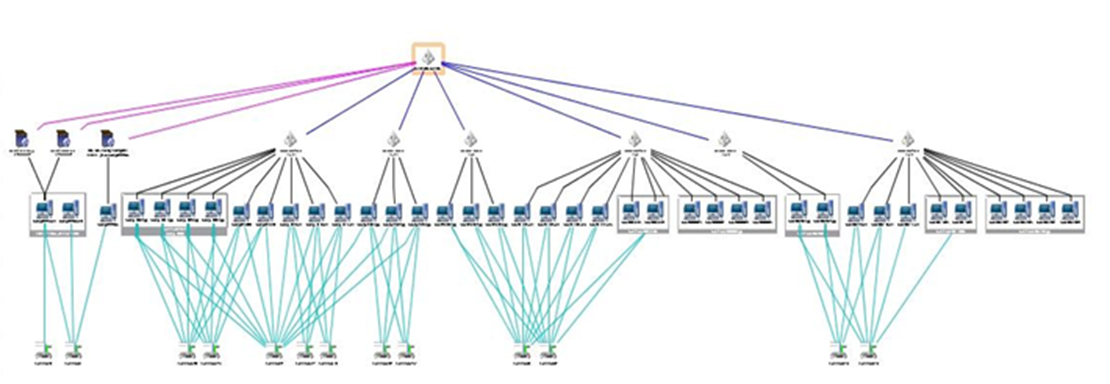
Collaborative Application Mapping makes the creation of self-maintaining application maps simple by providing a workflow tool that makes it easy to obtain information about business applications. Using these maps, IT can better understand how applications and infrastructure work together to deliver the services that organizations depend upon.

Application Map

The ADDM Extended Data Pack includes two reference libraries. The software pack provides dates for software end of life, end of support for operating systems and software.  The hardware pack provides information on physical and thermal characteristics of hardware.

Understanding complex application dependencies is a fundamental requirement for all strategic IT initiatives. With ADDM, IT has the necessary insight to make the right planning choices, safely manage changes, prioritize support and understand the real costs of IT.

Posted in BMC, ITSM, Remedy, Technology Trends | Tagged , , , , , , , | Leave a comment

Has ITIL Lost its Mojo?

By Dick Stark

Last Thursday, I attended a panel discussion sponsored by the National Capital Area itSMF user group.  The topic: DOD IT Service Management Perspective. Kirk Holmes, itSMF founding member led the discussion with representatives from the US Navy, DISA, US Coast Guard, and the the US Air Force. This was an impressive group and talk centered around service management and ITIL. Despite the investment each of these organizations has made in service management and ITIL, and even though good progress has been made, the recuring theme from each speaker was the on-going level of effort ITSM requires.  Here is a summary.

ITIL maturity. ITIL has lost some of its luster  recently due to its lack of perceived value and complexity.  One panelist stated, “Be careful how hard you try to sell ITIL. When you try to shove it down someone’s throat, they won’t swallow.” Jeff Hiatt from the Air Force remarked, “sometimes the government is an inhibitor; we need to figure out how to get out of our own way.”

Process really matters. One panelist stated that he doesn’t mention ITIL anymore, just process improvements. It is all about IT capabilities delivered the right way 100% of the time. IT departments must focus on things that make the agency run better, not necessarily by “standardizing on ITIL. There is an incredible pressure to deliver results now and to make sure that the agency’s needs come first.

Value is more important than ever. In this era of sequestration, value, or return on investment may be the most important success factor. Drew Jaehnig from DISA mentioned that his agency is investigating ways to share potential cost savings with prospective bidders.  For example, he said that a contractor might get to keep 10% of a potential $200,000 cost savings.  Drew admitted that he liked the idea, but it is stuck presently in legal.  All other panelists agreed that cost savings is critical and a top project selection criteria.

Adoption. It was clear that user adoption was a delicate balancing act, and that “grass roots is where it’s at.” Oftentimes the reason an ITSM project fails is not due to process or technology, but to user adoption and politics. One lesson learned was never to underestimate the role politics plays in a new initiative.

I pointed out that the anchors of service management are CMDB and service catalog and asked the panelists to describe their level of maturity with both.  DISA has made the most progress.  Drew described their success with federated databases and discussed the integration with Remedy, NetCracker, and Maximo. All the other panelists admitted that more progress is necessary. One discussed the difficulty of building and maintaining a CMDB.  Another discussed the value a service catalog provided: “an excellent way to limit the services that our agency provides.” But it was clear that every agency lagged behind where they thought they should be.  One panelist pointed out that an 85% solution should be acceptable.  The remaining 15% customizations may not be affordable.

Has ITIL lost its mojo?  Hardly, all representatives agreed that ITIL is a required framework for future ITSM process improvements. Jeff Hiatt summed things up this way: “My biggest mistake is that ITSM is not my full time job.  We have so much more work to do.”

Posted in ITIL, ITSM | Tagged , , , , , , , | 2 Comments

Why Knowledge Management is Important to the Success of your Service Desk

By Dick Stark

Last Thursday I hosted a joint webinar with RightAnswers.  The topic: “Knowledge is Power, IT Knowledge Management for your BMC Service Desk.”  Surprisingly, Knowledge Management (KM) gets less than expected mindshare with most of the service desks that we support.  This is undoubtedly due to the popularity of Google, other search engines, social media, and crowdsourcing, such as the friend who knows the answer. Why implement a KM system if Google has all the answers?

Several months ago we implemented a KM software add-on for a Remedy customer.  After we finished, the customer remarked that the final outcome was not significantly different from Google.  So, I asked the RightAnswers team to comment on how their system differed from Google.  (The aforementioned KM system, by the way was not RightAnswers.)  Here is what I gathered.

KM software and knowledge packs have been around for years and should be a critical success factor for all service desks.  Most organizations have a raft of company specific information, not available on Google, which needs to be readily accessible to users with a need for that information. The return on a KM process and software investment pays dividends in terms of improved problem and incident resolution especially when offered to all users. Unfortunately, some KM projects fail because of poor user adoption making the data quickly outdated.

Nearly all service desks have implemented some sort of self-service portal in varying degrees of sophistication ranging from on-line ticket entry to knowledge bases to service requests to service catalogs (fix it, order it, or learn it).  According to last Thursday’s webinar survey, 70% of service desks have self-service, but surprisingly 65% do not utilize any KM tools or processes.

Most commercial based service desk software is evolving such that the service request module, and not the agent screen is the centerpiece of the application. Software such as BMC’s Remedyforce even comes with a built in chat feature to allow for a rapid-fire response to any type of query.  Also coming is integration to social networks. It’s a self-service world and the good news is that self-service knowledge management reduces the number and duration of calls, which allow service desks to do more with less.

Often overlooked, Problem Management must be a keystone habit of all service desks as the potential impact, especially when linked to incident, change and knowledge management is enormous. Identify, rank and make sure he problem and the resolution are readily accessible.

One thing is certain: IT is becoming more and not less complex so continuous service desk process and technology improvement will return significant value to the organization.  The result:  reduced costs, increased agent and employee productivity, and overall, improved customer satisfaction. If service desks can’t or don’t evolve to compete with Google or other crowdsourcing technologies, then then service desks will change significantly over the next several years.

Posted in Business Management, ITSM, RemedyForce | Tagged , , , , , , | 1 Comment

Unreasonable Customer Service

By Dick Stark

“I believe that the level of priority and the amount of passion and emphasis that must be put towards the customer experience must be, in a word, unreasonable.  It must be excessive.  It must go beyond the limits of common sense.  It must be extreme, irrational and out of proportion with what your competitors are doing. It cannot be anything less than remarkable.”

–Joe Mechlinski, Grow Regardless

Customer satisfaction, or “every customer a reference,” is a RightStar customer motto and a critical success factor for RightStar.  What type of unreasonable customer service stories do we have?  When I visited BMC in Tampa, their Director of Technical and Customer Support, told us a story about a large customer we both share. He said that they ran out of disk space recently when working AssetCore.  Without flinching, BMC ordered new servers and expressed shipped them to the customer for free.

Several years ago, we did something similar for a ScanStar customer. Once we began the project, we discovered that their scanners were not compatible with ScanStar. This was surprising since we make it a point to ensure that all ScanStar customers receive our list of certified scanners. Rather than argue about who was right, we rushed five new scanners to them overnight at no cost. This guaranteed an on-time delivery and a very satisfied customer.

Likewise, our consultants are often faced with situations where a BMC defect has slowed our implementation progress. Rather than push the customer for a change order to make up for our lost time, we will often work “for free” until the job is complete.

Every customer a reference may be a slight stretch, since some customers may never be fully satisfied, no matter how hard we try. However, thanks to social media, companies and brands have to compete on a completely different level than they used to.   As a result, most customers now feel entitled to excellent service and select vendors, on the basis of good service, not just product or price.

This means that we must deliver unreasonable customer service.  If we’re merely meeting our customer’s needs, we’re not doing anything noteworthy.

Posted in BMC, Business Management, RightStar | Tagged , , , , , , | 1 Comment

To Sell is Human

to sell is human

By Dick Stark

I finished Daniel Pink’s new book, To Sell is Hunan, right before our annual sales kick-off, as I was eager to report on any new information and to help jump start our sales team for 2013.  I’ve been a Daniel Pink fan since his book Drive, and applied his motivation principals of Autonomy, Mastery, and Purpose at RightStar.  We celebrate all of these things in our Weekly Star employee newsletter, and company all-hands meetings. So, I was very excited about the release of this new book.

The premise of To Sell is Human, of course is that everyone is in sales. Pink re-writes the Glengarry Glen Ross, Always Be Closing scene, into Attunement, Buoyancy, and Clarity as follows.

Attunement. Pink points out that thanks to the Internet, we moved from a Buyer Beware (Caveat Emptor) to a Seller Beware (Caveat Venditor) sales environment. According to Pink, “We’re all in sales now. Old-style salesmanship is dead or dying,” he says, “because the widespread knowledge to assess their purchase has made it hard for sellers to exploit a knowledge gap.” Pink takes the concepts of introversion and extraversion and shows that neither extreme is good for sales success.   Instead, he points out that Ambiverts, (what happens when extraverts are crossed with introverts), make the most successful sales people. The majority of people fall into this category, another reason why “to sell is human.”

Attunement means being “in tune” with customers or prospects.  Good sales people understand this and are able to size up the situation to their advantage. Humility is a better weapon.

Buoyancy.  I had an ex-sales manager that said he, “walked on a cushion of good news,” meaning only good news, i.e., new sales orders were welcome.  Pink states that good sales people are able to “stay afloat in a sea of rejection.” Positive autosuggestion, “Tell yourself you can do it,” is not the best way to overcome blows to self-esteem. Instead, the research suggests, it is better to prepare for the sale by asking yourself a question, the answer to which should help explain how to meet the challenge ahead.

Clarity. When I ask potential sales hires, what they like most about selling, the answer I hear back surprisingly is not the money, but the ability to solve clients’ problems. Pink discusses finding the right problems to solve and at RightStar, what matters most is not just solving problems, but proving value. For example:

  • At Memphis City Public Schools, thanks to AssetCore, we achieved a rapid ROI based on power savings alone.
  • Selling Remedyforce yielded a $60K first year savings when compared to a similar on-premise solution.
  • At an Air Force customer, a 60 to 85% increase in asset management effectiveness has stopped the “leakage” of assets and resulted in big savings.

What Daniel Pink does not address is lead generation as his book assumes that activity has already occurred.  In other words, we already have the good “Glengarry” leads. Regardless, To Sell is Human is worth the read and a good way to start the new selling year.

Posted in BMC, Business Management, FootPrints | Tagged , , , | Leave a comment

Service Catalogs and Customer Care

screenshot_srm_request_entry_large_update1

By Dick Stark

On Thursday we hosted a BMC FootPrints/Service Core Webinar for approximately 100 SDE, Remedy, FootPrints, and Track-It customers and prospects.  I pointed out the three key building blocks of any successful ITSM system: a finely tuned CMDB, Analytics Engine, and Service Catalog. Then, we backed this up with a terrific presentation and demo.  As I mentioned during the webinar, whether we’re ready or not, Service Catalogs are everywhere, as illustrated by my new car purchase. Turns out it came with its own personalized service catalog.

I experienced first-hand “my own” service catalog this week. While driving on the beltway, I noticed a tire icon blinking on the dashboard.  While disconcerting, I hoped this incident was a “false positive,” and kept driving.  When I did stop, I noticed that everything seemed to be ok. My next step, a phone call to the dealer?  Hardly, I wasn’t even sure whom to call.  Try to research this using the owner’s manual? At 800 pages, it took up the entire glove box.  Instead, I hit the automaker’s web portal (service catalog), that was customized for me when I purchased the car.  There I determined next steps and was able to fix my own incident.

Fortunately, this automaker understands excellent customer service and how to build service catalogs that really work.  For example, my customized service catalog offers:

  • Knowledge management (searchable manuals and resources) that allows me to resolve my own incidents.
  • Education and training (how-to and do-it-yourself videos, )
  • Service history and maintenance schedule (so a technician has the necessary information to properly troubleshoot a particular incident)
  • Service appointments (like Apple’s Genius Bar, in case I needed to bring the car in).
  • Account Management. From here, I can link my mobile phone to my car and to Facebook, Pandora, MovieTickets.com, and OpenTable. This allows me to buy movie tickets, make restaurant reservations, and listen to Internet Radio while driving.

Like this auto manufacturer, IT organizations need to move from service support to customer care. Astonishingly, based upon our survey of our webinar attendees, only 23% have a working service catalog, with just 20% in the process of implementing one.  IT must move quickly to show value back to their respective organizations.  They can do this by reducing the number of tickets and delivering a better user experience.

A well though-out service catalog is a good place to start.  BMC offers service catalogs with all its current service desk tools: Remedy, Remedyforce, and FootPrints. IT’s goal, for example, should be to make provisioning a laptop or cellphone as easy as ordering a book from Amazon. It is the service catalog that defines and communicates standardized offerings, to ensure that every request is not a one-off project. And RightStar has the experience to give organizations what they need: fewer tickets, fewer support staff, and better customer care.


Posted in BMC, FootPrints | Tagged , , , , , | 1 Comment

BMC FootPrints AssetCore: Best Value of any BMC Offering?

By Dick Stark

MCPS Ad

Last Friday, RightStar a RightStar senior FootPrints consultant led an internal discussion and demonstration of BMC’s FootPrints Asset Management offering, AssetCore.  RightStar has installed AssetCore for many customers, including Memphis City Public Schools (MCPS), BMC’s largest FootPrints/AssetCore account. I strongly believe that AssetCore should be the centerpiece of any IT organization’s service management offering.  Using MCPS as a guideline, here’s why:

Software License Management. Accurately tracking software can lead to cost savings, compliance, increased data integrity and security. Despite these benefits, and based upon observations over the past ten years, less than 50 percent of our customers do a good job is this area. A key function of AssetCore is discovery and inventory tracking to help guide investment decisions, reduce manual processes, and maintain compliance.

PowerManagement. Especially for larger organizations, an investment in green IT initiatives normally leads to a rapid ROI. MCPS expects a 100 percent return on their BMC FootPrints investment in approximately two years based on PC power consumption savings alone.

Patch Management. Centrally managing, deploying, and reporting on patches ensures that systems are secure and that the integrity of the organization is never compromised. With more than 498 applications, patch management was a never-ending battle for MCPS requiring IT employees to run around to each school. As a result, MCPS saw a reduction in patch deployment times from one week to under 24 hours through the automation of previously manual processes.

Device Management. AssetCore offer the ability to centrally define and enforce device usage policies, control upload and download activity, log peripheral device events for proactive response, and audit any unwanted activity. This enabled MCPS staff to download appropriate resources while blocking those that are inappropriate.

Migration.  AssetCore simplifies the migration of user data and personalities, including desktop layout, metadata, drive mappings, customized settings, and file/folder structure. At MCPS, even FootPrints Level 1 techs can deploy the most complicated of installation, for example, Windows 8 migrations, with both approval processes and audit trails.

Over the years RightStar has partnered with various asset management vendors: Altiris/Symantec (while at Evergreen), LanDesk, BigFix, BCA (formerly Marimba), and now AssetCore. Except for Microsoft SCCM, most of the competition is fading.  Thanks to customers like MCPS and experienced RightStar consultants, expect to see lots of interest and success with AssetCore in 2013!


Posted in BMC, FootPrints | Tagged , , , , , , , | Leave a comment

Why I’m Bullish on Remedyforce

By Dick Stark

On Tuesday, BMC held a webinar for its sales team and partners to announce that BMC had created a new division, headed by Matt Dircks, to focus solely on Remedyforce.  This is good news for RightStar as it reinforces the investment we’ve made in Remedyforce and provides a positive outlook moving forward.  Here is why I’m bullish about Remedyforce.

ScanStar for Remedyforce. Yesterday, Joe Fiorello and Brett Winston closed a significant ScanStar Remedyforce barcode scanning opportunity with Alexion Pharmaceuticals.  Alexion will use barcode scanners with ScanStar to reconcile and inventory their IT and some non-IT assets using the Remedyforce CMDB as the data repository.  Only RightStar can offer this capability to provide a “cradle to grave” asset management solution.

Separate Remedyforce BMC Division. By creating a separate division, BMC sends a strong message that BMC is really serious about Remedyforce.  And picking Matt Dircks, a former BMC FootPrints executive to head up the group, only reinforces that decision. During the Tuesday webinar, Matt made it clear that BMC was significantly investing in Remedyforce’s future.

RightStar is the #1 Remedyforce partner.  With more than 80 Remedyforce implementation under our belt, RightStar has more experience than anyone else, including BMC.

Force.com platform. Remedyforce is fueled by Salesforce.com’s force.com platform.  Not only does this give Remedyforce instant credibility, but it also opens up hundreds of potential add-on applications. (ServiceNow doesn’t have anything that can compete with Salesforce’s App Exchange.) Additionaly, RightStar has made a commitment to bring Collin Parker into Brett’s group to begin work on a purchasing application which RightStar can offer either standalone or in combination with our Remedyforce-ScanStar-Asset Management offering.

Remedyforce continues to improve. The Winter 13 release includes significant enhancements: 9 Pink ITIL certifications, a new Release Management Module, and integrations to AssetCore, BMC Server Automation (aka BladeLogic), EUEM, Dell KACE, and CTI.

As a result, the average customer size is increasing. For example, at a large enterprise customer, RightStar began with ADDM, and then BPPM, followed by ADDM.  Their next move? Not Remedy, but Remedyforce, which we are currently implementing. They made the move to Remedyforce because of the available integrations, and of course the perceived better value.

Like BMC, RightStar will continue to invest in Remedyforce. We’re looking for additional Remedyforce consultants and will aggressively market and develop our Remedyforce apps like ScanStar and our purchasing module. I’m bullish about Remedyforce and look for significant growth in 2013.

Posted in BMC, RemedyForce, Technology Trends | Tagged , , , , | 1 Comment

Your Top 10 Priorities for 2013

By Dick Stark

I’ve borrowed ten quotes from CIO Magazine’s President and CEO, Michael Friedenberg and applied them to the business service management and RightStar.  Let’s use them to think about your top ten priorities for 2013.

10. “The medium is the message.” Philosopher Marshall McLuhan’s phrase still resonates in our four-screen world of TV, desktop, tablet and smartphone. How have our solutions adapted to optimize the user medium to enhance the business message?  Is BMC’s MyIT the answer?

9. “All software is going to look like Facebook.” Salesforce CEO Mark Benioff’s remark predicts a world in which software is self-explanatory. Just look at Remedy version 8 and Remedyforce Winter Release 13.

8. “Accumulating data about you isn’t just a strange hobby for these corporations. It’s their whole business model. And you are not their client. You are their product.” Senator Al Franken’s observation about the big business of big data could mean big opportunities for better BSM data writing and reporting.

7. “Simplicity is the ultimate sophistication.” Leonardo da Vinci’s saying reminds us that the era of IT complexity must end. What legacy systems will we replace with Remedyforce?

6. “The whole is greater than the sum of its parts.” Aristotle wasn’t thinking of cloud or mobile devices here, but his aphorism still applies to technology. BMC is the market leader in Cloud Lifecycle Management.

5. “It’s technology married with liberal arts, married with the humanities, that yields us the result that makes our heart sing.” Steve Jobs reminded us how much design matters. How can we ensure that a good process design works for our customers?

4. “Resistance to change is often just a lack of clarity.” Business author Dan Heath nailed it. How can we do a better job understanding our customer’s requirements and clarifying a response that better meets their needs?

3. “Never mistake activity for achievement.” Basketball coach John Wooden made a great point: Are we working hard without delivering business value?

2. “The illiterate of the 21st century will not be those who cannot read and write, but those who cannot learn, unlearn and relearn.” Futurist Alvin Toffler saw the value of lifelong learning. What does your personal development plan look like for 2013?

1. “You better start swimming or you’ll sink like a stone, for the times they are a-changin’.” Bob Dylan wasn’t thinking about the RightStar sales or consulting teams. Is there anyone more adept at change?

Posted in Business Management, RightStar | Tagged , , , , , , , , | Leave a comment