10 Ways to Get More from BMC Remedyforce

remedyforce-winter-17

By Dick Stark

Last  Wednesday, RightStar hosted a Webinar, “10 Ways to Get More from BMC Remedyforce.” RightStar’s Remedyforce business, business is going strong and other new orders are on the way, with several similar orders forecasted to book by the end of the year. Good thing Remedyforce just keeps providing more value. Winter17, the latest version will be out in January. Here are a few RightStar suggestions for customers to get more value out of their current Remedyforce system:

Editing CMDB Items in Bulk. Most users edit CMDB data on a line-by line basis which can be very tedious. By editing using “bulk mode,” a user can make multiple changes on the screen and then update all at once. This prevents the user from exporting the data to Excel, making the changes and then importing the data back in.

Adoption Dashboards. In the salesforce App Exchange there is a free app called Adoption Dashboard. We demoed why this is a great way to get started with Remedyforce. Adoption dashboards include: who is logged in, how many are using the system, logins by department, logins by region, and logins by role. Since user adoption is an important success factor, this helps pinpoint steps to ensure more participation and usage.

Validation Rule: Resolution. Validation rules require data entry fields to meet certain criteria or conditions. For example, if the service desk status is closed and the total characters are less than 20 in a description field, display an error message. This enforces more meaningful data that can become part of a resolution knowledge database.

Set Actions Visible in Self-Service. By making actions visible or public, the administrator can ensure that the end users see a specific field, for example a note. Of course, public or private fields should be carefully considered, based upon the level of transparency within the organization.

Allow clients to Add Notes in Self-Service. RightStar recommends checking the add notes box so that end-users can add notes to the incident. Otherwise, reporting an incident can be a frustrating experience for the user.

Incident Time Tracking. Since time is money and since some organizations actually track the actual cost per call or incident, Remedyforce allows technicians to check a box to denote time spend working or not working an incident. Reports can be generated by technician and incident type to determine which technicians are more efficient than others, which technicians “sit on incidents,” and which incidents take the most time to resolve.

List views in Administration. Administrators often get “lost” in the various workflow settings of incident, problem, or change management. By using the List View option, an administrator can look at workflow in a particular area like change management, instead of trying to sort through everything. This is a terrific timesaver when reviewing specific workflow.

What’s new in Remdyforce Winter 17? BMC promises that with this new release, especially Self-Service 3.0, Remedyforce takes a giant leap forward with self-service functionality.
Posted in BMC, RemedyForce, RightStar, Uncategorized | Tagged , , | Leave a comment

The DevOps Handbook

devops-handbook


By Dick Stark

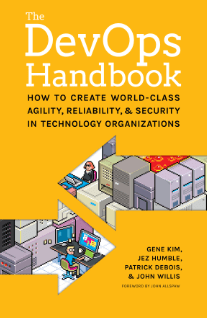
Remember the Phoenix Project? Well, good news, The DevOps Handbook is just out, a book by Gene Kim, Jez Humble, Patrick Debois, and John Willis. (Gene Kim was the lead author of the Phoenix Project.) Like the Phoenix Project, I highly recommend this book for anyone in IT or dealing with IT, although for anyone in DevOps, this should be required reading.

To recap, the Phoenix Project is about a fictional auto-parts company, Parts Unlimited, with retail outlets nationwide. In its rush to develop a new “killer app” to allow its customers to make on-line purchases in a way that “leap-frogs,” the competition, nearly every IT calamity possible befalls the company. We learn lesson after lesson about security, change management, knowledge management, and of course DevOps.

The Phoenix project concludes with three underpinning principles:

three-ways

  1. The first way is about the left-to right flow of work from Development to IT Operations.
  2. The second is about the constant flow of fast feedback from right-to-left at all stages of the value stream.
  3. The third way is about creating a culture that fosters two things: continual experimentation, and understanding that repetition and practice is the prerequisite to mastery.

This is where the DevOps Handbook begins. From the book’s introduction, “DevOps astonishingly enables us to simultaneously improve organizational performance, achieve the goals of all the various function technology roles (e.g., Development, QA, IT Operations, Infosec), and improve the human condition.”

At 437 pages, it is not likely that anyone will get through it in a single sitting. Nor, will many read it cover to cover. The book is divided into six parts, beginning with an introduction of Agile and continuous delivery, and detailing the three ways. The DevOps Handbook concludes with chapters on security and compliance. It also includes case studies from Google, Capital One, Target, Netflix, etsy, and others.

Thanks to our growing DevOps and Atlassian practice, RightStar has an incredible opportunity to work with customers to help them merge both DevOps and ITSM/ITIL practices to enable them to be more efficient, productive, and of course, more competitive. Look for future blog posts when I will tackle and summarize a chapter at a time…..

Posted in Atlassian, DevOps, Uncategorized | Tagged , | Leave a comment

Digital Enterprise Management: Government in a Web-Driven World

By Dick Stark

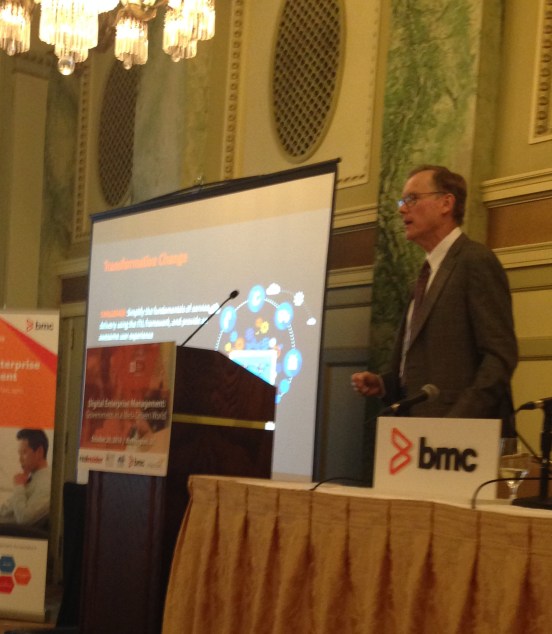
On Thursday, October 20, RightStar and BMC sponsored a Breakfast briefing at the Willard: “Digital Enterprise Management: Government in a Web-Driven World.” The seminar featured a panel discussion of several government IT executives. Topics consisted of federal cloud strategies, digital-first workplace, big data, security, and legacy software. I presented the final keynote, “Finding Business Value with Digital Enterprise Management.” Panelists included: Dr. Leslie Perkins, Deputy CTO, US Air Force, Tony Summerlin, Special Advisor to the CIO, FCC, and Paul Morris, Acting CIO, TSA. Here is a short summary.

dick_oct-event_3

Dick Speaking at the Willard


Cloud. Tony Summerlin, a self-proclaimed Cloud evangelist, is pushing to go 100% Cloud “cold turkey.” Indeed, he has already moved more than 40% of the FCC’s applications in the Cloud with applications like Office 365. FCC, with an IT staff of 36 FTEs and 200 contractors, has sponsored more FedRAMP vendors than any other agency. Tony also moved his agency’s datacenter to the cloud (really West Virginia).   Both DHS and the Air Force are also interested in Cloud applications, but have received some internal push-back due to security considerations.

Security. With more than 63,000 employees, TSA’s Paul Morris pointed out that cyber security is just as important to DHS as fighting terrorism, and is “an important part of every major decision by the agency.” At the Air Force, according to Dr. Perkins, cyber security is extremely hot, and role-based access would go a long way in solving security challenges, But, she stated, “no one wants to do the hard boring stuff.”

Digital-First Workplace, or what Gartner refers to as social, mobile, accessible, and information-driven work, also generated an interesting discussion., specially in regard to legacy applications, Tony Summerlin’s suggestion was “rip and replace,” primarily to the Cloud, where he argued security is much improved, as compared to legacy applications. Paul Morris cited his time at a Silicon Valley software company when suddenly the legacy C+ programmers were replaced by Java programmers, no easy task in the world of legacy government IT.

What’s Next? Dr. Perkins said the Air Force is moving to a mobile environment for all its employees. Likewise, Tony Summerlin pointed out that the FCC is moving to a BYOB model with device level security protection, and will continue to push for 100% agency-wide SaaS applications. Paul Morris said that TSA has “post-traumatic vendor fatigue,” as a result of having to deal with vendor products that don’t talk to each other. TSA will also spend money on improving their aging network, which is currently “bandaged together.”

Stay tuned next week when I discuss the value obtained from Digital Enterprise Management.

Posted in Digital Engerprise Management (DEM, RightStar, Technology Trends, Uncategorized | Tagged , , , | Leave a comment

Getting Dev and OPs Under One Roof with JSD

By Dick Stark

RightStar won the Atlassian “Rookie Partner of the Year Award,” on Monday, October 10, at the Atlassian Summit in San Jose, CA. Although most of our services involve Atlassian’s more traditional DevOps toolsets including JIRA Software, Confluence, and Bitbucket, we have seen an increase in ITSM opportunities.

jira-service-deskTo make JSD more competitive, Atlassian recently, “Pink Certified,” JSD for Incident, Problem, and SRM. But don’t expect JSD to take on the likes of Remedy or ServiceNow any time soon. JSD does not even show up in the Gartner Magic Quadrant for ITSSM. I asked Atlassian why during a recent webinar. The answer is that Atlassian has no interest in getting in the Magic Quadrant or any other quadrant. Atlassian offers a very unique, very collaborative, and very customizable solution designed for teams and with direct integration to the Development side of the company.

Where then does JSD play?

With more agile and collaborative organizations trying to get “Dev and Ops under the same roof.” The service desk in most large organizations normally resides under the CIO or IT Director and is viewed as employee facing where people can get help with IT issues, problems, and requests. This works well for most computer related issues, but not so well when the development team is needed to fix a bug or create a new feature. What happens in this situation?

A common response is to transfer the call to the dev team and let someone there deal with it. Or, maybe the service desk is integrated to the dev bug tracking system so that when a fix is applied the ticket can be closed off and the caller alerted (best case). But more likely the service desk is stuck with the ticket and has little communication and little control over how the issue is resolved. It’s frustrating and inefficient and no one wins.

JIRA Software is one of the most popular, comprehensive, and flexible DevOps toolsets in the market today for design, code development, testing, issue tracking, and software project management. Combined with JSD, Operations is both literally and figuratively plugged into the Development team, which uses JIRA Software to manage the software development life cycle, smashing the wall between the two disciplines.

With JSD, support is able to track work across teams. And ITSM is no longer isolated from development. There’s a cohesion in how the two teams operate. This enables companies to organize their teams into new, more integrated, multidiscipline organizations.

Of course, JSD also plays with cost conscience buyers. With an average selling price of one third to one half the price of other similar offerings, JSD is a great value for organizations, especially when software lifecycle costs are factored in.,

Aligning ITSM and DevOps is not only smart, it’s easy to do with JSD. The result is improved collaboration and faster bug fixes. Everyone wins.

Posted in Atlassian, DevOps, Digital Engerprise Management (DEM, RightStar, Uncategorized | Tagged , , , , | Leave a comment

Pledge 1%

Do all the good you can At all the times you can
By all the means you can To all the people you can
In all the ways you can As long as ever you can
In all the places you can  

pledge-1

This is a quote from 18th century theologian and social reformer John Wesley, co-founder of the Methodist movement.  How can RightStar, an IT consultancy, do “all the good we can do?” One way: by pledging 1% of profits.

Last week, RightStar joined Pledge 1%, a corporate philanthropy movement dedicated to making the community a key stakeholder in every business. Spearheaded by Atlassian, Rally, Salesforce and Tides, Pledge 1% empowers companies to donate 1% of product, 1% of equity, 1% of profit or 1% of employee time to improve communities around the world.

RightStar is joining an impressive network of entrepreneurs and companies across the globe that have committed to philanthropic efforts through the Pledge 1% movement. By pledging 1% of its profits, RightStar is demonstrating a commitment to philanthropic leadership.

RightStar is a National Capital Area Ethics Award winner, having demonstrated a commitment to business excellence and to the highest standards of integrity and ethical conduct, along with civic and social responsibility.

Ethics, honesty, integrity, and civic and social responsibility are the foundation of RightStar and our success. I see Pledge 1% as something that adds value to our customers, employees, and partners. I am delighted to have made a formal commitment and joined the Pledge 1% movement.

“We are thrilled that RightStar has joined the Pledge 1% movement and is committed to sharing its success with the community,” said Scott Farquhar, co-founder and co-CEO, Atlassian. “Employees, shareholders, customers, and the community all benefit when a company builds giving back into its DNA. It’s one of the best decisions we ever made.”

“We are incredibly excited that RightStar has taken the pledge,” said Amy Lesnick, chief executive of Pledge 1%. “RightStar can play a pivotal role in building this movement and promoting a new normal in which all companies—big and small—integrate giving back as a core value in their business.”

Even more reason for RightStar to be profitable. RightStar will continue to give to local, regional, and national charities.  In 2016, we already donated to heart transplant research, spinal cord injury research, and to an organization providing eye glasses to the underserved in the developing world.

What else does RightStar do? In addition to regular paid-time-off, RightStar offers two days off per year to use on pre-approved volunteer activities.  We’ve had excellent participation this year.  For example, this past weekend, an employee assisted on a church project, helping repair a facility in central Pennsylvania.  Another employee earlier this year volunteered her time on a model UN project, someone else worked on a fund raiser for his church, and yet another spent a day with a vet for an organization called Honor Flight Chicago.

Thanks, and I expect to share even more volunteer stories before the end of 2016!

Posted in Atlassian, Uncategorized | Tagged , | Leave a comment

BMC, Coming on Strong

By Dick Stark

On August 24, 2016, Gartner released its Magic Quadrant for IT Service Support Management Tools. In this report, Remedy has remained in IT’s holiest of holy places, the upper right corner. However, the top spot still belongs to ServiceNow (SNOW), especially when their overall market share is factored in. Credit BMC for fighting back and gaining ground against a formidable competitor. (Remember, competition is a good thing. It was only a few years ago that Gartner was complaining about the “boring ITSM toolset space.”) The BMC-SNOW fight, however, is far from over as there are still plenty of bright spots ahead for BMC. For instance:

BMC still wins based up upon core technology. This is according to ITSM University, in Release 12 of its State of the IT Service Management Market, which was just published August 30. In fact, as a result of extensive product testing, Remedy 9.1 scored higher in the following modules: Incident, Problem, Change, Asset and Configuration, Release, Event, and Service Level Management. SNOW scored higher in Service Request and Service Catalog. Here are several comments from ITSMU about Remedy 9.1:

  • The new interface can be described as nothing other than awesome.
  • The SmartIT interface is absolutely groundbreaking and beautiful. The way you change locations, categories and services is simple and powerful. This will lower average handling times and improve data quality for management in a meaningful way.
  • With Change Management’s new interface, it has quickly become the most user-friendly with a wizard based approach to creating changes.

remedy-itsm-v9

Don’t forget about Remedyforce. ITSMU did not evaluate Remedyforce due to the lack of a significant number of Enterprise level customers, but does say, “Remedyforce is one of the most promising upcoming solutions in this market,” implying that Remedyforce, and not Remedy-on-Demand is best positioned to compete against SNOW. ITSMU even has something good to say about FootPrints 12, “ServiceCore version 12, is actually a pretty decent product for the price.”

BMC is working hard to make upgrades much simpler. As I reported last week, the upgrade to Remedy 9.5 should take minutes, not days. Unfortunately, the perception is that Remedy is expensive, and cumbersome to upgrade. And ITSMU reports that upgrade costs are reasonable if you get the right services partner. He must have been referring to RightStar.

The bottom line: RightStar is very well positioned to offer excellent ITSM solutions: Remedy, Remedyforce, and FootPrints, along with the other BMC ITOM products such as TrueSight (Performance and Application Management) and Blade Logic Service Automation (now referred to as Threat Director) for SecOps.

For the ITSMU report see:

http://www.itsmuniversity.net/state-of-the-it-service-management-market-release-12/?ct=t(SITSM_12_3_7)


Posted in BMC, Digital Engerprise Management (DEM, Remedy, RightStar, Uncategorized | Tagged , , , , , | Leave a comment

Report from Engage 2016

By Dick Stark

BMC’s annual user group conference, Engage, wound down last Friday in Las Vegas. Attendance was up this year by 10% with more than 2000 customers, partners, and BMC employees in attendance. RightStar had good booth traffic, and many customers stopped by to see us. RightStar also had three presenters this year delivering several Track-It! training sessions, and two customer Remedy v9 success stories

And the best news: RightStar won the BMC DSM Partner of the Year, North America. DSM, or Digital Service Management is BMC’s new term for ITSM, and is an important component of BMC’s Digital Enterprise Management (DEM) architecture. Here is a short Engage 2016 update.

Three key DSM themes:

  • Make upgrades to latest software version as easy and as valuable as possible. Upgrading to BMC’s new Remedy 9.5 (targeting November release date) should take no more than a couple of hours.
  • Transformation. Change how people access and leverage the power of the solution. To be competitive, all companies must become a “hyper-agile digital enterprise.” IT departments must focus 50% of their time now on innovation IT. Go digital or become extinct.

hyper-agile-digital-enterprise

  • New Innovation Suite for developers and partners. Several BMC partners are already developing Remedy apps using this new suite, which is currently free for developers. We saw two demos: a crowd sourcing funding app for companies to track their employees’ donations of time and money, and an employee visit request app to check visitors in and out. Both developers said that they finished these apps in less than two weeks thanks to the drag and drop Innovation Suite developer toolkit.

Other focus areas include:

  • SecOps. BMC has rebranded its BladeLogic Server automation offering as the Threat Director, and is targeting organizations like hospitals and retail that are especially vulnerable. Security is also hot in the government space and we have three new opportunities with this product solution.
  • DevOps. BMC demoed how developers are using the power of its Control M platform to run jobs such as Jenkins and JIRA.

BMC is on a roll (and so is RightStar),  and I’m optimistic about our BMC future.

Posted in DevOps, Digital Engerprise Management (DEM, ITSM, Remedy, RightStar, Uncategorized | Tagged , , , , , , | Leave a comment

The Art of Business Value

Art of Biz Value

By Dick Stark

Mark Schwartz, CIO at US Citizen and Immigration services (USCIS), is one of the leaders in the government’s move towards agile. Specifically, Mark is a proponent of continuous delivery as a way to shorten the software development life cycle by automating the delivery process (think Atlassian toolset) and making software releases smaller and more frequent (think Amazon). Mark is also author of a new business book, “The Art of Business Value.” What is business value and how can we be sure that RightStar is delivering it?

Mark tells a story about when he was a CIO at Intrax, and responsible for a transformative project, one that was a true collaboration between the IT organization and the business line. The launch of the project was a disaster. Mark defended the project to the CEO saying that it had been delivered on-time and budget and met the requirements of the business unit. He stated “The issue is not with project delivery, but rather with the business requirements.” The CEO responded, “I trusted you with an investment in an IT system. Your job is to make sure I get a return on my IT system. I am not getting a good return.”

This begs a question. Is RightStar responsible for executing projects, or delivering business value? I like to think, and most customers would agree that we are responsible for business value, not just project delivery. In fact, RightStar’s mission is to be our customer’s expert advisor in the service management and DevOps space, AND to deliver value back to the organization. How do we do this?

After a recent Remedy 9 upgrade and MyIT rollout, I met with the customer to ask about business value. I wanted to know about improved efficiencies, customer satisfaction, or cost savings, especially as it applied to a reduction in calls to the service desk (also known as shift left.) Instead, the customer’s perception was that IT is a service broker, responsible for networking, data storage, help desk services—in general “keeping the lights on.” This wasn’t what I was expecting to hear.

According to Mark Schwartz, “the real value—and the real effort—lies in helping business managers identify how to change the business and then helping them play their roles in implementing those changes.” In other words, we cannot afford to be “software guys with screwdrivers.” We must help ensure that real value is obtained through better up-front process analysis, and then post-implementation reviews.

So, how does value apply to RightStar and our implementations?

  • Our ITSM customers, no matter how small or immature, have a desire to move up the maturity model and drive real value. We can help them get there, by first mapping out an IT strategy and deploying tools such as Remedy or Remedyforce in a phased approach.
  • Our DevOps customers, may have higher expectations, even transformative expectations. It is up to us to properly set those expectations up-front and then help them play their roles in implementing those changes.
  • Finally, we need to continue with post customer interviews and surveys to help us understand not only the customer’s perception of value, but what impact our solution had on organization value, and what gaps still exist. Continual improvement is an important objective for RightStar and our customers.
Posted in Atlassian, BMC, Business Management, DevOps, RightStar, Uncategorized | Tagged , , , , , , | Leave a comment

BMC Discovery 11 and the New Federal DCOI

BMC Discovery

By Dick Stark

On Wednesday, RightStar presented a live webcast, “BMC Discovery 11 and the New Federal DCOI.” BMC, discussed some of the new features in Discovery 11 (formerly ADDM), and how to use Discovery to comply with the new Federal DCOI mandate.

DCOI, or Federal Data Center Optimization Initiative, is a successor to the Federal Data Center Consolidation (FDCCI) effort. According to a recent article in FCW, results have been a mixed bag. Although FDCCI has resulted in thousands of facilities being powered down, according to a GAO report, the number of data centers has grown significantly, from 3100 to nearly 7500. (Of course, a data center is defined as any room with at least one server that supports development, production, staging, or testing.)

On August 1, Tony Scott, US CIO released the final version of the DCOI. In a blog post accompanying the initiative, Scott wrote that the new policies, “include strengthened and direct CIO authority over data center related budgeting and management decisions, increased use of the cloud and inter-agency shared services, and replacement of manual data collection with more accurate and efficient automated monitoring tools.”

Optimization is an important priority. Agencies have new targets for energy metering, effective power use, virtualization, automated monitoring, and utilization of both servers and facility floor space. As Mike pointed out in the webcast, “Agencies shall replace manual collections and reporting of systems, software, and hardware inventory housed within data centers with automated monitoring, inventory, and management tools, by the end of fiscal year 2018.”

This is good news for BMC, and RightStar data center infrastructure management (DCIM) partner, Nlyte. How does this initiative apply?

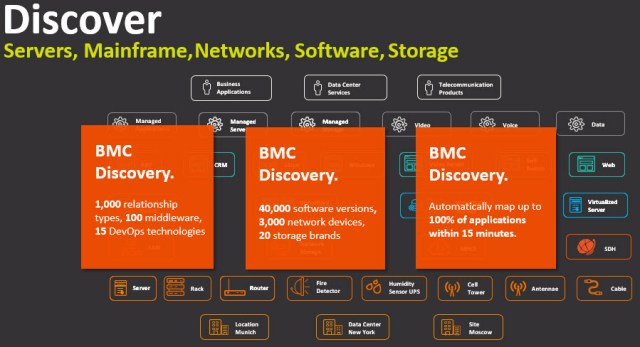
First, BMC Discovery discovers servers, mainframes, networks, software, and storage.In fact, it discovers over 40,000 software versions (its next closest competitor discovers on ly 20,000). Then, BMC Discovery finds the dependencies, shows the services, and “if you can draw a circle with a mouse,” maps the dependencies. And with version 11’s Start Anywhere application mapping, does this very quickly. Knowing how everything is connected allows for proper data center planning.

Second, Nlyte a leading sofware provider in the DCIM space, offers solutions that manage the physical infrastructure of a data center and its on-going operation. RightStar has a proposal into a major government agency to address its data center locations (i.e., expansion and consolidation), assets (i.e., workload migration, capacity service refresh), and to make the most efficient use of power, cooling, networks, weight and space.

The combination of BMC Dicovery along with Nlyte DCIM offers the government a better way to integrate, connect, manage and model the physical, logical and virtual layers, correlating all data center assets into one seamless business process. At the same time, this solution allows agencies to comply with the new Federal DCOI. Tony Scott summarized, “Reducing the number of data centerss is still a goal. Agencies are expected to close 25 percen of their larger facilities over the next three years

Posted in BMC, Digital Engerprise Management (DEM, RightStar | Tagged , , , , , | Leave a comment

Remedyforce Summer 16 Update

By Dick Stark

Last Tuesday, RightStar hosted a Webinar, “What’s New in BMC Remedyforce Summer 16.” Remedyforce just keeps providing more value. One perfect example is that agentless discovery is now part of Remedyforce The new release of Remedyforce allows users to discover assets and pull them into the CMDB, at no extra cost!

Agentless Discovery. We pointed out that agentless discovery was “borrowed” from BMC’s Client Manager, formerly Asset Core, and “if you want the other pieces, for example software license management, patching, compliance management, and financial management, users can look at the premium and premium plus options.” Agentless discovery offers an excellent value for those organizations looking to get started with configuration management. What else is new?

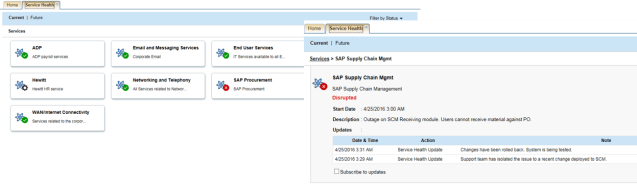
Service Health. This is a new self-service tab that allows organizations to display health of business services to the rest of the organization (its end-users). It shows both the current health and future planned outages. Similar to the broadcast function, end-users can check out that status of business services, rather than calling the help desk or submitting a ticket. (A service like this would have been helpful for me when returning from Atlanta on Thursday. Trying to check the status of my flight, I was very surprise to discover that the Southwest web site was down with no indication of why or when service would be restored. The outage was not just confined to the website–we boarded the airplane with the gate agent checking off our names manually with a highlighter, just like what airlines did this in the 1960s.)

RF Service Health

Smart Suggestions for Self Service. Similar to Remedy’s Smart IT, Smart Suggestions helps customers and clients find the information they need more quickly based on their ask or need. Smart Suggestions extends to self-service broadcasts, knowledge articles, common tickets, and service requests.

How does this work? When the end-user starts to type in the issue, “suggestions” pop-up so the end-user can try to resolve their own issue. This is especially useful for specific organizational applications that may not be available using a google search.

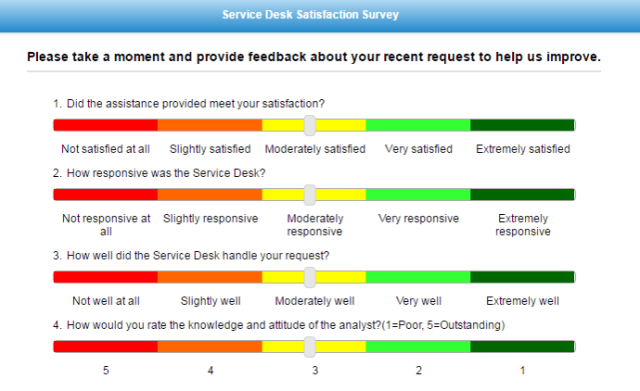
Make Surveys Pop. Customer satisfaction may be the most important metric for the service desk, and surveys should be completed not by a fair cross-section of users, not just the angry ones. So, rather than the old style with just a list of questions, the new survey allows users to slide a bar, with more colors, making the response time even faster.

Make Surveys Pop.png

Mobile for Self Service. End-users now have access to the Salesforce1mobile app. The prior beta release allowed submission of incidents and knowledge article viewing only. Now, end-users may view broadcasts, respond to approval, and create and update incidents. What makes the app so easy—it works for both end-users and service desk staff.

One feature that is only available on the mobile app is CIs and Assets. Now users can see what applications, e.g., SAP, and assets, e.g., Dell laptop they are associated with or assigned to.

Finally, what about availability? BMC began pushing Remedyforce Summer 16 to Sandboxes on July 15 with the production push on August 12.

Posted in BMC, Business Management, Digital Engerprise Management (DEM, ITSM, RemedyForce, RightStar, Uncategorized | Tagged , , , , , , | Leave a comment