
Gartner’s New ITSSM Magic Quadrant

By Dick Stark

In November 2010, BMC climbed to the top of the mountain, the pinnacle of IT’s holiest of holy places, the upper right corner of the IT Service Desk Gartner Magic Quadrant.  And when they looked around, they found their closest competitors, CA, HP, and ServiceNow, lagging well behind in the challenger’s quadrant.

Now, 20 months later Gartner has replaced the IT Service Desk with IT Service Support Management Tools (ITSSM) Quadrant.  Once again, BMC is higher and farther right than any of its competitors, except this time the Leader’s Quadrant is empty. Blank. Zilch. Nada.  It turns out that none of the vendors Gartner evaluated this time exhibited the characteristics of either Leaders or Visionaries.  The good news is BMC did not take a step backward, it’s just that Gartner developed a new set of criteria for the market and has raised the curve, meaning that BMC and other vendors must earn their way to the top.

The specific Quadrant under discussion is the Magic Quadrant for ITSSM. It “offers a tighter integration of functions that correlates with the activities of the broader IT support organization.”  This means the ITSM market is maturing. It is much more than integrated incident, problem, change, and configuration management. It is about life cycles, business views of IT, ITIL framework automation, and self-service and healing. ITSSM does not focus on BMC’s Service Assurance and Service Automation product families.  Nor is this about Remedyforce or FootPrints. The product line of focus is Remedy or Remedy on-Demand ITSM, which has been the market leader in this space for years.

What makes Remedy so great is that it has evolved from the ground up to an integrated tool set of ITIL modules. Implementations can be out-of-the-box quick using the ITIL framework in just a matter of weeks. Alternatively, implementations can be several months or longer based upon factors such as integrations (for example, between ADDM and the CMDB), and the level of automation desired (for example, closed loop change management). The recent Gartner Magic Quadrant report also identified several Remedy cautions around ease of use and user experience, and ease of upgrade capabilities related to Remedy’s reputation as being overly complex.

Fortunately, BMC has been aware of these cautions and has moved quickly to address them.  In the soon to be released Remedy Version 8, both the user experience and upgradability is much improved.  RightStar goes live with a version 8 beta site customer on Tuesday and anticipates no issues.  The version 8 upgrade process is much faster and the installs worked “without a hitch.”  The new Remedy overlay model means that future upgrades should occur as fast as one would upgrade Microsoft Word.  Of course, there may still be a need for a dev, test, and production environments, but the total upgrade process is days now, not weeks.

In addition, the user experience is much better.  Although there are no significant changes other than to the Service Request Management module, there are many minor improvements, such as reductions in the number of screen pops. My prediction: an excellent Remedy 8 review and a hasty ascent into the next ITSSM Leaders’s Quadrant.
Posted in BMC, ITSM, Remedy | Tagged , , , , , , | Leave a comment

What Fed Execs Want From IT

By Dick Stark

A few weeks ago MeriTalk, a Federal IT think tank, commissioned a study entitled, the Customer is Always Right, that focused not on what IT thinks, but what IT’s customers think of IT.  Not surprisingly, just 46 percent of Fed execs view IT as an opportunity.  Thirty-two percent view IT as a cost, and twenty-two percent are unsure whether it’s a cost or opportunity.

What’s interesting is that the Fed execs polled see IT as a support and not a transformational function. Fifty-six percent see IT as a “necessary evil” supporting daily agency operations.  The good news is that IT can do better.  Just 48 percent believe their agency leverages its IT department to the fullest extent.

I met recently with a Federal CIO, who stated that he was under tremendous pressure to reduce costs. Long gone are the days when CIOs are scrambling to spend year-end money on uncertain IT projects just to ensure that budget dollars are spent and not returned to the Federal coffers.  In fact, that CIO was looking at ideas such as cloud computing, mobility, and service desk consolidation to save IT dollars.  Another important consideration is an overhaul of outdated IT systems and processes.  According to the MeriTalk survey, the top priority for Federal Execs: streamlining and modernizing business processes.

As a sub to a NASA contractor, RightStar is currently upgrading Remedy to the latest version. At NASA, it’s not surprising that process improvement has emerged as a very critical success factor.  There is no better way to start an IT project or upgrade with a process review or analysis.  At NASA, RightStar led an ITIL awareness training session and has recommended ITIL simulation training as a way to kick-off an upcoming service desk consolidation project.

Change is difficult and process improvements are not always warmly welcomed by employees and stakeholders alike. RightStar has seen improved participation and process acceptance on ITIL process projects, when preceded by ITIL simulation training.  For example, at the University of New Hampshire, RightStar rolled out a PoleStar simulation training session to the CIO and her direct reports. The training session went so well, the CIO asked for the simulation training for the entire IT organization.  The result: improved participation, enthusiasm, and understanding of why process improvements are so important.  Of course, the Remedy upgrade was also a success.

IT support has also become more difficult, and streamlined processes using ITIL as the framework help simplify that complexity. Several Polestar simulation options are available.

  • PoleStar ITSM Airport Simulation is a highly interactive ITSM and ITIL simulation.
  • PoleStar Health demonstrates the powerful benefits that ITSM and ITIL can bring to the Healthcare sector.
  • PoleStar NPO is a high tech ITSM simulation based around public sector organizations.

Let’s face it, the first step to streamlining and modernizing business processes is a better understanding of how new processes will help. IT will improve but IT can’t transform government efficiency without executive support that new process rollouts require.

Posted in ITIL, ITSM, Remedy | Tagged , , , , , , | Leave a comment

Simplicity and Service Management

By Dick Stark

“Simplicity is the ultimate sophistication.”

-Leonardo Da Vinci

Several weeks ago, CIO Magazine’s cover story, In Search of Simplicity, detailed how complex IT has become.  Between private and public clouds, mobility, BYOD, social media, Big Data, security, and misuse of technology, IT organizations have more to deal with than ever before.  Additionally, applications have proliferated, and at a recent seminar, a hospital customer confided in me about the hundreds of applications they run, many of which are no longer needed, maintained or supported.

IT support has also become more difficult, and ironically, simplified processes now have come at a price–more sophisticated support software. Several customers have complained about Remedy upgrades to version 7.604 taking too long, up to six months, depending on the situation. In addition, developing Service Request Management (SRM) workflow can be very tedious and time consuming adding to already lengthy implementations. During a recent customer visit, I asked the project manager to describe the value she thought she would gain after upgrading to the current Remedy version.  Her answer: “I’m not sure; we just want to be on the current version.”

Fortunately, Remedy software is getting much easier to implement.  Now with Abydos, which is included at no charge with all current versions of Remedy, complex workflows which previously required hours of implementation can be accomplished with a few simple design steps.  BMC has also stated that the next minor release after version 8 will include a capability to allow upgrades to occur in an hour, instead of the days previously required.  Of course, BMC’s SaaS offering, Remedy onDemand, means never having to upgrade, since SaaS based upgrades occur in the cloud.  What else can your organization do to reduce service management complexity?

  • BMC offers less complex solutions such as FootPrints and Remedyforce. Both applications allow for integrated incident, problem, change, and configuration management to be up and running in days instead of weeks.
  • Application consolidation.  According to the Hackett Group, typical companies run more than twice as many applications as high performance companies.  As a result, the best managed companies deliver IT services 15% more cheaply than typical companies.
  • Service Catalog/SRM is a “front end” for asking for anything within the organization, not just IT.  And the CMDB should not just be for IT assets.
  • Virtualization.  BMC’s BladeLogic Server Automation offers virtualization management and automation across an organization’s entire server population. This offers more opportunity for IT simplification than any other solution.

A new BMC RightStar customer in Cleveland summed up their recent service management selection this way:  “We chose BMC because we wanted a service management suite that was easy to use and fully integrated between the service support, automation, and assurance modules. No one else offered that same level of integration simplicity.”

Posted in BMC, FootPrints, ITSM, Remedy, RemedyForce | Tagged , , , , , , , | Leave a comment

Morning at the Newseuem

By Dick Stark

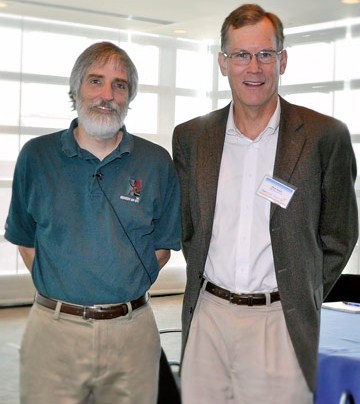
RightStar and BMC held a seminar last week at the Newseum in Washington, DC to discuss trends in ITSM and the new version of Remedy 8 to be released next quarter. The speaker was Doug Mueller, Remdy co-founder and current BMC corporate architect.  Doug is well known in the Remedy community and was a big draw.  What follows is a short synopsis:

Doug began by stating that IT needs to change the way it does things.  It is all about IT capabilities delivered the right way 100% of the time. Like turning on a light switch, IT services must always be available. Doug pointed out that IT departments must focus on things that make the business or organization run better, not necessarily by “standardizing on ITIL, COBIT, or Billy Bob, or Mary Sue.” Doug, however, stressed the importance of good processes but reiterated the bigger picture—making sure that business needs are met first.

Doug Meuller and Dick Stark

The anchors of service management are CMDB, Service Request Management (SRM), and Decision Support. Get them right and everything else falls into place. Doug was especially excited about SRM as there has been a shift in how people want to interact with a service desk. Rather than calling or emailing a support desk, uses look for a “one size fits all” support portal. And it should be a simple portal , e.g., www.mycompany.help that provides a “single pane of glass” for all service requests in the company—IT, HR, and Facilities. Combined with a knowledge base, users can fix their own issues and escalate to support only when they have exhausted all other means.

Doug spent the rest of the morning discussing the new release of Remedy v8, currently in beta. Features include:

  • Totally revamped SRM with links, submitted requests, and popular knowledge all on the same page.
  • New data management tool to simplify on-boarding and data synchronization.
  • Enhanced best picture view with fewer fields on the screen.
  • Chat and other social media support.
  • Hub and Spoke model which allows those organizations with several disparate Remedy (or other ITSM systems) to have a central Hub to collect and assign tickets.
  • Significant improvements in asset management resulting in a 40% CMDB performance improvement.

It was a very productive morning and I look forward to seeing Doug again at the WWRUG in San Jose in October.

Posted in BMC, Remedy | Tagged , , , , , , | Leave a comment

The End of Solution Selling

By Dick Stark

It’s the end of traditional solution selling. Customers are increasingly circumventing reps; they’re using publicly available information to diagnose their own needs and turning to sophisticated procurement departments and third party purchasing consultants to help them extract the best possible deals from suppliers. The trend will only accelerate. For sales, this isn’t just another long, hot summer; its wholesale climate change.

                –Brent Adamson, et al., The End of Solution Sales, Harvard Business Review, July-August, 2012

In case you hadn’t noticed, selling, and especially solution selling, (which is what RightStar does) is getting more difficult. Budgets are very tight, and customers are looking at projects that return immediate value. Additionally, service management solutions are not often at the top of the short list which means waning interest and long sales cycles. Are we left to focus only on commodity sales where low price (and very low margin) wins?

Fortunately, according to the Harvard Business Review (HBR), the news is not all bad.  Selling is still happening, but it is evolving.  Sales reps must now, “seek out customers that are primed for change, challenge them with provocative insights, and coach them on how to buy.” Today’s buyers are not looking for solutions, they are looking for insights. And since RightStar is a consulting firm focused on becoming our customer’s trusted advisor in the service management space, this new selling strategy should play nicely at RightStar. Here are Adamson’s new selling strategies as they apply to RightStar.

(1) Avoid the trap of “established demand.”  At the beginning of all RightStar webinars we poll the audience and always ask about their level of ITIL maturity.  In one recent session, the results were: hight level—30%, no, but moving to ITIL—42%, and no plans to use ITIL—16%.  The obvious takeaway here is not to waste any time on both the mature and non-ITIL users.  Instead, focus on those customers planning to move to ITIL because demand is emerging, not established.  These accounts have not settled on a course of action and could be ripe for change. They should require ITIL consulting or training, and eventually software purchases or upgrades.

(2) Target Mobilizers, not Advocates. The HBR Article identified seven customer stakeholder profiles and identifed Go-Getters, Teachers, and Skeptics (collectively Mobilizers) as better at building consensus and driving the sale more than any other profile type. These are people that are engaged by big disruptive ideas and are looking at outside experts to share insights about what their company should do. Maybe a Go-Getter interested in consolidating applications and service desks into one.  Or, maybe building a service catalog, so that several help desk positions could be eliminated.

(3) Coach Customers on How to Buy.  According to Adamson, the “super star” sales reps, are actually responsible for assisting with the purchase process.  They can forsee likely objections and anticipate organizational politicking. Of course this works better with commercial rather than government customers, but an important goal is to get in early, rather than wait until an RFP is released.

In the end, I still believe that RightStar has to sell value, improved efficiency and customer satisfaction. But by acting as the customer’s trusted advisor, and working with organizations that truly understand the need for change, RightStar is in better shape, perhaps even than BMC, to affect change and capture the customer’s business.

Posted in BMC, ITIL | Tagged , , | Leave a comment

What We Did on Volunteer Day

By Liz Yost


Liz Yost and friends at the first annual Chrome Ride.

On Saturday June 2, parents, volunteers, supporters and participants came together at the famous “Rainbow Road Club” in Rippon, WV in support of children with disabilities, specifically, the Benedictine School for Exceptional Children. 

Friends from Virginia, Maryland and West Virginia roared in on their motorcycles to ride and show off their “chrome” for a fun filled day. For a $25 contribution each rider received a special event t-shirt and a catered lunch. The 5-stop poker run took riders through scenic West Virginia roads returning to The Rainbow Club where the best hand received a $100.00 prize, and the worst hand a $25.00 consolation.  One special boy received a ride from committee member Clovis Van Ness that he will never forget. In seeing the excitement in the eyes of this special child, it was evident the kids have found a place in the hearts of the bike enthusiasts.

Riders and non-riders alike enjoyed the rest of the day with plenty of events from i-pad, chest of cheer, and 50/50 raffles. There were over 100 items in live and silent auctions some of which included Southwest airline tickets, NASCAR tickets, Brinkman gas grills, leather riding gear, rafting trips, signed paintings, a Prada purse and so much more. Hogs and Honey on site photos were taken and all enjoyed catered meals of pulled pork and barbeque chicken with all the trimmings.

It was truly a unique day of fun with special people coming together to help enrich the lives of “special people.” Much thanks goes out to the riders and everyone who came out to support, with a special thanks to all the sponsors, volunteers, and committee members. 

By Dick Stark

On volunteer day, May 12, 2012 I volunteered for the Goodwill of Greater Washington, specifically at a drop-off spot in Springfield, Virginia.  I helped empty out people’s cars and trucks as they dropped off donations.  A real estate company allowed the use of their parking lot and had marketed the neighborhoods to try to drum up business.  The event was a success as we nearly filled up the truck with all sorts of household items.


Dick in front of the Goodwill donation truck.


In talking to Goodwill’s director of marketing I learned that donations are the lifeblood of the organization. Goodwill accepts used clothing, furniture, housewares, working electronics and many other items (everything except mattresses). These items are resold to help fund employment, job training and placement services for people with disabilities and disadvantages.

I was really impressed with Goodwill’s emphasis on job creation. The Goodwill of Greater Washington has a Jobs in ’12 initiative: Let’s put Greater Washington Back to Work. Jobs in ’12 supports Goodwill’s efforts to: train, equip and place nearly 200 people into new local jobs that support the local economy during 2012. These 200 jobs will come through the placement efforts from Goodwill’s intensive job training programs as well as continued expansion of Goodwill’s retail stores

Goodwill already provides 600+ jobs to local residents currently employed through its retail stores, janitorial contracts, and Goodwill’s administrative and support divisions.  Year-to-date, Goodwill has created 66 new jobs towards its goal of 200!

By Alison Appenzellar

Back in October, I became involved in a local food pantry that ended up closing in December. As a result of this, a friend of mine and I decided to start our own food pantry, Tabitha’s Table, under the auspices of the church we both attend. Our pastor actually gave up his office so that we could store food! We had already created a relationship with the Maryland Food Bank, receiving monthly donations of over 6,000 lbs of food, so this continued with our new food bank. As time went on, the donations increased to over 7,000 lbs.


Alison’s Food Pantry, aka Tabitha’s Table.


As the food bank has grown, we are now serving close to (and sometimes over) 20 families per week in our community. When we have our monthly distribution, an average of 100 families are served on that day. We now have our own non-profit and in addition to the food pantry, have started an after-school program for children (many of whose parents frequent the food bank) to feed them snacks, do Bible studies and help with homework. Over this summer, we’ve been feeding them lunches and then have Bible time and snacks in the afternoon. We send them home with breakfast bags so that they have something to eat in the morning. Several times a week we feed them dinner, as there continues to be financial challenges for these families.


Posted in RightStar | Leave a comment

20 Mile March Part II

By Dick Stark

Last December I wrote about Jim Collins’ latest book Great by Choice where concepts like 10Xers, 20 Mile March, Fire Bullets, then Cannon Balls, and SMaC are introduced.  In 2012 RightStar is focusing on 20 Mile Marching (slow and steady growth) and SMaC (Specific, Methodological, and Consistent) operating principles and practices like “project management for every project.”

To refresh, the 20 Mile March concept is based in part on the race to the South Pole in 1911 between Scott and Amundsen.  Amundsen, a “20 mile per dayer” methodically planned the entire trip making progress every single day.  He made it to the South Pole within a day or two of his plan and returned safely home also as planned.  Scott did not plan with the worst case scenario in mind, did not have enough food stockpiled, and did not 20 Mile March.  He did not make it back.

Just last week I reread Alfred Lansing’s Endurance, a book about Ernest Shackleton’s 1914 quest to cross by foot the entire Antarctica continent. Coincidently, Shackleton was a member of Scott’s first 1901 successful expedition to march halfway to the South Pole. The major difference–Shackleton was a 20 Mile Marcher.

The irony is that on this attempt, Shackleton never made it to the Antarctica continent. When he was within a day of landing, his ship the Endurance, and his 27 crewmen became locked in an island of ice. The Endurance is an amazing story of survival as miraculously everyone survived the 17 month ordeal.  But it is also a story of leadership because it was Shackleton’s courage and conviction that made the difference. Here are several leadership examples that I took away from the story:

  • Responsibility. Shackleton had a deep sense of responsibility for everyone. His mission when marooned on the ice, was to return every man safely home.
  • Unbridled optimism. When the Endurance broke apart on the ice, hundreds of miles from land in the Antarctic winter with no chance of rescue, one might start to feel the situation was hopeless….  It was Shackleton’s enthusiasm that kept the men going.
  • Never quit attitude. Shackleton, “set men’s souls on fire.”  Just to be in his presence was an experience.
  • No special treatment. Remember this was 1914, and Shackleton was one of England’s most respected explorers.  More than 5000 men applied for the 27 open crew positions.  Yet, Shackleton wanted to be treated like anyone else and afforded himself no special privileges.
  • Not a big risk taker. While planning a voyage to cross Antarctica was undoubtedly a very risky proposition, Shackleton carefully considered and planned every option once the Endurance became stranded. For example, he and his men had an exact and practiced escape plan should the ice flow they were stranded on break apart.

I encourage everyone to read the Endurance, which is one of the best adventure and leadership books I’ve ever read. Like Shackleton, let’s continue to 20 Mile March in 2012!

Posted in Business Management, RightStar | Tagged , , , | Leave a comment

RightStar’s PKI Solution

By Dick Stark

You arrive at work to begin the day and logon to Windows using your CAC card.  But before you can get into Remedy you enter a password and hope that password didn’t change the day before.  Later, you attempt to log into the BMC Dashboard and Analytics program but have forgotten that password.  Finally, access to an HP server is thwarted when your third password attempt fails.

Sound familiar?  Although the federal government has made great progress in standardizing on security, access controls, security credentials, and password management, significant policy differences still exist among agencies.  For example, the DOD requires CAC or Common Access Cards also known as Personal Identity Verification (PIV) to gain access to facilities and computer systems. Civilian agencies, however, have been slower to follow suit.

The good news is that this is all spelled out in the Federal Identity, Credential, and Access Management (FICAM) Roadmap.  This GSA document and task force mission is to “foster effective ICAM policies and enable trust across organizational, operational, physical, and network boundaries.” That roadmap lays out the intersection of digital identities (and associated attributes), credentials (including PKI, PIV, and other authentication tokens), and access control into one comprehensive management approach.

Even better news is that RightStar is already helping federal agencies authenticate and access BMC ITSM software applications such as Remedy in a single sign-on approach. RightStar’s PKI Connector (RPC) is a simplified Logical Access Control System that provides Public Key Infrastructure (PKI) based authentication to various enterprise applications.

How does RPC work? Basically, PKI cryptography allows two parties to communicate with each other using keys (large numbers), a hashing algorithm, and a digital certificate to confirm the identity of the user, server, or organization. When installed, RightStar’s RPC intercepts the system’s password request and validates the certificate information from the PKI certificate associated with the user’s PIV card. Then it validates the credentials against that application’s certificate. After that, it authenticates the user to the application and authorizes the login.

More simply put, the RightStar RPC provides single-sign on, eliminating the need for multiple passwords and user IDs. This is a “lightweight” application meaning that it does not require a “fat” agent and extensive development. Today RPC works with BMC ITSM products but due to the pluggable nature of the application, new client plug-ins can be created with minimal effort.  Additionally, RPC works on multiple platforms out of the box and does not require any client installation.  The ROI is immediate.  No longer do users have to fumble with separate IDs and passwords, and users are granted entry in a more secure manner.

Posted in BMC, ITSM, Remedy | Tagged , , , , | 1 Comment

The End of Your Service Help Desk

By Dick Stark

Network World reported last Wednesday from the Gartner Infrastructure & Operations Management Summit on Gartner’s “top 10” list of the most significant emerging trends that will impact data centers and information technology used by businesses and government from now into the next four or five years.  The list included the usual suspects of mobility, hybrid clouds, and big data.  Number nine on the list is “the end of your service help desk.” That caught my attention since RightStar has spent the past nine years designing and implementing service desks for companies and government agencies.

What Gartner Chief of Research Dave Cappuccio actually said is:  “Mobility, consumerization of IT, the cloud — all of these trends are leading to another trend, the possible end to the traditional helpdesk. It may be ending, or morphing. The emerging trend is more reliance on crowdsourcing, such as the friend who knows the answer, the Web resources of vendors or blogs, and it all may mean a “transition strategy” related to how IT troubles are handled.” While his “end of the help desk” trend may be somewhat exaggerated, certainly help desks must change and are changing to keep up with user needs and evolving habits.  Here is my list help desk trends that must change.

(1) Self-service. Nearly all help desks have implemented some sort of self-service portal in varying degrees of sophistication ranging from on-line ticket entry to knowledge bases to service requests to service catalogs.  And most commercial based help desk software is evolving such that the service request module, and not the agent screen is the centerpiece of the application. Software such as BMC’s Remedyforce even comes with a built in chat feature to allow for a rapid-fire response to any type of query.  Also coming is integration to social networks. It’s a self-service world and the good news is that self-service reduces the number and duration of calls, which allow help desks to do more with less.

(2) Knowledge Management (KM). KM software and knowledge packs have been around for years and should be a critical success factor for all help desks.  Most organizations have a raft of company specific information, not available on Google, which needs to be readily accessible to users with a need for that information. The return on a KM process and software investment pays dividends in terms of improved problem and incident resolution especially when offered to all users. Unfortunately, some KM projects fail because the data quickly becomes outdated.

(3) Problem Management. Often overlooked, Problem Management must be a keystone habit of all help desks as the potential impact, especially when linked to incident, change and knowledge management is enormous. The problem and the resolution should be identified,  ranked and readily accessible.

One thing is certain: IT is becoming more and not less complex so continuous help desk process and technology improvement will return significant value to the organization.  The result:  reduced costs, increased agent and employee productivity, and overall, improved customer satisfaction. If help desks can’t or don’t evolve to compete with Google or other crowdsourcing technologies, then the end of the help desk as we know it may be at hand.

Posted in BMC, ITSM, RightStar, Technology Trends | Tagged , , , , , , | 1 Comment

BMC FootPrints: Three Months Later

By Dick Stark

Matt Orend and I spend Wednesday at BMC/FootPrints in Tampa meeting with the sales, support, and management teams.  The dust has settled somewhat, it is a new BMC fiscal year, and the FootPrints team, now referred to as the BMC Commercial group is off and running. It’s been more than three months since the acquisition, and RightStar and BMC both look forward to mid-market success.  Here’s a report from our visit.

BMC’s Commercial group consists of FootPrints, Track-IT!, SDE and Remedyforce business units focusing on commercial and state and local accounts within the mid-market space.  The commercial group will also sell Mobile Device Management (MDM), ADDM, and End-User Experience Management (EUEM) product offerings into this market segment. BMC now claims 40% market share in service management space and this Commercial business unit is tagged to provide a large percentage of the continued growth expected in BMC’s ESM (non-mainframe based product lines).   This is obviously a good move for BMC, but what does it mean for RightStar, three months later?

Since the acquisition RightStar has sent our SDE and L1 teams for two weeks of FootPrints Service Core and Asset Core training.  All passed the exam, and we have FootPrints shadowing assignments underway.  The next step is a practical exam in Tampa for final certification. Our pre-sales team has worked hard to get up to speed on delivering FootPrints demos and understanding the implementation requirements.  The sales team has not been idle and has several FootPrints opportunities ready to close by June 30.  What’s especially exciting is that our six month commercial forecast pipeline is six times what we actually booked in the last six month period ending 12/31/2011.

During the past three months, we have also been very busy marketing.  Already we have hosted two ServiceCore, oneAssetCore, and one SDE to FootPrints/Remedyforce webinars.  All have been well attended.

Meanwhile our development team is working on ScanStar barcode scanning for Remedyforce, which will provide inventory and reconciliation solutions in a SaaS environment. A ScanStar for FootPrints is definitely planned as FootPrints does not currently offer this capability so there is plenty of pent-up demand.

We are also looking at data conversion migration utilities from SDE to FootPrints or Remedyforce.  We know SDE better than any other partner so who better to lead this effort than RightStar.

RightStar will continue to move quickly to ramp-up its Remedyforce and FootPrints sales and delivery capabilities.  Our objective is to be BMC’s number one commercial mid-market partner and with a lot of hard work, we’ll get there. Change is never easy, but RightStar will emerge a much stronger company.


Posted in BMC, FootPrints | Leave a comment