Report from the Atlassian Washington DC Team Tour

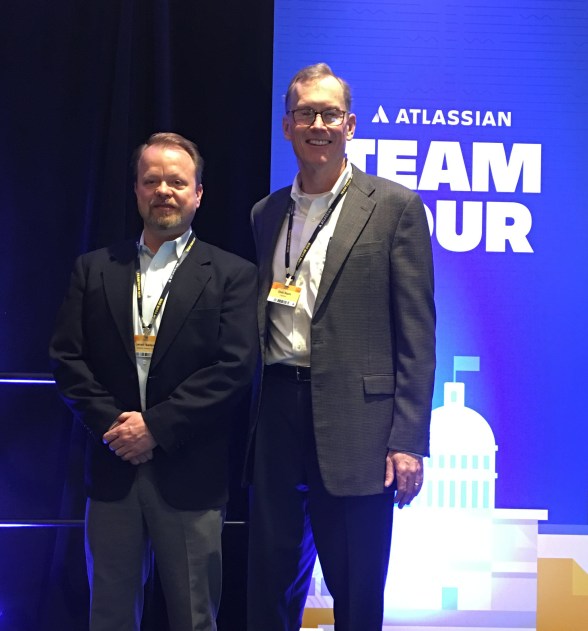
Dick and Lenair at Atlassian Team Tour

By Dick Stark

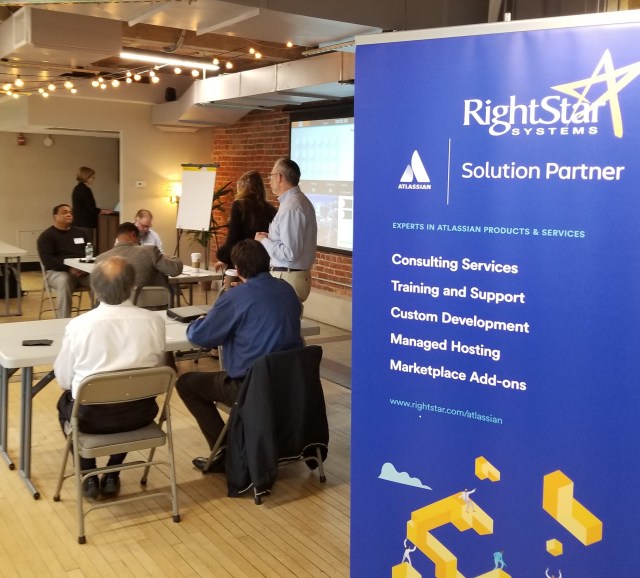
Last Monday, RightStar sponsored and exhibited at the Atlassian Federal Team Tour. This is one of a series of eleven worldwide stops to promote Atlassian products, services and customer networking. For a spring break Monday morning, Atlassian had an outstanding turnout with more than 325 attendees, almost triple from two years ago, and a strong statement that Atlassian is starting to take hold in Washington DC. Here is a short summary.

Atlassian opened by announcing that they now have more than 112,000 unique users worldwide with more than 5300 .gov domain user accounts. This explosion of Atlassian, both federal and commercial is a testament to the value of teams, sharing, communication, and getting things done. Product updates mentioned included:

Atlassian Home is critical for those that need to stay on top of what matters most. Lots of apps help users feel busy, but not productive. Atlassian Home provides a quick snapshot of the day, what to prioritize and how to do it.

Stride is Atlassian’s new HipChat replacement that has been out for six months in beta, but just released. Stride’s premise is that chat is more distracting than enabling. Stride includes, “beautiful messaging, coordination of action and notification volume with lots of bots to interact between other Atlassian and non-Atlassian apps such as incident management.” Best of all, Stride provides a multi-media real-time meeting capability.

The Atlassian Team Playbook is made up of tools and templates offered to customers for no charge and available on its website. It consists of a simple light weight monitoring system for key Atlassian metrics. Included is Health Monitor, a quick way to get a pulse on progress made over time. It uses an Objectives and Key results (OKR) Google framework for setting goals and tracking progress towards those goals. Right people plus the right products plus the right practices equals great teamwork.

Next up, a technology consulting firm made four points about using agile development:

  1. Use the tool, but don’t “throw it out into the wild.” Process is critical.
  2. The tool offers both a standardized approach, and the freedom to customize.
  3. Dashboarding can provide a lot of power, especially when onboarding new groups.
  4. Train with the tool so that everyone understands how to use the portfolio available.

Atlassian normally starts out with a small footprint in a company or agency and then grows organically until products such as Jira and Confluence, spring up in several places. The next step may be a consolidation or migration to the data center or cloud versions. This is an excellent opportunity for RightStar, a DevOps consultancy to begin with an assessment that shows the benefits of Jira across the entire organization along with a map of what needs to be done to achieve true business value.

Posted in Atlassian, DevOps, RightStar, Technology Trends, Uncategorized | Tagged , , , , , , | Leave a comment

Federal Data Center Modernization

By Dick Stark

Last week I talked to a large DOD customer where we have just started year two of our data center infrastructure management (DCIM) Nlyte contract. I’m happy to report we are making excellent progress and should soon have an Authority to Operate (ATO) the Nlyte DCIM solution What’s exciting is that Nlyte (and RightStar) offer a way for government agencies like this one to modernize their data centers and comply with the new Federal DCOI mandate.

DCOI, or Federal Data Center Optimization Initiative, requires government agencies to consolidate Federal data centers and increase interagency shared services such as the cloud. DCOI also requires that Agencies meet targets for energy metering, effective power use, virtualization, automated monitoring, and utilization of both servers and facility floor space. According to the mandate, “Agencies shall replace manual collections and reporting of systems, software, and hardware inventory housed within data centers with automated monitoring, inventory, and management tools, by the end of fiscal year 2020.”

Although DCOI is a mandate, the not-so-good news is that little progress has been made and as a result, the government extended the compliance deadline from 2018 to the end of fiscal year 2020. MeriTalk, a Federal think tank recently surveyed 150 data center decision makers and discovered that fewer than one fifth were on track to meet the original September 2018 goals.

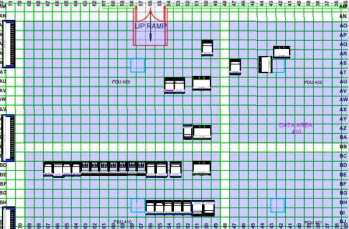
Typical Data Center Floor Plan with Nlyte:

typical data center floor plan

The really good news is that there are pockets of excellence and success at many agencies already, and we can guide others that are just starting. This contract will be a model for other agencies, especially the DOD which is just starting to modernize. Another reason to be optimistic about DCOI is the recently passed Modernizing Government Technology (MGT) Act which lays a foundation for IT modernization across the government. Even better, MGT, signed into law on December 12, creates working capital funds for IT projects at Federal Agencies. What’s interesting is that MGT is not designed to just spend money on IT modernization projects, but to find ways to accrue savings from these projects. A DCIM project, with more accurate and efficient automated monitoring tools, is a perfect solution.

According to the MeriTalk report, 73% of those surveyed say the drive to close, consolidate, and optimize data centers is a necessary precursor to the larger goal of IT modernization. Optimization is an important priority. While auto-discovery tools like BMC Discovery track an organization’s networked IT assets, Nlyte provides DCIM solutions for management of the data center’s physical assets and infrastructure. An Nlyte/Remedy integrated solution provides detailed data on the physical location of each asset in the data center and maps the relationships between these assets as it applies to applications, ownership, service support, cable connections and energy use. This is an exciting opportunity for Nlyte and RightStar to help government agencies meet the DCOI mandate and the larger goal of IT modernization.

Posted in Business Management, DevOps, RightStar, Uncategorized | Tagged , , , , , , , , | Leave a comment

Pink 18: How to Remain Relevant

pink-elephant-logo

By Dick Stark

The 22nd annual Pink Elephant Conference, held last week, February 18 to21 in Orlando, has traditionally been IT’s annual tribute and awards ceremony to all things ITIL. That’s changing, as there is a new Sheriff in town, DevOps. And Pink has coined a new word for this conjoined DevOps/ITIL new world: Integrated Service Management. Here are a few things I learned at this year’s show.

ITIL alone is not enough. So said Pink Elephant President, David Ratcliffe at the Pink 18 kick-off. David went on to say that ITIL is still the star of the show, but it needs a new supporting cast. He proudly announced that over three million people now have some type of ITIL certification, with Pink training at least 500,000 of them. Have over three million ITIL certified people made a difference? Does ITIL matter? Yes, especially translating knowledge into results. Delivering knowledge, like taking an ITIL class is only the first step.

It’s not like this message has come as a surprise. ITIL’s waning popularity has not happened overnight. First, not everyone embraces change. At RightStar we know from experience that a shiny new toolset, (and Pink certified to be sure) doesn’t always equal customer satisfaction, increased efficiency and lower overall costs. Sometimes the users don’t cooperate making adoption more difficult. Additionally, some customers go for a “huge” go-live of everything rather than taking an iterative phased approach (which doesn’t always have a happy ending). Finally, we’ve seen ITIL / ITSM projects take years, not months which has opened the ITSM door to DevOps and why Gartner asserts that “DevOps is the bimodal bridge to Mode 2.” (Meaning DevOps/Mode 2 is focused on agility, while ITIL / Mode 1 is focused on stability.)

Speaking about agility, DevOps is a discipline that is all about speed, faster time to market, real sense of urgency, IT modernization, and doing more with less. Culture, tools, vision, now must all be managed alongside different processes. A single best practice is not enough. What’s needed, according to David Ratcliffe, is Integrated Service Management.

How to remain relevant. Next up was Jeremy Gutsche, Pink’s Keynote Speaker. He is founder of trendhunter.com and author of the book, Better and Faster. His mission is to help people find better ideas faster and he regularly consults with F500 companies to help ensure that they remain innovative and relevant. Jeremy has an innovation process that looks at hidden strengths, and helps teams compare to the world’s best. A few good ideas include:

  • Everyone wants to get better, but not everyone puts in the effort. Would we work 24×7 to try to eat a competitor’s lunch?
  • How often do we experiment with new ideas? Is there a future for the BMC Innovation Suite? Has every Atlassian app already been invented?
  • What parts of our business do our customers actually care about? Consulting, implementation, training, support, software?
  • What can we combine with our offerings? DevOps simulation training? What sales plays are most effective?
  • Who ese can we partner with?

Answers to these questions and others will help RightStar shape and refine out 2018 strategy. One thing for sure: like ITIL, RightStar must also figure out how best to stay relevant.


Posted in Atlassian, Business Management, DevOps, Digital Engerprise Management (DEM, RightStar, Uncategorized | Tagged , , , , , , | Leave a comment

Would You Rather Play a Game or Listen to a DevOps Lecture?

DevOps Simulation Training Feb 2018By Dick Stark

What would you rather do, listen to a lecture on DevOps or play a game? The answer was obvious last week at RightStar’s half day DevOps simulation / gaming session in Washington, DC to a sold-out crowd of 25 attendees. This role based simulation is highly realistic and leverages game dynamics to provide a vision of successful DevOps practices and the resultant business value. It was clear that the attendees enjoyed the session, left with a greater understanding of how DevOps practices could benefit their organization, and most importantly, had fun.

Like in the book the Phoenix Project, the attendees are part of a fictional retail company that must rely heavily on IT and ecommerce for marketing and sales success. Also, during the session, and like the Phoenix Project, nearly every IT calamity possible befalls the company, which drastically impacts its on-line sales and causes the company to lose money. Time to put DevOps to work!

Round 1. The attendees are divided up into six groups: Service Desk, Business, Dev Team 1, DevTeam 2, Testing, and Operations. In addition to keeping the “lights running,” the teams must develop new applications and continue to improve existing ones. But after a few IT glitches, things quickly go from bad to worse. It’s total chaos: Ops’ “hair is on fire,” no new software is deployed or patched, customer sat is terrible, and Dev team 1 becomes a huge bottleneck. To make matters worse, sales slow and profits drop.

Round 2. Before diving into the second round the instructor and the students did a retrospective to look at what went wrong and figure out what to do next. It’s determined that better communication, (actually co-location of the two Dev teams), offers better work flow and utilization. The Test group actually starts testing software. The Service Desk pushes back on the Business group and asks for help to better prioritize the incidents. Ops looks at hiring a consultant to fix one of the breaks, and Dev builds a Kanban board to better prioritize and track work. By the end of the round, things have moved from total chaos to a more controlled chaos, with improving sales and profitability.

Round 3. Now things are starting to really improve. The Dev Team posts more information on the Kanban board, resources are shared and not siloed, and automated testing happens. Everyone works together to clear the backlog and software gets deployed. Ops starts implementing problem management (problem solving and study always trumps, “when in doubt, reboot). This reduces the number of incidents. The best news: all teams begin operating under a process framework which allows for continuous integration, or “shift left,” to ensure even more rapid and accurate product development success. Naturally, sales improve and profits rise.

Time flies and suddenly the morning session is over. Getting Dev and Ops under the same roof reinforces shared goals, improves communication and can dramatically reduce the time to get help or needed information.

The end result is a reduction in time to value, especially as lead times shrink and quality improves. What would you rather do? Learning by doing made a big difference with the fictional retail company and it can make a big difference in your organization too.

Posted in Atlassian, DevOps, Digital Engerprise Management (DEM, RightStar, Technology Trends, Uncategorized | Tagged , , , , , , , | Leave a comment

RightStar’s DevOps 101 eClass Summary

Atlassian Continuous Loop2.pngBy Dick Stark

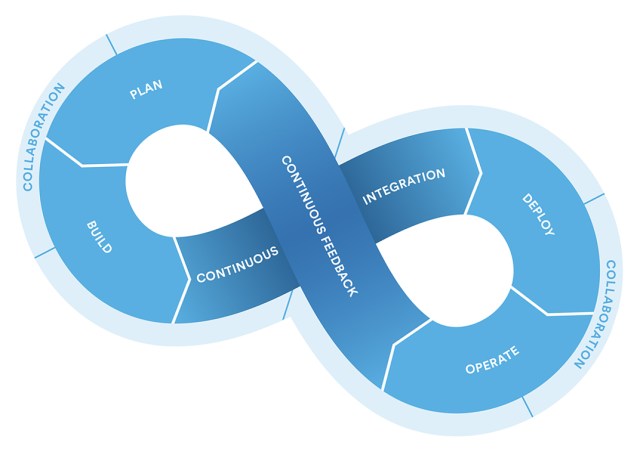
Last week RightStar presented an online eClass: DevOps 101, to an on-line audience. We covered the fundamental principles and best practices of DevOps and reviewed how organizations can benefit by utilizing these concepts within their own organizations. It was an excellent overview that concluded with a discussion of how the Atlassian toolset can get most of the way to DevOps. Here are some of the highlights.

Every industry is now software first. We reviewed the importance of software development in organizations like Starbucks, P&G, and General Motors (GM). Given that a car is really just a computer on wheels, auto manufacturers now have more software developers than large software companies. (And yes, GM is an Atlassian and RightStar customer.)

The way software teams work has changed. Competition means that software is now released on average every six weeks versus once a year, and companies like Netflix and Amazon make hundreds of releases daily. Agile development has skyrocketed and roles on a development team have come together to prioritize, scope, and support one another. According to an Atlassian survey, 77% of teams report using Agile methodologies and 78% have moved to a distributed version control system like Git. What’s next after Agile?

DevOps is a culture where dev and ops collaborate to build a faster, more reliable release pipeline. We quoted Werner Vogels, Amazon CTO: “You build it, you run it.” In a traditional scenario dev teams engineer a solution and then hand it over to ops to deal with production issues. A DevOps approach requires both dev and ops teams to come together to “run what they build,” means that work is a shared responsibility with greater transparency and accountability.

What is the best way to get started? We discussed a small software development company that RightStar just started working with. The organization develops websites for non-profits and faces challenges including more accurate time tracking, visibility into the current workload, capacity planning, standardization, consistent use of tools, and productivity.

So, RightStar proposed an assessment as the first step and we spent several days onsite better understanding their challenges and requirements. RightStar then delivered a report detailing their current environment, along with culture, process, and tool recommendations. We’re hopeful that the customer will continue using RightStar first for a week of Agile coaching, and then later, RightStar’s remote administration offering to help fine tune their Atlassian tools.

Another excellent way to gain a “live” understanding of DevOps is through simulation training. RightStar offers a half day DevOps simulation session that demonstrates the business value and positive impact of a DevOps approach. This role base simulation is highly realistic and leverages game dynamics to provide a vision of successful DevOps practices. RightStar has three sessions scheduled in the next 45 days. The first one is full and we’re optimistic that we will fill all the others.

I’m excited about the DevOps consulting progress RightStar is making already in 2018 and expect even more sales of advisory services, process improvements, and toolset implementations.


Posted in Atlassian, DevOps, Uncategorized | Tagged , , , , | Leave a comment

Remedy, Discovery, BCM, and ScanStar: A Winning Combination

ScanStarNew

By Dick Stark

Earlier this month, we submitted a proposal in response to a hardware/software asset management RFP. Of course, with a large opportunity like this, anything is possible, but I feel that we worked hard to deliver an excellent proposal and demo, putting RightStar in a good position to meet the prospect’s needs and win the business. Why? Because the unique combination of Remedy, Discovery, BCM, and ScanStar are tightly integrated to provide a total asset management life cycle solution.

Most large organizations have large, complex, and dynamic environments. To be successful with critical IT initiatives such as IT modernization, secuity, and clould migration, it is essential to have a single comprehensive picture of how the IT infrastructure supports business services. (I suspect that most organizations may not quite be there yet and this gap could negatively impacts other support and operations processes and may ultimately prevent IT from living up to its full potential.)

When done right, configuration management and application mapping improves staff productivity and heightens the quality of services. Cost reduction is achieved by reducing MTTR (Mean Time To Recovery), maintaining license compliance, and reallocating assets and discovering unused licenses.

For this prospect, RightStar proposed Remedy Asset Management integrated with BMC Discovery, BMC Client Management, BMC Atrium CMDB, BMC Atrium Integrator, Remedy Knowledge Management, BMC Remedy Smart Reporting, and RightStar’s ScanStar barcode scanning.

BMC Discovery (formerly ADDM) creates a dynamic, holistic view of all data center assets (hardware, VMs, and applications) and the relationships between them, giving crucial visibility into how the assets support the business. Each scan delves into the information and dependencies for all software, hardware, network, storage, and versions, providing the context needed to create an application map from any piece of information about it. A lightweight footprint allows organizations to map applications with up to 100% accuracy in as little as 15 minutes or less.

BMC Discovery offers seamless integration into BMC Atrium CMDB and Asset Management module, with out-of-the box, continuous data synchronization. The integration can be configured so filters and rules are applied to the data prior to the load. In addition, BMC Discovery offers web services and database integrations that can be used to synchronize the data with other CMDB technologies.

An important componet of asset management is the ability to manually and efficiently take inventory, and reconcile to a “single source of truth.” RightStar’s ScanStar barcoding add-on allows inventory to be scanned and reconciled which helps identify missing and moved assets. And at some customers we take data from BMC Discovery, SCCM, and physical inventory (via barcode scanning) to make one composite record from multiple sources.


Posted in BMC, Digital Engerprise Management (DEM, RightStar, ScanStar, Uncategorized | Tagged , , , , , , , | Leave a comment

When?

When

By Dick Stark

Daniel Pink just released a new book last week, When, the Scientific Secrets of Perfect Timing.  I’ve been a Daniel Pink fan since his book Drive, and applied his motivation principals of Autonomy, Mastery, and Purpose at RightStar.  We celebrate all of these things in our Weekly Star employee newsletter, and company all-hands meetings. So, I was very excited about the release of this new book, about timing. We all know that “timing is everything,” but few of us know very little about what to do about timing. Let me share several takeaways with you.

When to go first or last. RightStar submitted a bid to a public-sector organization in October and were notified in December that we made the short list.  The next step was an onsite 90-minute demo/presentation. After that, the prospect would make an award. RightStar was selected to present last.

All sales reps are taught to ask to go last, thinking that it’s better to leave a lasting impression with the audience. Is that the right call?  According to Daniel Pink, “it depends.” Pink states that, “if there are few competitors (say five or fewer), going first can help you take advantage of the “primacy effect,” the tendency people have to remember the first thing in a series better that those that come later.”

However, Pink explained, “if you are the default choice, don’t go first as judges are more likely to stick with the default late in the day after a break, when they are revived.” Did going last help us in this situation? No, after three prior 90 minute presentations the judges were exhausted and it was clear all they wanted to do was go home. We did not influence this bid and it is likely that the default choice won. Next time, we’ll ask if we can go first.

When to do our best work. Pink categorized people into three groups: Larks ((early birds), Third Birds (65% of us) and Owls (late nighters). We all have our own internal clocks, and there is a simple way to determine how it is set. When do we do our best work? See below:

  Lark Third Bird Owl
Analytic tasks Early Morning Early to mid-morning Late afternoon and evening
Insight tasks Late afternoon/early evening Late afternoon/early evening Morning
Making an impression Morning Morning Morning (sorry owls)
Making a decision Early morning Early to midmorning Late afternoon and evening

For example, a third bird sales rep should prospect (call or email) during the morning to make the best impression. In general, morning is also the best time to connect. An owl consultant should shift her less essential tasks to the morning and begin her most important tasks in the late afternoon and into the evening. If we are involved in a strategy session or workshop, go for morning since most of the attendees are likely to be third birds, and workshops call for analysis and decision making.

Of course, it is not always realistic to move your schedule around, especially if your schedule is out of your control, but if you are aware of the optimal type of work assignment, you may be able to optimize your performance. If you are a lark or a third bird, don’t waste an hour in the morning on email. Spend that time doing your most important work.

Posted in Business Management, Uncategorized | Tagged , , | Leave a comment

Always Be Leading

Silhouette person jumping over 2015 on the hill at sunset

By Dick Stark

On January 19, RightStar will officially kick off 2018 with an All-Hands Webinar. RightStar’s tagline for 2018? Always Be Leading. We will discuss leading from the inside and how everyone can help drive RightStar’s next stage growth. We will also summarize 2017 and discuss our plans and strategy for 2018. The following is an excerpt from my weekly email to all RightStar employees.

Whether we realize it or not, every one of us interacts in some form or fashion with customers, prospects, or partners. This puts us all in a leadership position on a regular basis. In case you don’t think of yourself as a leader, let me review several examples.

Thought Leaders. RightStar sales and consulting teams have an opportunity to get badged or certified in a specific area of expertise: Atlassian, BMC, DevOps, or ITIL. This is strongly encouraged and attainable through self-study, web-based or on-line instructor training, followed by a certification exam. Once certified, it is very likely that you will know as much if not more than 90% of the customers or prospects that you work with. Having this badge or certification gives us the confidence to say that we really are our “customers’ expert advisors, and we always have their very best in mind.” Value creation and solving problems trumps just reselling software any day.

Continuous Improvement Leaders. Great leaders are not born, they continually get better. Want to feel more confident about talking to CIO’s? Read Mark Schwartz’s, A Seat at the Table. Can’t really talk intelligently about DevOps? Read Gene Kim’s, The Phoenix Project, or, The DevOps Handbook. In 2018, let’s start a bi-monthly webex based book club brown bag lunch. RightStar will pay for the cost of the book. All that’s required is your participation. Will reading, discussing and applying several books a year help you become a better leader? Yes! No doubt about it.

Accountable Leaders. We all must be accountable for our actions, no matter what. If we promise a customer a deliverable or proposal by a certain date, we must deliver. From experience we know that our customers do not want to hear any excuses. They don’t care if the dog ate our homework. They only want the job completed. By holding yourself accountable, even when making an excuse is an option, it sends a strong message that we care more about results (and the customer) than anything else.

Tough Leaders. Every one of us possesses some level of what Angela Duckworth, author of Grit, calls grit—mental strength, which is a unique combination of passion, tenacity, and stamina, that enables us to stick with our goals until they become a reality.

If you’re in sales you must make calls you don’t want to make. If you’re a consultant, you may have to scrap a project and start over. The week before Christmas, one of our consultants worked 30 hours straight trying to move Remedy into the Azure Cloud. Despite all those hours, she had to roll back, not exactly the outcome she was expecting, but will try again next weekend. Tough leaders don’t stress about failures. They see failure as a necessary step in the process of reaching their goals.

What kind of leader are you? How can you get better and what can RightStar do to help? The good news is that any of us can improve with a little extra effort and focus. Here’s to 2018: Always Be Leading!

Posted in Business Management, RightStar, Uncategorized | Tagged , , , , | Leave a comment

This Year’s High-Tech Prayer Breakfast

Bob and Dick at HTPB 2017

By Dick Stark

RightStar bought a full table at the High-Tech Prayer Breakfast held this past Wednesday at the Ritz Carlton in Tysons Corner. This is an amazing annual event with more than 800 attendees. The speakers this year were Pat Gelsinger, CEO of VMware and Ken Harvey, former NFL linebacker. Here’s a brief report:

Ken Harvey kicked things off with a summary of his life—how he saved enough money to allow him to attend a community college in Oakland, CA, and then accepting a full scholarship to Cal Berkeley two years later, which resulted in a first round (twelfth overall) draft pick in 1988, playing for the Phoenix Cardinals and the Washington Redskins from 1988 to 1999. Ken credits his success to prayer. He stated that he asked God for a plan and a vision. He said that to him it felt like God was saying, “You have a purpose, you are worth something.” Ken said that he was blessed with “God given athleticism and earned his way into the NFL by working hard. Of course, he also credited his college girlfriend (now wife) for this transformation.

Pat Gelsinger, CEO of VMware, the 5th largest software company of the world said that he is the senior pastor to more than 22,000 congregants (employees) every day. Like Ken, he came from humble beginnings, a farm in Pennsylvania, where a good score on an exam landed him a job at Intel and acceptance to Stanford. This “Cinderella” career at Intel lasted 30 years and earned him the number two spot there as its first CTO. After Intel he moved to EMC as President/COO for several years before ending up as the CEO at VMware.

Pat said that as a business leader, the most important thing he does is, “establish and live the values of the organization.” He calls VMware an EPIC company: Execution, Passion, Integrity, and Customers. The end result of this set of values? Epic people and customers.

Pat told a story about a quota club sales event he held in Hawaii. On one day the entire sales team refurbished a local Boys/Girls club as a community project. At the end of the trip, one of the cab drivers refused to accept any fare, saying, “most of the visitors come to Hawaii to take, you all came to give.”

Pat reported that as a Christian in 1980 he moved from “lukewarm” to “hot” for God. He said that was the most important decision that he every made and should be the most important decision for anyone. Pat pointed out that Christian CEOs in Silicon Valley are a rare breed, and said that he and his wife are “out there.” Although Silicon Valley has the highest wages in the nation, it is also the least “churched,” and has a very low charitable contribution rate. Pat happily pointed out that he embarrasses his CEO friends by giving away 50% of his earnings.

Pat closed with good advice for all:

  • Build a mission statement for the rest of your live.
  • Prioritize. God, family, work not work, family, God. How do you build this type of life? By building a life that mirrors your priorities.
  • Mentors. Pat’s mentor, was Intel’s icon CEO, Andy Grove. “Having Andy as a mentor, was like going to the dentist and not getting Novocain.”

Pat summed things up this way: “As a leader, everything we do is on display every day. I will lift up my organization. I must be encouraged, so I may bring encouragement. Let your workplace be the place that you honor God every day.”


Posted in RightStar, Uncategorized | Tagged , , , | Leave a comment

Agile Project Management at RightStar

By Dick Stark
I’m mostly finished with Mark Schwartz’s just published book, “A Seat at the Table,” and like the 2016 book, the DevOps Handbook, I’ll dedicate several blog posts to this excellent book. “A Seat at the Table,” is definitely worth a read. Mark Schwartz, by the way is the one that is credited to helping bring Agile into the Federal Government when he was the CIO at USCIS.

A seat at the table

What exactly is Agile project delivery? Well, like the US Supreme Court definition of obscenity as “we’ll know it when we see it,” Agile paradoxically, is, “we’ll get there when we get there.” This is not to imply that Agile has no sense of urgency. On the contrary, Agile, according to Mark Schwartz is, “we should inspect and adapt frequently, rather than slavishly following a plan.” This is opposed to the way that the rest of the world typically delivers projects.

RightStar follows a process for new business development that begins by working with prospects that have pains, like poorly defined code version control, release management, and testing processes. We propose a solution consisting of software such as Jira, Bitbucket, and Bamboo, combined with RightStar consulting services. Then we deliver a price quotation along with a statement of work, either fixed price, or T&M, with identified deliverables. We follow the project in a waterfall approach, as detailed in our project plan or work break-down structure. If changes crop up, we either ask for a change order or work the change for “free” because the customer often indignantly states, “how could you have not known our real requirements.” We normally prefer T&M contracts to try to avoid this scenario. When working a FFP project, we typically include a FFP premium to cover any contingencies that might arise along the way.

The challenge with Agile projects is the customer’s contract process. A prospect doesn’t normally give us a contract to provide a “we’ll know it when we get there,” contract. Instead we have a contract with fixed requirements and deliverables. This is often not ideal, because neither the customer nor RightStar have a very good idea about what the customer’s real needs are until we begin the project.

In contrast, we deliver our Atlassian projects on an Agile basis. The process begins by understanding that the limiting factors are time and cost. Scope is variable factor. The key is to ensure that we have quoted sufficient hours to the customer so we can implement most if not all of their business requirements in the allotted time.

When we start an Agile project, we begin by making sure that the customer understands that we will focus on the highest priority business needs at each point of the project and that the lower priority items may not get implemented within the authorized budget.

Regarding customer satisfaction, an Agile approach that emphasizes fast implementation through incremental scope lets the customer clearly see the progress of their project. In a waterfall approach, the customer specifies all of their requirements and then we go off and implement, according to the specification. Occasionally, we will discover during go-live, that we didn’t build the system they had expected. Our experience is that most customers don’t fully understand the Atlassian tools until they actual start to use them. Asking them to accurately define their requirements at the outset is an exercise in frustration. An Agile approach therefore allows for iterative and continual customer satisfaction. No surprises ever!

Posted in Atlassian, DevOps, Uncategorized | Tagged , , , , , , , | Leave a comment