
RightStar’s Social Network Map

By Dick Stark

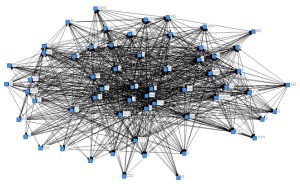
Who is RightStar, anyway? The below Social Network Map tells the story.  Thanks to the survey we all completed for the American University study conducted several months ago, RightStar is on the map, at least the social map, and the outcome is very positive.
RightStar Social Network Map

The squares indicate employees (approximately 60), and the solid lines indicate lines of communication.  The gist of the study was to determine if highly ethical companies like RightStar have healthy communication and transparency (lots of solid lines), which is what is expected for an Ethics Award winner. Despite the large number of employees that work autonomously out of their homes (“lone ranger” types), the lines of communication through email, chatter, boxnet, and telephone, indicate that most of us are well connected with each other.

The Social Network, and especially social media is becoming a very big deal. On Thursday, I attended a webinar sponsored by LinkedIn.  One of the guest speakers was Clay Skirky, associate professor at NYU and Social Media expert.  He told a story about DARPA’s red weather balloon project. In 2009, DAPRP sponsored a competition to locate ten red balloons placed around the United States and then report their findings. A cash prize was to be awarded to the team that discovered all ten locations in the least amount of time.  DARPA anticipated that solving the contest would take up to a week.  Instead, the winning team from MIT took less than nine hours to locate all ten balloons. MIT took advantage of multi-level marketing, and social media sites, to gather information or to recruit people that would look for balloons.

Another webinar speaker was Research Analyst Kim Celestre, from Forrester.  She reiterated how important social media is to the IT buying process.  According to Kim, buyers spend 70% of the decision making process gathering information before even talking to a buyer. Today’s buying funnel is complicated and social media plays a significant role.

Speakers from LinkedIn concluded by discussing why LinkedIn is the preferred choice for IT decision makers. LinkedIn provides a broad network of peers, experts, and opportunities to learn from experts. An impressive statistic: in the two months since LinkedIn released its new “endorsement” feature, more than 400 million endorsements have flown across the internet.
Posted in Business Management, RightStar, Technology Trends | Tagged , | Leave a comment

Actionable Analytics and xMatters

By Dick Stark

xMatters, formerly AlarmPoint offers alarm/communication management through a relevance engine to capture and provide alerts to what really matters to an organization– whether in supply chain, IT management, or  business continuity.  RightStar has several new xMatters prospects and we are very excited about our new partnership to resell and implement the xMatters product line.

One of Gartner’s Top 10 Technology Trends for 2013 is Actionable Analytics, and xMatters’ relevance engine enables enterprise users to make faster, more informed decisions.  xMatters filters and manages thousands of static and dynamic factors to deliver information on a broad scale to bring in people efficiently and rapidly when they are needed.  What is xMatters’ value proposition and how does it apply to RightStar and our customers?

A good place to start is Department of Justice, where RightStar has been on-site for more than a year working with the BMC BPPM product line for enterprise and application monitoring. There we are implementing xMatters for high impact and severity infrastructure events that are detected by the DOJ operations team. We have set rules to take key events and automatically publish them into xMatters to engage the right teams. By integrating xMatters directly into their BMC event management setup, DOJ can have technical resources engaged even before an incident is raised. When fully implemented, DOJ hopes to minimize the duration and impact of outages.

Another key xMatters focus area is the IT service desk. Often times, tickets are distributed in a queue fashion with emails sent to everyone and tickets “up for grab.” xMatters can route tickets to one person at a time, based on rotating on-call schedules, and reach out to other people, only if they don’t respond. The result is increased responsiveness from assigning a ticket to confirmation of ownership.

xMatters also provides an automated conference bridging capability. Service desks often elevate a priority 1 outage (Major Incident Management) to Level 2 or 3 technicians that may require specific subject matter expertise. A normal response is to set up a conference bridge with all the right participants.  This is often a time consuming process and it may be 30 minutes or more before the right people are identified and dialed-in. Automated conference bridging reduces this assembly time to less than five minutes.

Business Continuity Planning is yet another key application area for xMatters.  By shrinking the time to notify everyone of a pending event from hours to minutes, the xMatters relevance engine can improve the safety and security of employees and their companies. The granularity of the product allows relevant information to be distributed by individual and department, (e.g., Facilities, HR, Security, or Corporate Communications), depending on the type of activity.

xMatters works because their relevance engine offers a non-generic highly tuned business process approach to Actionable Analytics as well as Enterprise Risk Management, Disaster Recovery and BCP planning.

Posted in Business Management, RightStar | Leave a comment

The Demise of Legacy Software Companies

By Dick Stark

Thanks to the boom in SaaS computing, Venture Capitalist Jim Goetz of Sequoia recently discussed the coming demise of legacy software companies.  “The business model, thanks to Salesforce’s Marc Benioff, is now a weapon for all of you,” he said, referring to cloud software and subscription billing. “In enterprise, there are fewer competitors and they are large, slow and flatfooted,” Goetz said.  Not coincidently, recent Sequoia IPO hits include SaaS Vendors: Palo Alto Networks, Jive, Splunk, and ServiceNow.

By taking every opportunity to compare BMC to Siebel, ServiceNow continues to “make hay” at BMC’s expense.  Ten years ago Siebel was the CRM market leader.  Salesforce emerged with a strong cloud competitive offering, Oracle acquired Siebel, Salesforce became the market leader, and Siebel disappeared. Could history repeat itself?  ServiceNow thinks so, but there are significant differences between BMC and ServiceNow that should prevent that:

(1)        Remedyforce.  BMC this week reported that Remedyforce is the fastest growing SaaS service desk offering ever with more than 350 customers. With the coming Winter release (Nov/Dec timeframe), Remedyforce is positioned to overtake ServiceNow in terms of base functionality.  Combine that with the thousands of applications that are available on the Salesforce App Exchange, and Remedyforce offers not just a service management application, but a platform offering organizations the ability to connect sales, customer service and product development across salesforce.com’s mobile and social business applications.  Every argument that ServiceNow makes against BMC (and Remedy) just doesn’t apply as Remedyforce is newer, more functional, flexible, open, and easier to install and maintain than ServiceNow.  Indeed, BMC recently reinforced the importance of Remedyforce within BMC by creating a separate Remedyforce division and agreeing to continue pouring millions into R&D development efforts.

(2)        Remedy Version 8. For organizations, where a SaaS solution is not the right fit, then Remedy Version 8 offers significant improvements from the prior version, the most significant being the overlays that allow for future upgrades to be completed in just days instead of months. Even initial implementation times should be an advantage for Remedy 8, as there are programs like Abydos work flow designer (now included) and standard ITIL based templates that bring a customer live within a very short window and without heavy customization.

Another advantage that can’t be overlooked is the passion for Remedy that continues to exist in the marketplace.  The WWRUG in an independent Remedy user group not sponsored by BMC that just celebrated its 21st anniversary.  While this sounds like a big number, it’s clear that the knowledge sharing and enthusiasm for Remedy will continue for years to come.

In summary, BMC offers the most complete and scalable ITSM solution, in an on-premise or SaaS based solution, for small organizations to large enterprises. BMC will continue to be the market-share leader for the near future, and with Remedyforce offers a non-legacy solution for those looking to get away from on-premise legacy software and move into the cloud.

Posted in BMC, Remedy, RemedyForce | Tagged , , , , | Leave a comment

Service Catalog: the Cornerstone of IT

By Dick Stark

On Wednesday more than 100 people attended RightStar’s “What’s New in BMC Remedy ITSM 8.0,” webinar led by Solutions Consultant, Roger East.  Just like the BMC service request module is now the cornerstone of Remedy 8.0, so should a service catalog be the cornerstone or center of the IT universe.

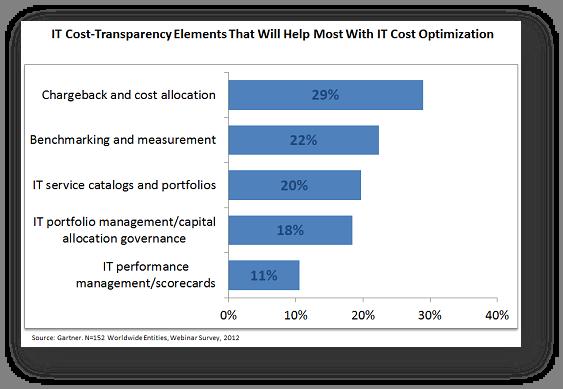
When I polled the audience, however I discovered that only 11 percent had implemented a service catalog, with only 20 percent planning to implement. This is a missed opportunity as service catalogs ranked third on Gartner’s list of elements that help most with IT cost optimization (see below). Service catalogs, which are sometimes referred to as self-service portals, or storefronts, have become mission critical to the entire organization. Properly deployed, a service catalog is the new “face of IT” within the organization providing actionable service offerings normally delivered quickly and efficiently to the requestor.

RightStar offers service catalog consulting and implementation services through BMC’s Remedy, Remedyforce, and FootPrints product offerings.  With Remedy’s Service Request Management (SRM), RightStar recommends designing a service catalog based upon what matters most to the organization and move onward from there.  For example, at US Customs and Immigration Service, RightStar implemented a Service Catalog for hardware, software, and cell phone requests across the USCIS organization.

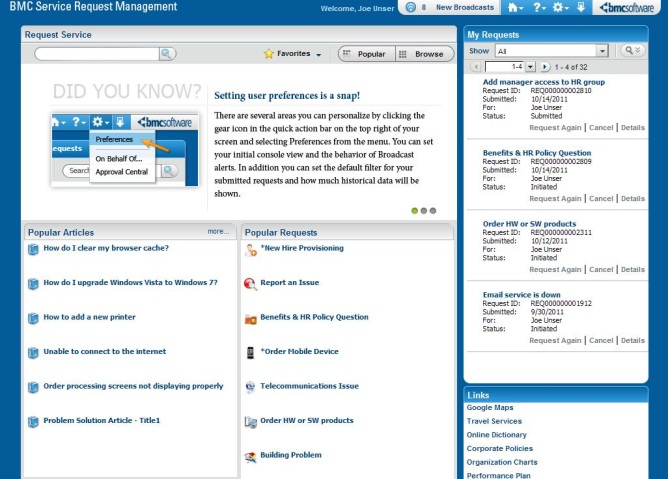
SRM 8.0 allows a customer to login and create actionable service requests from a customizable menu as shown below.

IT’s goal should be to make provisioning a laptop or cellphone as easy as ordering a book from Amazon. It is the service catalog that:

  • Defines and communicates standardized offerings.
  • Provides an easy-to-use interface to enable self-service for business users or developers.
  • Facilitates automated provisioning and tracks the lifecycle of the service.

In summary, service catalogs bring true automation and efficiency and provide IT organizations with improved customer satisfaction and cost savings.

Posted in BMC, Remedy | Tagged , , , , | Leave a comment

BSM’s Value Proposition

By Dick Stark

RightStar’s mission is to be our client’s expert advisor in the Business Service Management (BSM) space.  Additionally, it’s to return value back to our clients in terms of the investment they make in BSM products and services.  How do we do this and what is the best way to make this happen?

When I hosted a webinar with Northwestern University a few weeks back, their IT Director informed me that the ROI that he received after purchasing BMC End-User Experience Management (EUEM) was the highest of any product they have ever purchased. I asked for specific numbers, but he didn’t have any.  He just knew based upon his years of experience, that EUEM was a real winner.  Northwestern is like many other organizations that may analyze ROI’s as part of the procurement process, but then do not follow up after the purchase is made to determine the real ROI

Because IT budgets are so tight, it is often only those projects with a well-documented ROI and hard dollar savings that get approved. Here is my list of potential budget saving BSM projects:

  • Virtualization Management. We recently rolled out BMC’s BladeLogic Server Automation (BBSA) at the Commonwealth of Pennsylvania. The reason for this investmet was to automate server compliancy reporting and management that currently requires several full time systems analysts.
  • Asset Management. At our Lockheed/844th project we have improved asset management effectiveness from 60 to 85%. By comparing the IT assets required with what is actually on-hand, the Air Force was able to identify surplus software and hardware and realized significant cost savings.
  • SaaS based service desk.  In addition to the saving from any process improvement, SaaS based service desks, like Remedyforce offer an immediate savings as illustrated below:
Old   Way Year   1 Cost New   Way Year   1 Cost
Buy 1 Server   w/ Software $10,000 Software as a Service $0
Admin /Operating   Personnel (50%) $40,000 Admin/Operating Personnel (25%) $20,000
BMC SDE 10   Users $30,000 BMC Remedyforce 10 Users $10,500
SQL License $2,000    
SDE   Implementation $20,000 Remedyforce Implementation $8,000
Total Cost $102,000 Total Cost $38,500

The comparison is between the first year cost of a new SDE or FootPrints on-Premise system versus Remedyforce.  Of course, the on-premise cost will go down in subsequent years, but the initial savings is significant. Even the cost of upgrading SDE to Remedyforce is approximately equivalent to the annual maintenance charges:

Existing   SDE Account Year   1 Cost New   Way Year   1 Cost
Admin /Operating   Personnel (40%) $32,000 Admin/Operating Personnel (25%) $20,000
BMC SDE Annual   Maintenance $5,250 BMC Remedyforce 10 Users $10,500
Server   Depreciation, Maintenance $2,000 Remedyforce Implementation $8,000
Total Cost $39,250 Total Cost $38,500

The savings are even more significant when considering the reduction in annual admin support and upgrade costs.

Nearly every BMC product offers a significant ROI, but four in particular offer very rapid returns: EUEM, Virtualization Management, Asset Management, and Remedyforce. Of the four, the hard dollar savings from a new or upgraded Remedyforce installation are substantial.

Posted in BMC, Business Management, RemedyForce | Tagged , , , , , , , | Leave a comment

RightStar Ethics Award: 1 Year Later

By Dick Stark

RightStar applied for the National Capital Business Ethics Award (NCBEA) more than two years ago.  This is an annual award presented by the National Capital Chapter of the Society of Financial Service Professionals. The winners are companies that demonstrate strong ethic programs and practice, along with community and civic involvement.

Without debating too much about this, I attended an introductory session and took the plunge.  At the time, RightStar, an IT Consultancy and BMC Solution Provider, was five years old with about 40 employees. My thinking about formal ethics programs at the time was: set a good example at the top, and good things will happen.  This means that ethics at RightStar consisted of “tricking down” my strong Christian upbringing and honest nature throughout the company. The problem with this kind of approach is that it doesn’t scale as the company grows and there is very little written down to go by.

The first step was to put together a formal Ethics policy and distribute it to RightStar for all to read and understand.  An ethics policy was created, modified to meet our needs, and distributed to all employees.  Since almost no one reads formal boring policy manuals, I followed up the ethics manual distribution with article in our Weekly Employee Newsletter, The Weekly Star with several real-life ethical situations in our space, about Value Added Resellers.  This became a one page “code of conduct,” that is fun to read and understand. Thanks to the power of habit, I’ve ensured that we redistribute our Code of Conduct every July, followed up by another relevant Weekly Star article.

When it came to employees, partners, and customers, RightStar already had a firm ethical foundation, so putting a formal Ethics program together was really the fun part. We surveyed our employees and customers, added a Volunteer Time Off policy to our list of benefits, created an annual company wide-volunteer day—all big company activities. We completed everything well before the Ethics application due date, and finished the formal application interview process some months later.

We didn’t win that first year, but were one of the four finalists. With some encouragement, we set off to try again since it seemed like the right thing to do.

My first step the second time around was to meet with Kathy Albarado, CEO of Helios HR, a previous Ethics winner.  Kathy gave me some good ideas about employee recognition programs, and corporate responsibility.  She has an amazing ability to garner full participation from her employees. Whether it is their annual coat drive, food drives, and walks for the homeless, Kathy’s enthusiasm was contagious.

Armed with more information and better ideas, along with another year of experience under our belt, we submitted the award for the second time.  Carefully reporting how RightStar responded to several ethical challenges related to new business opportunities (we did the right thing), helped bolster our application for round two.

It paid off as we received the 2011 award a year ago last October, small company category. Ethics, honesty, integrity, and doing what is right have become the foundation of RightStar and our success.  Customers want to do business with other ethical companies and several times in the last year, we submitted our ethics policy along with a proposal for a new business opportunity.  Having a strong ethics program already in place made this a cinch.  Additionally, employees want to work for ethical companies that they can trust to do the right thing.   We now see ethics as a business driver that adds value to our customers, employees, partners, and to our bottom line.

Posted in Business Management, RightStar | Tagged , , | Leave a comment

BMC’s ITSM Launch Event

By Dick Stark

Are you ready for a revolution? This is an opportunity for solutions that will revitalize the ITSM space, help IT be more relevant, and get people excited again about what’s possible.

So proclaimed Paul Avenant, President of BMC’s ESM group in its ITSM Launch Event held last Thursday in Houston and broadcast worldwide. BMC announced new releases of all its ITSM offerings simultaneously—Remedy, Remedy-on-Demand, FootPrints, Remedyforce and Track-IT. So, was this a big deal?  Yes, BMC, unlike HP and CA is fighting back aggressively against ServiceNow, which is taking ITSM market share. This was a very good showing:

First, Remedy version 8 is available now and is a real winner.  BMC’s beta testing program this time included more than 200 customers which guaranteed to eradicate most of the bugs before general availability, an important lesson from version 7.604. Other features included:

  • Totally revamped SRM with links, submitted requests, and popular knowledge all on the same page.
  • New data management tool to simplify on-boarding and data synchronization.
  • Enhanced best picture view with fewer fields on the screen.
  • Chat and other social media support.
  • Hub and Spoke model which allows those organizations with several disparate Remedy (or other ITSM systems) to have a central Hub to collect and assign tickets.
  • Significant improvements in asset management resulting in a 40% CMDB performance improvement.
  • Simpler. Version 8 offers a simpler and faster user interface for mobility.  Additionally all documentation is available in PDF (no more hard copies) in a searchable Wiki format.

Next, BMC has just released version 11.5 of FootPrints, BMC’s mid-market service management offering.  New features include:

  • An improved user interface that significantly improves the user experience.
  • Artificial intelligence support to auto suggest solutions for more rapid ticket close-out.
  • Improved service catalog descriptions and costing.
  • Twitter and FaceBook social media support. For example, if the email server is down a Twitter feed can automatically alert the service desk.
  • Better integration with AssetCore and more intelligent deployment and patch management.

Finally, Matt Dircks, Vice President, R&D, Mid-Market Solutions, announced that Remedyforce, BMC’s cloud based offering, with more than 300 customers is the fastest growing ITSM product ever. (RightStar has already implemented 71 Remedyforce accounts, about 25% of the overall total.) New features of the just released Remedyforce Summer12 version include:

  • A new Release Management module and Pink ITIL certification for 9 other modules.
  • Improved ability to configure SRM and Self-service.
  • More than 50 new customer requested enhancements.

BMC closed the session by highlighting its 20 years of service management experience across all platforms. Paul Avenant concluded by stating that BMC is, “currently the #1 provider of choice in all ITSM markets. Real power is real choice and no one offers more ITSM options than BMC.”

Posted in BMC, Business Management, ITSM, Remedy, RemedyForce | Tagged , , , , , , | Leave a comment

End-User Experience Management

By Dick Stark

You’re making a purchase over the web and experience a significant delay…

Should you stick it out or go to a competitor’s website?

That is the question that BMC’s End User Experience Management (EUEM) guarantees that your customers won’t have to ask.

On Wednesday, RightStar hosted a webinar with BMC and Northwestern University.  The topic: EUEM, an application performance management offering from BMC. When I asked Dana Nielson, Director, Monitoring and Management Systems, Northwestern, to describe the value EUEM provided, he stated that no other solution that he has purchased has ever seen such a rapid return on investment as EUEM.

This was refreshing news as RightStar is accustomed to working with service management customers that tend to view their service desks as cost centers, and ITIL consulting and service management tool implementations as unavoidable evils. (In reality, a well-managed service desk with fine-tuned processes can offer considerable value over a less mature service desk with outdated toolsets and processes.) What caused Northwestern University to rate EUEM so highly?  Dana explained that the need for improved performance was the main factor driving EUEM adoption.

  • Like most large academic institutions, Northwestern’s IT Department supports many university wide web based applications on servers hosted in university datacenters. Indeed, Northwestern has three primary mission critical applications: HRIS, Student billing and enrollment, and Course Management (Blackboard). These applications require 99% uptime, especially during peak periods such as student enrollment.
  • Blackboard has quickly evolved into a more mission critical application.  Students and professors rely on Blackboard for scheduling homework assignments, and paper submissions.  Blackboard “must” always be available.
  • Northwestern’s other performance management tools didn’t provide any information from the end-user or student perspective. A network, application or database error, for example, doesn’t always correlate with a bad user experience.

At Northwestern, the selection process included a proof of concept, and Northwestern was able to install EUEM in a matter of days. Today, benefits include real-time access to web applications and University access to performance and availability data.  Additionally, EUEM provides a better means of watching BlackBoard. EUEM helps Northwestern predict usage over the quarter, day to day, and hour to hour, and helps see current problems and usage. There are drill down capabilities that provide performance data (how often users can view the website quickly (eight seconds or faster) or availability (how often the user can view the website without any errors).  Dana can drill down to look at specific errors such as “content not found,” “client timed out in mid-request,” and “network retransmission.”

Dana summed things up this way: “Instead of relying on anecdotal information, we have a baseline for an intelligent conversation about performance. Having a true measurement of what’s happened has increased our credibility.  We can show that our systems are up 99 percent of the time.  All of that has been tremendously helpful.”

Posted in BMC, Business Management, RightStar | Tagged , , , , | Leave a comment

Mobile Device Madness

By Dick Stark

In case you missed it, Friday was the official release date of Apple’s new iPhone 5.  Apple has sold 244 million iPhones since 2006 and figures on selling 10 million new iPhones over the next several days. Many retailers sold out in just a couple of hours.  It is no wonder that so many iPhone fans started lining up at 5 PM last Thursday night.

Mobile Device Madness?  Definitely. Fortunately, RightStar along with BMC and AirWatch have a solution to this madness: BMC Mobile Device Management or MDM.

MDM, or enterprise MDM is defined as a configuration management tool for mobile handheld devices, such as smartphones and tablets based on smartphone OSs. MDM supports security, network services, and software and hardware management across multiple OS platforms. It can support a Bring Your Own Device (BYOD) environment, corporate owned, or a heterogeneous environment. BMC teamed up with AirWatch, an MDM vendor based in Atlanta to offer BMC MDM, a SaaS based solution.  BMC chose AirWatch based upon its market leadership, Gartner Magic Quadrant positioning, and integration with ITSM and ITAM solutions.

BMC MDM offers complete mobility management from deployment to configuration to security to application/content management to support to retirement.  Security is a big driver and value-add for BMC MDM. For example, I have a friend that works at IBM.  There they have a policy that disables Siri for all iPhone users.  (Siri is Apple’s personal assistant.) Apparently all Siri voice requests go through a single server which could be a security hole should that sever be compromised. At any rate, MDM software allows IBM to support iPhones and still maintain high levels of corporate security.

Another interesting capability is the MDM Secure Content Locker. This provides document management from mobile devices, automating distribution based upon user role, device ownership and location.  Two interesting case studies include:

  • The NFL. BMC explained that NFL tracks and manages their playbooks using the Secure Content Locker. This capability allows NFL players to access their playbooks through their mobile devices using multi-factor authentication.  The only downside is that when players no longer have access to their playbooks, a visit very shortly from the coach is likely.
  • United Airlines. United has recently replaced its flight charts with iPads. Previously pilots flew with 45-pound flight bags.  An iPad not only offers quicker access to more up-to-date information but also offers a significant space and weight savings.  (United estimates that this savings amounts to 16 million sheets of paper per year or 326,000 gallons of fuel.) BMC MDM provides United a Secure Content Locker to guarantee that the air chart data will remain secure.

BMC MDM offers a relief from this madness with increased compliancy, security and a very rapid ROI. I’m finally ready to trade up my old BlackBerry.  I just hope I don’t have to wait too long in line.

Posted in ITSM, RightStar, Technology Trends | Tagged , , , | Leave a comment

What Customers Really Think about Sales and Marketing

By Dick Stark

Last week I tuned into an IDC webinar, “The IT Buyer Speaks: What Do Customers Really Think about Your Marketing Techniques and Sales Teams.” I was interested because we spend nearly as much time on sales and marketing as we do on implementation and consulting.

What do customers think? The short answer is customers value marketing content more than they value sales calls and they want help with problems.

The Webinar reviewed IDC’s recent IT buyer experience study in which IDC surveyed 204 organizations including manufacturing, finance, public sector, and education. Emerging trends are: larger buying teams (7 people), longer buying cycles (5.4 months), and more knowledgeable and more connected buyers. Interestingly, buyers receive on average 6 calls and 14 emails per day from vendors, but only return about 10%. Here are the top takeaways:

  • Buyers actually want a shorter sales cycle and value time with the technical more than the sales teams. The most helpful approaches: listen, justify, be honest, and bring the best pricing to the table early.
  • Provide more valued content. Financial justification, e.g., ROI studies tops the list. Regarding content, vendor credibility, press articles, independent authority and peers make the best sources.
  • Improve engagement quality. The CIO, although important to the sales cycle, is not the greatest level of reported influence. Instead of focusing on the CIO, make it all about the buyer.
  • Value is what matters. Buyers look for value over relationship over cost. To achieve trusted advisor status with the buyer, be honest, be responsive, strive to establish a long-term relationship, and keep the buyer up to date on products and solutions.

The action items for RightStar are plenty, but it is clear that we need to continue to invest in pre-sales resources, proof of concepts, customized demos, and sell value.  On the marketing side, it is important to continue with regular technical webinars and educational events. Social media is coming on strong, meaning Linked-In and blogging should become a more effective marketing strategy.  Most importantly, we need to help our customers solve problems so they don’t have to. Only this way can we continue as their trusted advisor.


Posted in Business Management, ITSM | Tagged , | Leave a comment