
The Power of Habit

By Dick Stark

As is my habit, I frequently browse the business bestseller list on Amazon, on the lookout for the latest fad or idea.  What’s been near the top for the past several months is The Power of Habit, by Charles Duhigg.  It’s a quick and fascinating read and I learned why I’m addicted to my morning run (good habit), and why it is so difficult for me to cut out my nightly dessert (bad habit).

The Power of Habit, can be a life-changer for individuals and transformational for companies. For example, Duhigg describes how Alcoa implemented new habits of worker safety and as a result, transformed itself into one of the most successful companies in America. Likewise Duhigg shares stories about individuals like Lisa Allen, who changed from an overweight chain smoker into a marathon runner with a successful career. But the biggest takeaway is that change is doable no matter your age or status. How is this possible?

Breaking habits requires establishing a new behavioral pattern.  As you might expect, the book does not contain “a miracle cure” or prescription like you might find on the Weather Channel website. Instead the book provides a framework for how habits work and a guide to experimenting with how they might change. Let me run through a bad habit of mine that I’m working to fix: reacting instead of pro-acting, as it applies to Duhigg’s framework.

1. Identify the routine. It’s easy to get sucked into a daily routine of answering the mail and telephone.  The cue is the telephone ring or the email ding with the reward being the satisfaction of clearing out my inbox every day (and pleasing other employees and customers). The price to pay is what little actually gets accomplished.

2. Experiment with rewards. Recently I’ve changed my behavior to write down on paper, my daily to-do list and as I go through the day, I cross off those items until the list is much smaller.  The reward of completing my to-do list (pleasing myself first) is much more satisfying than a day of email.

3. Isolate the cue. Our addiction to email is readily apparent and hard to break. We’ve all been to meetings when everyone is repeatedly checking email (probably non business related) instead of concentrating on the tasks at hand. By ignoring the email ding, I’ve been able to focus more on what’s really important.

4. Have a plan. As I mentioned, I’ve starting putting together a daily to-do list again and do this the night before (If I wait until the next day, it’s too late). Now, when the email dings or the phone rings, it reminds me to start attacking my list, not email.  My strong desire to please others by answering the mail has now been replaced by my desire to finish the list. The resulting personal satisfaction from completing the list is much greater (and more productive) than answering the mail.

Duhigg concludes, “Once we choose who we want to be, people grow to the way in which they have been exercised . . . If you believe you can change, if you make it a habit, the change becomes real. This is the real power of habit. The insight that your habits are what you choose them to be. Once that choice occurs, and becomes automatic, habitual, it’s not only real, it starts to seem inevitable.”

Posted in Business Management, RightStar | Tagged , | 1 Comment

The 7 Critical Success Factors of BSM

By Dick Stark

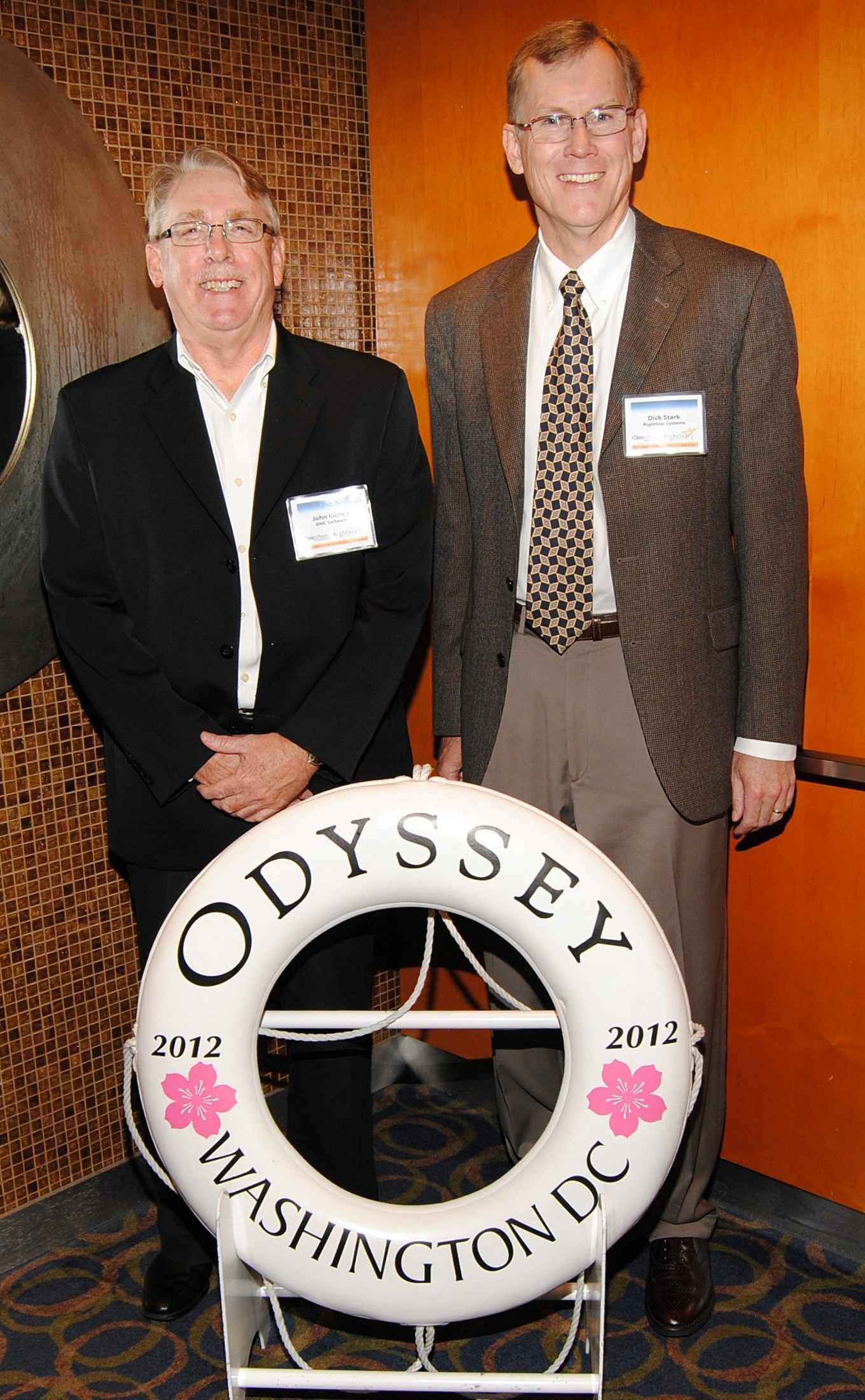
RightStar’s sixth annual customer appreciation cruise, held Thursday on the Potomac River in Washington, D.C., drew a large crowd of more than 100. John Richey, Senior Director in the Service Management Office at BMC was the key note speaker.  His discussion topic was the 7 Critical Success Factors of BSM.  Here’s a short synopsis:

1. Establish the Service Management Office (SMO).  John heads up the SMO at BMC and has a strong mandate from the CIO and BMC management team. The keys to success have been BMC’s executive support, their process investment and an emphasis on ITIL good practices.  John mentioned that at BMC, “Perfect is the enemy of good.”

Dick Stark and John Richey

2. Dedicated BSM Enablement Team. John explained that several years ago IT was isolated from the business.  By having dedicated and accountable Service Managers and Process Owners, IT is now the “face of the business.” These relationship or service managers meet with the business leaders and hold formal quarterly business reviews to ensure that IT is properly aligned.

3. ITIL Training for All.  ITIL is a job requirement for all IT employees and according to John, “what a difference that has made.” And IT jobs at BMC are evolving rapidly.  As IT automates, former system administrators are becoming “workload automation specialists.” At BMC, the objective is not to drive people out as a result of labor saving automation, but instead to retrain and refocus them on more challenging and strategic responsibilities.

4. Building and Maintaining the CMDB.  John recommended that IT organizations, “ease into things; don’t try to boil the ocean.” He also pointed out that configuration management is a “game changing good process” that can provide a tremendous ROI to the business. He admitted that BMC followed several cycles of service improvement before they were satisfied with their own CMDB, and its structure continues to be evaluated, updated and improved on a regular basis.

5. Constructing a Service Catalog. At BMC, a service catalog is more than a “list of services.” John described what BMC has accomplished through standardization, i.e., “the more things look the same, the easier they are to support.” He also stated that BMC recognizes the need to be flexible and to support and track employee devices that are capable of running corporate services and applications.

6. Keeping Score Internally and Externally. Transparency is a critical success factor at BMC.  John supports this by publishing a regular IT Operations report and by tracking costs using BMC’s IT Business Management service costing software.

7. Encouragement from All on Internal Business. This encouragement comes from both inside and outside of IT and helps drive behavior.

John concluded by describing how much BMC’s focus on using their own products and how this investment in BSM has paid off—to the tune of about $20M in reduced costs of operations.

Posted in Technology Trends | Tagged , , | Leave a comment

BMC’s Partner Summit Summary

By Dick Stark

I attended BMC’s Partner Summit held last week in conjunction with BMC’s sales kickoff. It was a very positive couple of days, not only because RightStar won the BMC Public Sector Partner of the Year award for BMC’s FY12, but because of continued BMC channel improvements.  Here are my takeaways from the meeting.

The ITSM/BSM space is getting more mind share from CIO’s and BMC is positioned very well.  Both CA and HP have not focused as intently in this space allowing BMC to take market share. What’s especially exciting is the impact that BMC’s SaaS based ITSM offering– Remedyforce is starting to have in this market.

BMC is more mid-market focused than ever before. With the acquisition of Numara, BMC has better offerings for customers with less than 10,000 employees. A recent company reorganization has created a new BMC commercial group, headed by the former Numara CEO who now has a  business unit responsible for FootPrints, Track-IT!, and Remedyforce.  His objective is to work direct and with partners to double this business unit in just several years. This bodes very well for RightStar as we are now BMC’s #1 mid-market partner.

BMC Remedy ITSM is getting much better. BMC announced that it had acquired long-time ISV and BMC Technology Alliance partner, Abydos.  This allows BMC to offer Abydos’ designer and analyzer software utilities for all BMC ITSM suite customers. Abydos’ Analyzer offers deployment and upgrades to Remedy, while generating high quality reliable and accurate documentation. Abydos Designer is a modeling tool designed specifically for Remedy applications. It allows requirements gathering, process workshops or best-practice process modeling for Remedy Incident, Problem, Change, and SRM applications with full access to Remedy form structures and field references.  BMC also discussed improvements to ITSM 7.7 around the improved SRM module.

BMC’s technical certification program is announced and ready to roll. RightStar and other partners must now maintain base certification requirements around technical disciplines such as ITSM and Cloud Lifecycle Management.  Consultants may now achieve and maintain appropriate technical certifications as BMC Certified Professionals, Experts, or Architects. This is good for us and RightStar will work hard to ensure that we have plenty of certified consultants

Posted in BMC, Technology Trends | Leave a comment

Ethics at RightStar: Six Months Later

By Dick Stark

Now that the afterglow of our National Capital Business Ethics award is starting to dim, it’s more important than ever to continue down our path of sound principles based upon integrity and corporate citizenship.  And as an award winner we need the discipline to get even better.

How can we do this?  We are continually confronted with potential learning experiences. For example, just this week, a RightStar competitor and BMC partner filed a bid protest over an award made to RightStar by calling into question our bid and proposal ethics. This is a good case study of ethical behavior that I’d like to share.

In February, RightStar responded to a government bid calling for ITSM process improvements along with a Remedy upgrade.  We analyzed the bid and proposed a detailed assessment along with an out-of-the-box implementation of most BMC ITSM modules. We submitted a fixed price bid and included a detailed statement of work. The protestor acused us of grossly underbidding, or specifically,  “Excessive Defective Pricing that puts the government at risk due to impossibility to perform the required work at the award price cited in the debrief.”   The protestor went on to complain that our intention was to, “add additional funds subsequent to contract award which would only serve to circumvent the procurement process.”

The truth of the matter is that RightStar bid based upon our best knowledge of the customer environment and our experience installing other out-of-the box Remedy systems. We proposed a “rapid results” implmentation and RightStar will make every effort to come in under-budget. It is never our intention to under-bid and ask for a change-order to make up the difference.

As an Ethics Award winner, it’s critical that we continue to employ the highest standards of integrity and ethical conduct and everyone at RightStar must agree to follow our Ethics Policy and Code of Conduct.  The real opportunity for improvement, however, comes by doing the right thing when confronted with an ethical dilemma.

Posted in Business Management, RightStar | Leave a comment

The Joy of Running

By Dick Stark

“Old age and treachery will always overcome youth and skill!”

– Waylon Jennings

At least I thought that would be the case when my 24 year old daughter informed me that she too was signed up for the annual Cherry Blossom Ten Mile Run.  She had never run that distance before and I was confident that I would prevail.  But I never really challenged her and my hoped for strategy that she tire at the end proved not to be a good one, as I was the one that ran out of gas and she went on to beat me by two minutes.

As you may know, spring in Washington, D.C. officially begins for me with the Cherry Blossom Ten Mile Run. A week ago Sunday, like I’ve done nearly every year for the past two decades, I successfully finished another one. It was a good day for a race—no wind, cool temperatures, but with spring arriving early, no cherry blossoms.  It was packed with runners of various ages (my bib number was 24,449) making it slow going for the first few miles.  As I get older (now 55), it seems that no matter how hard I train, my current time can’t keep pace with my time from last year. I did, however, manage to finish in the top twenty-five percent in my age group.

Sometimes on runs like this one, I ask myself, “if I can’t improve, why bother?” Other than the obvious health benefits, I love to compete and I can still set “age group appropriate goals” for a race.  I also enjoy devising a workout plan to meet race objective is an enjoyable process for me. Without having the goal of running a specific race with a fixed finish time in mind, I’m not sure that I could get motivated to run just for running’s sake.

Long distance running is about dealing with challenges and adversity. It’s about razor-sharp focus on an intended outcome, teaching you how to handle pain without quitting and giving you the satisfaction of completing something that you thought wasn’t possible. (At my age, it’s also about avoiding injury. That means more recovery time between runs and, as a result, more cross-training.)

I’ll keep running as long as I can. Because I’ve done this for so many years, I don’t have to get any better to enjoy running, or to be considered a runner. The true joy of running for me is an expression of strength and respect for the life I’ve been given.

Posted in RightStar | Tagged , | Leave a comment

BMC FootPrints at RightStar

By Dick Stark

Just this week RightStar held a private webinar for several SDE customers interested in FootPrints, BMC’s new on-premise service desk solution acquired through their recent acquisition of Numara. The customer feedback was positive as FootPrints offers a wide range of capability, especially when combined with its asset discovery and management tool. RightStar is quickly jumping on the FootPrints bandwagon to support existing SDE accounts and new customers.  Here are several reasons why we should all be excited.

FootPrints is flexible and easy to configure.  RightStar is investing in two weeks of FootPrints training per consultant this month. With this certification training (and some shadowing), we will be able to easily configure FootPrints to meet specific customer requirements based upon the ITIL framework. Additionally, an integration engine allows synchronization with other applications and databases such as LDAP.

FootPrints is extensible.  Asset Lifecycle Management is a process that when done well, can return thousands of dollars to the organization. FootPrints allows for easy automation of asset management processes to better enforce good ITIL configuration management processes such as IT asset purchasing, inventory, deployment, and disposal. Likewise, desktop management can be a difficult task, especially for an IT department that is understaffed. By automating those processes that discover and update operating system software and applications, hundreds of manual hours can be saved. Additionally dependency mapping between hardware and software applications can be easily viewed and built, making troubleshooting easier.

SaaS is not for everyone. FootPrints is BMC’s on-premise solution for the mid-market space. For those mid-sized customers not ready or comfortable to move to the cloud (maybe due to security or control reasons), FootPrints is the best thing going. It provides an all-in-one solution combining, Incident, Problem, Change, Configuration, Knowledge, Self-Service, and Service Catalog.

RightStar’s value proposition for our FootPrints accounts will be significant. First, like Remedy, SDE, and Remedyforce, RightStar provides up-front ITIL based consulting, design, implementation, and training services. We have years of service management consulting experience and will be able to implement FootPrints quickly and effectively.

Second, RightStar has a huge head start in configuration management and barcode scanning compared to our competitors. There is no BMC or third party barcode scanning interface for Footprints and we are moving quickly to roll out ScanStar for FootPrints.

Third, we have an experienced L1 support team that is learning FootPrints so we can provide remote administrative and support services.

Finally, as we get to know FootPrints, other ideas for additional services will emerge.  For example, the FootPrints Service catalog will allow RightStar to offer our customers a “shopping cart” experience for IT products and services. This is something every IT organization is interested in and something we will propose to every new FootPrints prospect.

Posted in BMC, FootPrints, ITSM | Leave a comment

You Did What?? IT Security at RightStar

By Dick Stark

In the past week, RightStar has been asked by two separate customers to certify our internal IT security policy.  Both customers are health care organizations concerned about patient personally identifiable information (PII).  As an IT consultancy it is our job to safeguard our customer’s PII by maintaining the appropriate security controls and best practices.  RightStar has an IT Security Policy and provides employee training using the below security scenarios.

Scenario #1: Traveling with a RightStar laptop. You take your RightStar laptop with you when you travel, to use at the customer site and at your hotel at night. Although you normally keep your laptop with you at all times, the one time you leave your laptop in your car, you discover in the morning that it has been stolen. Fortunately, you have a current backup of your important data, and all your email is stored on RightStar’s email managed service provider.  You’ve also password protected your laptop to make it more difficult for the thief to access any data.  Most importantly, you’ve kept no customer or PII data on your laptop.  After calling the police and the RightStar IT Security Officer, you return to the customer site.

Scenario #2: Virus infection. While surfing the internet, you pick up a virus that has severely impacted performance essentially making your laptop unusable. Your only recourse now is a phone call and Webex session with the RightStar Service Desk Team to rebuilt your laptop and restore your data.  This is a terrific time waster for all parties and could have been prevented by only surfing trusted sites and avoiding unsafe attachments and hyper-links. Also make sure you keep your antivirus software and operating system up to date with the latest patches.

Scenario # 3: Personally Identifiable Information. While working with a customer, you’ve asked for their database so you can work with the BMC application at your home over the weekend.  When you arrive home and start the upgrade, you notice that there is PII data, customer names and social security numbers in some of the database records.  You are surprised, because you asked for cleansed data. You decide to complete the upgrade anyway because it is a fixed price job and you don’t want to go over-budget. Good call?  No, immediately notify the customer that you have PII data and permanently delete the data, to ensure that it cannot be recovered.  Call the RightStar IT Security Officer and explain what happened and the steps you took to delete the data. It is better to go over-budget, than risk a security breach.

Just like service management best practices, good IT security processes and safeguards are essential. Release of customer PII data, even unintentionally, could have severe consequences for the organization that we were contracted to support. It’s up to us to recognize what is PII data, how to protect that data, and the steps to take to prevent a security breach from occurring in the first place.

Posted in Business Management, RightStar, Technology Trends | Leave a comment

What can RightStar Learn from Stanford Football?

By Dick Stark

As a Stanford alumnus I follow Stanford sports very closely and for the last few years it has been great fun being a Stanford football fan. With the NFL annual combine a couple of weeks ago, Andrew Luck, Stanford’s top rated Quarterback, is again in the news as the probable number one NFL draft pick.  With Luck’s graduation and departure along with several other top draft picks from Stanford, I figured that the Cardinal would return to its old ways as a bottom dweller among the Pac-12. I mean when has Stanford ever been able to string together more than a handful of great seasons?

What Bruce Feldman of CBS Sports points out on CBSSports.com is that Stanford may be in for a much longer ride among the nation’s elite football programs.  Why?   Recruiting.  The Cardinal just completed its best recruiting year ever by beating out USC, Notre Dame, Alabama and other football powerhouses for several top candidates. Stanford is now viewed as a “cool” school among potential recruits, especially when other top schools have been struggling with their images as a result of past violations.  What specifically can RightStar learn from this?

Tough Standards. Although Stanford athletes don’t face the same entrance pressure as others applying to Stanford, they are looked at academically first.  The coaching staff won’t even review films of the recruits until they evaluate their academic transcripts.  Says Mike Sanford, the running back coach and recruiting coordinator, “We’re not just throwing offers out like their candy.” The joke on the other schools is that this is Revenge of the Nerds.

Intensity and Focus. Jim Harbaugh, Stanford’s coach credited with the turnaround arrived at Stanford in 2006 and departed four years later to become the San Francisco 49er’s Head Coach.  He transformed Stanford from 1-11in 2006 to 11-1 in 2010, the first 11 win season ever. By recruiting football players who are also great students, Stanford is getting dedicated student athletes with mental and physical toughness, both essential characteristics for football success.

Several years ago RightStar tried recruiting at the college level, but found that despite more lucrative offers from RightStar, the better prospects opted to sign on with the bigger named household known consulting firms and integrators.

RightStar must hire proven performers, invest in their success, measure, and appropriately react to performance. We should and can become known as a company that requires tough standards of performance.  We certainly want our systems consultants to be certified in their particular focus area and we need everyone to continually refresh these certifications or obtain new ones.  And since RightStar is so focused in the service management space, and since there is so much constant change, annual certifications should be required.  The end result–improved productivity and better projects.  Tougher standards will “raise the bar” for everyone, and make it easier to attract top performers. In our push to be the best BMC solution provider in the world, improved recruiting is a critical success factor.

Posted in Business Management, RightStar | Leave a comment

Building a CMDB at NYHHC

By Dick Stark

I attended a CMDB session at BMC’s Public Sector Forum two weeks ago hosted by Mark Settle, BMC CIO, and Michael Keil, Assistant Vice President, IT Service Management, NY Health and Hospital Corporation (NYHHC), the largest municipal hospital in the country.  There, RightStar has been on-site assisting with a Remedy upgrade. NYHHC has made a major investment in nearly every BMC solution area and is a model success story for how IT should run from a Business Service Management perspective.  Michael’s topic was the CMDB.

Although the concept of a CMDB has been around for years, the adoption rate for asset management projects is not as high as you might expect. Forrester confirmed in a recent IT survey, that only 15% of the respondents were halfway through an asset management rollout. Fortunately, NYHHC is much further along and shared their experiences.

First, define how you will be using a CMDB. Michael Keil began, “Don’t try to boil the ocean.  Keep the scope small.” He explained that it was essential to examine your processes.  Figure out what works and doesn’t work and make sure that you can identify your consumers of your CMDB.  (Presumably service desk analysts, change managers, data centers, and various hospital units that track assets, either IT or non-IT.)

Second, if you have an ITAM solution in place, that is a good start. Most organizations have something: Excel spreadsheets, a database from which to import data.  Discovery tools are also essential, but require manual reconciliation. Use your ITAM solution to add your non-discoverable items such as medical equipment. Then, federate data from other sources such as Microsoft SCCM for desktops and servers and BMC ProactiveNet and ADDM for Network Topology. Reconcile often either manually or take inventory using barcode scanners.

Third, execute. Consider adding states to configuration items such as test, development, production, current, future, and retiring. NYHHC’s rule of thumb is only put items in a CMDB if they: solve a problem, have a metric, have an owner or have a metric on the owner. When moving from an old tool to a new tool, make sure to keep the concurrent time to a minimum.

Finally, continually improve. There will be bumps in the road. Check processes to see if they are ready.  For example, will the service desk be able to locate configuration information in a ticket and how will they use that information?  Make sure this is part of your CMDB plan.

Don’t forget that BMC ITSM Suite is a good place to start. RightStar’s configuration management value proposition for this account and most of our other customers is significant. By comparing the IT assets required with what is actually on-hand, most organizations can identify surplus software and hardware and realize significant cost savings. In addition, linking IT assets to incidents and problems allows troublesome assets to be identified before future incidents are reported. This facilitates problem management and reduces call duration and volume.

Posted in ITSM, RightStar, Technology Trends | Leave a comment

itSMF Speaker Summary: Automate, Consolidate, Simplify

By Dick Stark

Last Thursday I attended the itSMF National Capital Local Interest Group meeing in Washington DC. Mike Brown, Director of the Information Technology Services Office at the Department of Homeland Security (DHS) told the group of service management professionals, that his office is providing better IT by reducing complexity, consolidating IT services, and automating and standardizing processes. He went on to say, “DHS has made significant progress in the past few years by rolling up smaller data centers into larger ones, deploying a standardized infrastrure across the enterprise, and deploying private cloud services such as SharePoint, CRM, and workplace as a service.”  Cost savings is now top of every government CIO’s list and the changes DHS is affecting can have an immediate impact as I’ve summarized below. 

 Automate. Virtualization is still red hot because of its very rapid ROI. According to a recent study, the Virtualization Vacuum, published by MeriTalk, the government should save as much as $30 billion by 2015 thanks to 82% user adoption of Virtualization at Federal agencies. Already Federal agencies have saved 19% of IT budgets or $15 billion thanks to virtualization efforts the past three years.

DHS, like most Federal agencies has invested significant resources in provisioning, upgrading, and adhering to security compliancy requirements, which can be automated with tools such as BMC’s BladeLogic Server Automation (BBSA).  Couple the virtualization efforts with BBSA and agencies such as DHS can automate key tasks as applications and systems are consolidated.

Consolidate. In addition to rolling up aging smaller data centers into larger ones, DHS is focused on application and infrastructure consolidation. The goal is to transform DHS’s data centers into private clouds offering basic hosting, care of the systems up to the operating system layer, and hosted applications.  An agency wide consolidated email hosting project is in the works, along with hosted SharePoint and CRM applications.

BMC is the market leader in cloud lifecycle management (CLM), with tools that allow organizations to build and manage their own private clouds. CLM would offer DHS an “engine room” for its own private cloud, as it allows for automatic provisioning, self-service portals, and flexible metering and billing offerings.

Simplify. Mike Brown also discussed the simplified service catalog that DHS offers its customers and described DHS as the “largest government IT fee for service organization.”

Mr. Brown then mentioned that although he has processes in place to manage a service catalog, he has not automated this process yet.  Since DHS is a very large existing BMC Remedy ITSM customer, building a service catalog based upon BMC’s Service Request Manager, is a good place to start.  For example, at US Customs and Immigration Service, RightStar worked with an integrator to implement a service catalog for hardware, software, and cell phone requests across the organization.

Mr. Brown wrapped up the session by concluding, “I wish I knew then what I know now—having solid processes makes all the difference.”

Posted in BMC, ITSM | Leave a comment