Five Myths of ITIL Certification

Last week, Nikki Haase, RightStar’s Director of Process Consulting and Training, led a three-day ITIL v3 Foundation Certification class at our new RightStar HQ training facility. Comprised of 13 customers and 3 RightStar employees, the class proved to be an enlightening experience for all.

Students find RightStar's preparation for the ITIL v3 Foundation Certification Exam both enjoyable and beneficial.

The highlight of the three days was the simulation exercise. Class attendees played roles in a fictitious retail IT department, working together to keep their servers and applications up and running in support of their online retail operations. What began in chaos ended in structured efficiency, a collaboration of IT professionals well-versed in ITIL processes.

During the class, it came to light that misconceptions exist among those who have not yet been familiarized with the rewards of ITIL v3 certification. Let me begin by clearing up five common myths surrounding ITIL certification:

  1. ITIL certification is boring. Nikki can attest to the fact that no one fell asleep in her class. The reason? Class exercises, discussions, real life examples, and the retail simulation exercise were so engaging that time seemed to fly.
  2. The certification exam is tricky and unfair. The test consists of forty multiple choice questions. Nikki’s review sessions help to ensure a high pass rate.  Of course, there is no substitute for studying.
  3. A classroom experience is necessary to pass the exam. ITIL training is offered online as well as in the classroom. RightStar provides a  half-day review session, which includes sample questions and study materials, for online students who want the added insurance that they will pass the exam.
  4. I don’t need ITIL certification to get ahead at work. While there are no guarantees, achieving ITIL mastery can increase your chances of employment success. In fact, some IT organizations are now requiring ITIL v3 certification.
  5. My v2 certification is good enough. V3 is a replacement of the previous v2 release, not an add-on. There are 13 new ITIL processes: Demand Management, Service Portfolio Management, Strategy Generation, Seven Step Improvement Process, Service Catalog Management, Information Security Management, Supplier Management, Knowledge Management, Transition Planning, Evaluation and Early Life Support, Event Management, Request Fulfillment, Access Management, and Common Service Operation Activities. V3 certification takes a giant step above and beyond v2.

Here’s my advice: if you’re not already ITIL v3 Certified, make it a priority to achieve this by the end of 2011. Who knows how much time we have until ITIL v4 is released!


Posted in ITIL, ITSM | Leave a comment

Do The Right Thing

Recently, I received a phone call from a Remedy developer who works for a large systems integrator. He had been on a project that RightStar was involved with and, although we had finished with the job, we were working on other sites with the same integrator. Our conversation went something like this:

Developer: I’m interested in leaving and would like to talk to you about a position at RightStar.

Me: We’d love to have you, but don’t you think your company would be upset with us if we hired away one of their best developers right in the middle of a job?

Developer: Well, they’ve changed their benefits significantly and I don’t think anyone would blame me for leaving.

Me: Are you sure that’s something you can’t work out with your employer? What makes you want to join RightStar?

Developer: Well, my company tried to hire one of your RightStar developers several times and he turned us down. I figured RightStar must be a great company if your guy wouldn’t come to work for us, even for more money!

So what is the right thing to do? In this case, the developer called me back to tell me the benefits issue had been worked out and he would see the project through to its end. Although it was very difficult for me to turn down a potential superstar, hiring him would have likely damaged our relationship with the integrator and jeopardized future business.

It’s in this spirit that I’m happy to announce that RightStar was once again nominated for the National Capital Business Ethics Award. We were a semifinalist last year, not bad at all, but I’d like to see us win this year. What an honor that would be! While we needn’t get an award to strive for a high standard of ethics in our business, making improvements in that area will always make us winners. This week I had the privilege to sit down with Kathy Albarado, CEO and President of Hilos HR, last year’s NCBE award winner, to see what I could learn from her. She graciously shared some ideas that we’ve put into practice here at RightStar:

Better onboarding and training. RightStar is implementing a more formal onboarding process that will include training on RightStar’s core business, corporate culture, policies, and ethical standards.

Improved performance appraisal process. Since continual feedback is important, I’m bringing in an HR consultant to see how we can improve our annual review process before rolling it out this year.

More employee participation in community service. To promote community involvement, RightStar is sponsoring a day in May for our staff members to work together on various service projects—think of Donald Trump’s show The Apprentice. The winning team will be treated to dinner at a nice restaurant.

RightStar consultant Crystal Little with participants in the MCiS 5K Run, an event she helped to organize to benefit the Wounded Warrior Project.

RightStar encourages its staff members to reach out into their communities and give back. Recently, RightStar consultant Crystal Little helped to organize the MCiS 5K Run to benefit the Wounded Warrior Project, a charitable organization that provides programs and services to severely injured service members. At the end of the day, it’s about doing what’s right. That’s what Ethics is all about. If we do the right thing, right things will happen. And that makes us all winners!

Posted in Business Management, RightStar | Leave a comment

A Day In The Life Of A President

A day in the life of this president, to be more precise, was a busy one on Tuesday. I spent the day on the road, traveling through Virginia and visiting customer sites to see what RightStar is accomplishing in the field.

Sculpture of the DTRA seal at Ft. Belvoir, VA

My first stop was the Defense Threat Reduction Agency (DTRA) at Ft. Belvoir. RightStar has teamed with BMC Software and Lockheed Martin to implement a Remedy-based Incident, Problem, and Knowledge Management system at DTRA. This new system is replacing the agency’s existing HEAT system and all is going as scheduled. At DTRA, we successfully implemented RightStar’s CAC PKI Integration Solution for the first time on Remedy version 7.6, a proud accomplishment.

My next stop was Langley Air Force Base where we just kicked off a Remedy Incident and Problem Management job. This is also a HEAT replacement and I’m happy to report that the project is off to a great start.

Leaving Langley, I traveled to Norfolk to visit one of our healthcare customers. They are in the process of merging all their service management needs into one BMC Service Desk Express (SDE) system, thereby pulling the plug on their old HP Service Desk system (formerly Peregrine). During times of change like this, it can be a challenge for users to accept new workflow and processes. As the hired experts, we need to demonstrate the many benefits of the new system so users will see that change can be a good thing.

Finally, I had the pleasure of enjoying dinner with several RightStar consultants in the field. I was updated on our progress at Joint Forces Command in Norfolk where we’re finishing up a full-fledged Remedy Incident, Problem, and Change Management upgrade. We’ve exceeded our customer’s expectations with this job, something RightStar endeavors to achieve on a daily basis with every customer.

The ability to deliver a solution that truly meets our customers’ needs is the foundation of our success. My trip on Tuesday confirmed that RightStar’s foundation is as solid as ever.

Posted in RightStar | Leave a comment

American Freak Show

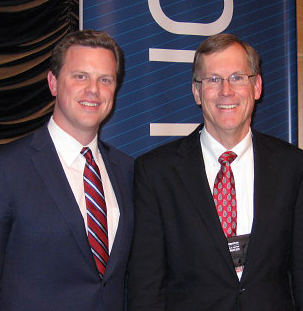
At the BMC Public Sector Forum in Washington, D.C. on Thursday, I introduced the afternoon keynote speaker, Willie Geist. Willie is the host of “Way Too Early with Willie Geist” on MSNBC and the co-host of “Morning Joe with Joe Scarborough.” He is also the author of American Freak Show, a hilarious satire about American political and cultural icons like Tiger Woods, Sarah Palin, and Rod Blagojevich.

Willie Geist and Dick Stark at the BMC Public Sector Forum on January 13, 2011

Willie provided a good change of pace on the Forum agenda, which began with a speech from BMC President and CEO, Bob Beauchamp. The main theme of Bob’s speech was about how BMC continues to be on fire. Their latest quarter results showed total revenue up 9% and ESM license revenue up 32% year-over-year. Bob also made hay over the latest Gartner Magic Quadrants for ITSM, where BMC is positioned all alone in the upper-right leaders quadrant, and IT Event Correlation and Analysis (Service Assurance), where BMC is also solidly in the leaders quadrant.

The rest of the morning sessions centered on cloud computing in the public sector. Cloud computing is becoming pervasive due to the government’s Implement Cloud First policy, data center consolidation efforts, emphasis on budget reduction, and focus on procurement improvement.

BMC’s Mark Settle discussed harvesting head count. BMC has studied the work effort among four IT job types: Service Desk (L1), Operations (L2), Engineering (L3), and Architecture (L4). In an ideal environment, only L1 teams do L1 work. Normally, what happens is that L2 teams end up doing some amount of L1 work, and so on, bringing up the overall service management costs. BMC has worked to move the work “down the ladder” by changing, moving, or eliminating the work. They’ve done this by monitoring the right metrics, like the percentage of service tickets properly assigned the first time.

The Forum concluded with a standing room only presentation from BMC executive Doug Mueller, a Remedy co-founder. Doug discussed the new Remedy version 7.6 and above, and his views on ITIL and BSM.

It was a very good day for both BMC and RightStar. There were more than 500 systems integrators, customers, and prospects in attendance. We had excellent exposure from booth traffic, event signage, the afternoon keynote address, and positive remarks from BMC Public Sector VP Ken Mellett. We also spent good time networking with BMC executives, sales, pre-sales, and professional service employees. It was a terrific way to start 2011!

Posted in RightStar | Leave a comment

Make a Commitment in 2011

“When you truly commit in your life you start receiving more than you imagine.”

– Jeff Bridges

If you haven’t seen the recently released movie “True Grit,” it’s well worth watching. Jeff Bridges plays tough U.S. Marshal Rooster Cogburn in this remake of the 1969 classic starring John Wayne. Hot off his Academy Award win for best actor last year, Bridges is a shoo-in for another nomination. But Jeff wasn’t always even sure that acting was what he wanted to do.

In the book “On Gratitude” Jeff describes a point early on in his career when he had done about ten movies and even received an Academy Award nomination. “I still wasn’t sure I really wanted to be an actor,” he relates. “This was back in the 70’s. I just wouldn’t commit. So I finished this movie, ‘The Last American Hero,’ and I didn’t want to work, but I got a call saying John Frankenheimer wanted to cast me in ‘The Iceman Cometh’ with Lee Marvin, Robert Ryan, and Frederic March. I passed. ‘Ah, I’m bushed. No thanks,’ I said. Five minutes later, the director of ‘The Last American Hero’ called me up and said, ‘You call yourself an actor. You’re no actor. I’m never talking to you again.’ I thought, ‘Gee, let’s think about this for a second. Am I an actor or not?’ You know, being a professional means you have to work sometimes, even when you don’t feel like it. But I decided then and there that, yes, I’m an actor. I took the movie. When you truly commit in your life, you start receiving more than you could imagine. That’s how it’s worked for me.”

How it can work for you in 2011 depends on what kind of commitment you make. Remember, RightStar differentiates itself by its commitment to education, customer service, and being a company that people enjoy working for.

Education will continue to be a key differentiator for RightStar. This week we have two people in Matrix42 training and several others are taking Remedy WBTs. We also have an ITIL Foundation class scheduled at the end of this month, and hope to have extra seats for our own employees. Make a commitment in 2011 to continue achieving new certifications, not only to improve your own resume, but to elevate our status with BMC and with current and potential customers.

In the spirit of every customer a reference, make an effort to “wow” our customers by really understanding their requirements and committing to their success. You’ve heard me say many times that “We’re not just software guys with screwdrivers.” Let’s prove it!

Finally, make a commitment to make a difference to yourself and others. Let’s all set aside just one volunteer time off day, tentatively May 13 or 14, to get involved in the community. You could pick up trash, work with youth groups, help out at a homeless shelter, or some other volunteer activity. Look for more ideas and suggestions as we get closer to May 13. Imagine the collective difference we could make if each of set aside just a little time to create positive change in the community.

Posted in RightStar | Leave a comment

Three Customer Stories

 I had the opportunity to introduce several BMC speakers at the CSC 2010 Transformation Conference held last week in Crystal City.  This is an annual partner conference to promote and review CSC’s Transportation Security Agency multibillion dollar ITIP contract.  BMC plays a large role in that contract, providing a unified Business Service Management (BSM) platform for the agency.  Before introducing the speakers, I told three DHS customer stories, in order of BSM maturity:

Transportation Security Administration

SITUATION: To enhance the security of air travel, TSA created the Secure Flight (SF) program to assume the responsibility for the passenger watch list, matching functions previously performed by aircraft operators. SF improves aviation security by identifying known and suspected terrorists and distinguishing them from the remainder of the traveling population. The problem at hand was that resources lacked efficiency with a less than optimal level of screening resources available to focus on potential terrorist threat efforts.

SOLUTION: The SF system is a collection of hardware and Commercial-off-the-Shelf (COTS) software, designed to support the requirements of the SF program. Implementing BMC Remedy to track incidents reported by TSA airport screeners was of critical importance. Using Remedy, TSA can more effectively allocate resources and better identify potential terrorist threats.

RightStar, as a subcontractor to a major prime, set up, and configured Remedy Incident Management software in a UNIX DB2 environment. The work included installation, configuration and testing of all software. Interviews were done with the TSA/IBM team to understand requirements and a detailed design document was delivered for the implementation. Additionally, technical documentation on the changes and configuration of the system, in addition to user training documentation, were provided.

DHS Headquarters

SITUATION: Running the DHS Headquarters organization presents many challenges. Managers were experiencing a serious dilemma: they had no integrated problem, incident, and configuration management system. The problem they faced was that fresh information and data changes were being logged into their system manually without a documented process for those changes. To make matters worse, unauthorized people were able to log into classified systems and make alterations, leaving the door open for potential disaster. In addition, a lack of automation and centralization meant that information could not be shared between the appropriate departments and, as a result, important data was often missed.

SOLUTION: Another major prime contractor and RightStar teamed up to provide a BSM solution under DHS’ Information Technology Networking Operations Virtual Alliance (IT-NOVA) umbrella. The change and asset management processes included maintaining control of numerous people and the information they entered into the Access database. Because of the security risks involved with the information collecting, RightStar was tasked to improve these processes.

RightStar created a strategic plan to address these pitfalls and shore up any possible loopholes. After reviewing the issues and requirements, RightStar implemented the BMC Remedy Change Management module at their headquarters and devised new procedures for data entry. As a result, changes to the environment must now undergo an approval process which includes authorization by select individuals. No one can make unchallenged alterations and all modifications are noted and time stamped. Asset and change management processes are now integrated into the Remedy system making information easily accessible by key decision makers. The outcome is a stronger defense network.

DHS USCIS

SITUATION: The US Citizenship and Immigration Service (USCIS) is the organization under the US Department of Homeland Security that is responsible for granting asylum to refugees, naturalization, issuing Green Cards, and ensuring the integrity of the US immigration system. Their Office of Information Technology (OIT) oversees the Security Operations Center, Network Operations Center, the Service Desk, multiple data centers, and the IT infrastructure supporting the USCIS. The problem they were challenged with was that their existing system was ineffective in handling the large volume of IT requests they received daily.

SOLUTION: RightStar, teaming with a small business, assisted with the design and implementation of BMC Remedy’s Service Request Management (SRM) application. SRM was selected as the tool for creating, monitoring, and fulfilling customer IT requests from across the USCIS organization. SRM allows a customer to login and create service requests from a predetermined menu. It only shows services that each customer is entitled to order. A general IT incident service form was also created for customers to directly report an issue. RightStar installed and configured SRM and individual services were created for each type of IT-related request. SRM was highly customized to the environment to reflect OIT’s organization and operational structure. Customers may order hardware, software and wireless devices. Requests can be approved or rejected directly in the system. IT and project management staff use the system to receive assignments, track progress and complete requests. By improving efficiency and transparency, SRM has greatly enhanced the USCIS IT customer service experience.

The SRM implementation was made in conjunction with improvements and customizations to the existing Remedy Incident Management application to mirror recent process changes.


Posted in Business Management, RightStar | Leave a comment

Adding Value to Your Service Desk

As a result of the economic slowdown, many IT organizations have seen their budgets drop by as much as twenty percent, with the overused mantra of “do more with less,” continuing to ring loudly in the halls. Oftentimes the service desk gets short shrift, with excess budget dollars allocated to virtualization, security, or other priorities. The good news is that most organizations have already invested in a service management software suite, so it’s possible to add tremendous value to the service desk without a major new investment of time or money. Here are some ideas that may help improvie the value of your service desks.

(1) Begin by showing the value through ITIL simulation training. Almost no one volunteers for an ITIL Foundation class. It’s even more difficult to get participation and buy-in for a service desk optimization workshop. This is because ITIL is usually thought of as important, but boring. By beginning with a short ITIL simulation exercise—set in an airport, healthcare, or non-profit/government environment—participants quickly gain an appreciation for the value provided by a unified service desk. Getting everyone energized about that value by, for example, seeing how problem management can prevent incidents from occurring, helps guarantee a successful service desk reengineering effort.

 (2) Service Catalog and Request Management. Do you ever wonder how restaurants with extremely large menus manage? Either they have very large freezers, or they have automated processes in place to create and deliver those dining options. Likewise, IT organizations are now offering service catalogs of IT services and components, such as server provisioning. A service catalog allows for speedy request fulfillment by automating the process and reducing the time it takes to get approvals.

(3) Service Asset Lifecycle Management. Without exception, every organization thinks their IT assets are better organized than they actually are. Very few service desks actually link their assets to incidents, problems, and change requests. And those that use discovery tools often do a poor job of reconciling what’s discovered with what is actually owned or licensed.

(4) Comprehensive Change and Release Management. During the recent Thanksgiving holiday rush, Spirit Airlines made national news because their Web-based check-in portals went down. It was the result of poor change planning. This outage could have been prevented if proper change policies were in place and enforced.

These are just a few examples of how IT organizations can lower the cost of service management, deliver superior quality services, and achieve process efficiency. With a service management software suite already in place, additional training or consulting may be the only investment required.

Posted in ITSM, Technology Trends | Leave a comment

The 25 Sales Habits of Highly Successful Salespeople

Note: The following was published yesterday in RightStar’s employee newsletter, The Weekly Star.

At RightStar we are all in sales. We may not all be on a commission plan, but we all share responsibility for business development from both new and existing accounts. For those of you that don’t consider yourself professional salespeople—and even for those that do—I’ve captured several key points from Stephan Schiffman’s book, The 25 Sales Habits of Highly Successful Salespeople:
   (1) Communicate the message that it is sound business to trust you and RightStar. Remember, our mission is to be our customers’ trusted advisor in the service management space. Even more important is our goal of “every customer a reference,” demonstrated by our track record and customer testimonials and surveys. Point out that RightStar is a 2010 National Capital Business Ethics Award finalist and that we are committed to integrity, accountability, and corporate stewardship.
   (2) Know how to make your product or service fit somewhere else. The recent Gartner ITSM Magic Quadrant reported that over half of the customers surveyed did not have incident and change management integrated from a process and tool perspective. That means that there is plenty of professional service opportunity just in getting Remedy or SDE to do what it was designed to do. Of course, there is also plenty of opportunity for new projects such as service catalog, tool integration, and on-demand solutions.
   (3) Pretend that you’re a consultant (because you are). Not only are we all in sales, but we are also all consultants. I was proud to hear Linda Kiechlin explain during a prospect meeting that she was ITIL certified. This gave her instant credibility. According to Luca Lazzaron, BMC SVP of Worldwide Sales, partner training is the most important success factor for sales excellence.
   (4) Give yourself appropriate credit. Talk about yourself, but be humble. In our more than seven years as a company, we have over 500 successful customers as examples of why a service management prospect should work with us. Point out the years of experience and certifications that we have collectively as a team. Show your value!
   (5) No one wakes up and says, “I’m going to be stupid today.” Let’s face it, mistakes happen. I’ve heard stories of a RightStar consultant mistakenly deleting the wrong database file only to discover there is no current backup, and a salesperson misquoting or leaving a critical component off a proposal response. It’s how we handle mistakes and the corrective actions we take that make all the difference.
   It’s tough out there. We will continue to scrape and fight for new and existing customers. By following these habits, along with the twenty others listed in the book, you can help greatly improve your win percentage.

Posted in RightStar | Leave a comment

Report from the BMC Partner Summit

Last week I attended a two-day partner summit at BMC headquarters in Houston. RightStar was one of twenty global partners invited, and one of only five based in North America. Not only did I pick up RightStar’s award for Top North American Public Sector Partner, but I picked up a lot of interesting information at the summit.
First of all, BMC is performing very, very well. Bob Beauchamp, President and CEO, reported that ESM revenue (the Service Support, Assurance, and Automation product lines) is up thirty-two percent from the previous quarter. He also said that no BMC product line is up less than twenty-nine percent. It was good to hear Bob say that “BMC can’t hit its sales targets just by hiring direct sales people—partners will play an ever increasing role in overall sales growth.”
I also heard that Business Service Management (BSM) continues to evolve and gain traction. BMC CTO Kia Behnia discussed Dynamic BSM—the concept that, due to the pervasiveness of cloud computing, “one size fits all” BSM no longer applies. It must support virtual environments across internal and external clouds.
Kia used a restaurant analogy to get this concept across. The best restaurants don’t offer a one price, all you can eat buffet. They package their selections into several menu items with different prices and options. Likewise, IT departments must offer different service options through self-service portals and on-demand provisioning with a “pay as you go” pricing model.
Paul Avenant, VP of ESM Products, reported that cloud computing is a top CIO priority and BMC is well positioned in this space. He presented BMC’s cloud strategy as its ability to deliver BMC solutions in a Software-as-a-Service model and provide management software for public, private, and hybrid clouds. BMC now offers Cloud Lifecycle Management for service providers. Paul said that this is the killer application for cloud service providers, as it allows for automatic provisioning, self-service portals, and flexible metering and billing offerings.
Bob Johnson, VP of SaaS, said that according to Gartner, SaaS deals will soon make up around thirty percent of ITSM wins. He described the success BMC has had with Remedy OnDemand and ServiceDesk on Force.com. What’s especially exciting for RightStar (and other partners) is that the onboarding will be subcontracted exclusively through the channel.
Finally, Kathy Bexley, VP of Enablement, described the training options available for partner sales and technical resources. Expect more information soon on the options and technical certifications available from BMC for both online and instructor-led classes.

Posted in BMC, Technology Trends | Leave a comment

RightStar All Hands Meeting Summary

As I reported in our company all-hands meeting on Friday, this is an exciting time to be at RightStar. Our total revenue through September has already exceeded our revenue for all of 2009. The backlog of Remedy service jobs is at an all-time high, with several jobs unable to start due to a shortage of RightStar Remedy consultants. The best news is that some new areas that we’ve invested in, Service Assurance and ITBM, now have service backlogs.

It’s not just BMC redirects that are hot. We also won several large direct Remedy ITSM jobs with the Government. These are full scale ITSM Suite implementations that are very visible to BMC and the customer. I’m confident that they will be successful.

Our Service Assurance team had big wins with nlyte at a DOD account, ProactiveNet and ADDM at a civilian agency account, ProactiveNet and BladeLogic at a DOD account, and ProactiveNet at a DOD account. We also start our first ITBM job, with a large Health Care organization, later this month.

At the BMC Partner Summit held in Houston, RightStar received an award for most BMC pupblic sector business. Additionally, RightStar received good publicity there for two ServiceDesk on Force.com (SDoF) jobs, Iron Bow and Calvert, that we’re currently working. We also started the process workshops last week for our first Remedy on Demand (RoD) project.

RightStar’s strategy moving forward is to continue to focus in the following areas: transform Remedy accounts to state of the art ITSM; Remedy OnDemand; SDE on-premise, especially APM; SD on Force; process consulting, especially around BSM and service desk consolidation; and Service Assurance. Additionally, we’ll continue to look for opportunities in areas including; ITBM; nlyte; RightStar internal products; and Dundas Dashboard.

Posted in Business Management, RightStar | 1 Comment