The Thank You Economy

By Dick Stark

  • 55 percent cite great service, not product or price, as their primary reason for recommending a company.
  • 66 percent said that great customer service was their primary driver for greater spending.

–Customer Experience Impact 2010 Report

In Gary Vaynerchuk’s latest book, The Thank You Economy. Gary writes, “The Thank You Economy isn’t some abstract concept or wacky business strategy—it’s real and every one of us is doing business in it every day, whether we choose to recognize it or not.  It’s the way we communicate, the way we buy and sell, the way businesses and consumers interact online and offline.  The Internet has given consumers back their voice, and the tremendous power of their opinions via social media means that companies and brands have to compete on a whole different level than they used to.”

If customer satisfaction or service is the most important factor for recommending a company, what can RightStar do remain competitive?  If spreading sunshine and rainbows is all that matters how will we ever be profitable? And should we participate in a rating service like customerlobby.com?

At RightStar, our mantra is and will continue to be every customer a reference.  Indeed, valuing every single customer is mandatory.  My favorite example is DJO, a manufacturer of orthopedic devices and supplier to all thirty-two National Football League teams. DJO purchased MagicWand for an asset management project. Once we began the project, we discovered that their scanners were not compatible with MagicWand. This was surprising since we make it a point to ensure that all MagicWand customers receive our list of certified scanners. Rather than argue about who was right, we rushed five new scanners to DJO overnight at no cost. This guaranteed an on-time delivery and a very satisfied customer.

As thought leaders, we must balance spreading sunshine, with delivering the right solution. Customers tell us what they want, and we in turn try to give it to them. How many times have we won the sale, given customers what they wanted and still ended up with an unhappy customer? We’ve learned the hard way:

  • The customer could be wrong, yet we still get the blame
  • It’s important to understand the problem we’re solving and how success will be measured

Should we sign-up for an Internet Rating service like customerlobby.com? Absolutely. Our customers must trust that our intent is compatible with their best interest and that we have the experience to design and deliver a solution that meets their needs.  In the Thank You Economy, customer focus is essential for growth and profitability.

Posted in RightStar | Leave a comment

Closing the Gap

By Nancy Donnelly, RightStar ITIL Service Expert

ITIL v3 Definition of Service:  A means of delivering value to customers by facilitating the outcomes customers want to achieve without the ownership of specific costs and risks.

At RightStar, we often meet with clients who feel their requirements are “unique” and that the technical solutions we provide “couldn’t possibly meet their requirements out of the box.”  They want their newly purchased applications to work the way their previous versions did, and they have “special” reporting requirements. Or they simply want to provide functionality to their service desk because they have “always done it that way,” and they want them to continue with something they are familiar with doing to avoid additional training.  As a result, these requirements, which may appear to be “simple,” add increased resource costs to maintain the application and increased risks in upgrading due to the complexity of customization rework. 

In partnering with our clients, our job is to provide advice and guidance on our client’s processes and technology based on their particular business climate.  We proactively work to bridge the gap between technology and business requirements to help them ultimately achieve their desired outcomes.  How is this accomplished? 

By asking “Why?”

This is often not a popular question, although the answers to “why” may reveal the need to make those difficult decisions and to change how our customers do business.  Asking these questions provides an opportunity for our clients to review their requirements again and to confirm that additional costs, resources and funding are truly required. 

These thought provoking “why” questions may include:

  • Why is this requirement needed?
  • What business challenge are you trying to solve?
  • How does it work today with your current application?
  • Describe the underlying business process that is driving this requirement. 
  • Is it fulfilling the desired need?
  • Are there opportunities for process modification or improvement?

Once we capture responses to these questions, the next step is to provide options.  These options may include suggestions for modifying current business processes based on ITIL v3 good practices.  We do this by performing an analysis of our client’s current processes based on a series of criteria (company size, environment, industry, etc.) We can then present an assessment highlighting areas for improvement consideration.

In addition, there may be methods for accomplishing the same results using OOB (Out of the Box) tool functionality.  During tool requirement meetings and discussions with our clients, it becomes clear that a “must have” requirement may result in increased support costs due to unnecessary tool customizations as well as the need to maintain an application that cannot be easily supported or upgraded.  In many situations, customer satisfaction with the product may be negatively impacted due to increased end user work load.  In documenting these discussions, we can recommend both process as well as tool improvements.

Our clients appreciate the fact that we are there to provide the best possible implementation experience rather than simply performing the work and moving on.  As trusted advisors to our clients, it is our responsibility to ask the difficult questions. 

Ultimately, our #1 goal is to provide customer value by facilitating the outcomes our clients want to achieve by proactively working with our clients to reduce project costs and risks.  In this way we can better “close the gap” between technology and their business.

Posted in Business Management, RightStar | Leave a comment

Social Entrepreneurship and Green IT

Do all the good you can
By all the means you can
In all the ways you can
In all the places you can
At all the times you can
To all the people you can
As long as ever you can

It’s a quote from 18th-century theologian and social reformer John Wesley, co-founder of the Methodist movement.  How can RightStar, an IT consultancy and BMC solution provider, do “all the good we can do?’ One way: by improving efficiency, and providing tools that reduce power consumption, we have an opportunity to participate in “green IT,” thereby helping reduce carbon emissions.

When visiting a government agency in Los Angeles this week, RightStar had the opportunity to meet with the agency’s data center manager and his team.  There they are challenged with supporting an aging data center and its approximate four to five hundred physical and virtual servers. Initially we were told that power consumption was not an issue because given the public sector nature of this account, power was “free” and did not hit the agency’s budget. 

What we discovered after visiting the account was that although power may be free, it was nearly impossible to increase due to an aging power infrastructure.  In fact, they admitted that it would cost far more to upgrade this infrastructure than they could afford, limiting new devices that they could plug into their grid.

RightStar can offer this agency and other budget strapped organizations value based solutions with green results.  Here are two ways:

  • Virtualize. Server consolidation and virtualization is an important first step. By turning off older more power hungry servers with newer virtualized servers, significant power savings can be achieved. Couple the consolidation effort with BMC’s BladeLogic Server Automation Suite provides the appropriate information to automate key tasks as applications and systems are consolidated.
  • Manage power consumption. Data Center Performance Management (DCPM) software tools like nlyte’s DCPM Suite provides real-time views into application instances and power relationships within both virtual and traditional server environments. This real-time power usage data monitoring provides an instant, accurate view of energy consumption throughout the data center.  As a result, the effects of planned or unplanned power server outages can be mitigated. In addition, because nlyte maps power usage of a server to its virtual instance, virtual server sprawl is controlled.

This means that with BMC’s BladeLogic Server Automation, nlyte’s DCPM, and professional services from RightStar, we can help agencies get a firm grasp on their data center costs, especially as applied to power management. This is an important first step to improving efficiency, reigning in energy use, costs, and CO2 emissions.

Posted in Business Management, RightStar, Technology Trends | Leave a comment

Making Government Efficient

By Dick Stark

On Monday,  I visited with our DOJ/Lockheed customer where we are on-site working architectural and operational issues related to BMC’s service assurance products.  The customer lamented that he just spent a fair amount of money upgrading Remedy (not something we were involved in) to the latest version and he has achieved no significant gain in functionality over the older version.

What hit me was that the Federal Government is taking a hard look now at cost savings AND squeezing value out of existing investments.  With budget cuts a reality for FY12, agencies are scrambling to “do more with less.” Will they make it?  Not according to a recent study by MeriTalk, a government think tank.  That study concluded:

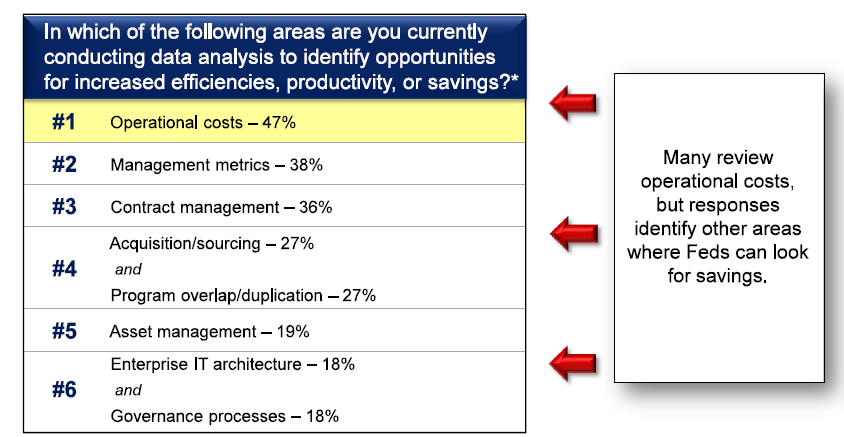
  • First, agencies lack the necessary budget analysis and insight. Only 47 percent say their agency conducts analysis on operational costs to identify opportunities for increased efficiencies. Thirty-one percent say that insufficient controls and insight into program performance hinder efficiency efforts.
  • Second, agencies lack disciplined management practices. Just 31 percent say their agency has a formal plan to identify spending inefficiencies. Twenty-seven percent say that management is not making oversight a priority.
  • Third, agencies are leaving too many stones unturned. Only 18 percent say they analyze their enterprise IT for savings. Nineteen percent review asset management, 27 percent consider program overlap/duplication, and 27 percent mine acquisition/sourcing for greater efficiency and cost reduction.

Chart below from MeriTalk Whitepaper, Taxing Times


  • Finally, and most troubling, Feds report that they lack incentives to cut costs. Some 40 percent cite use-it-or-lose-it budget mentality as a critical obstacle to realizing real savings.

How does this apply to RightStar? Beyond BSM, there is BMC’s IT Business Management or ITBM. In addition to project portfolio management and vendor management, there is now the new Service Costing module. This means that with ITBM Service Costing software and professional services from RightStar, we can help agencies get a firm grasp on what it costs to run their IT departments from a comprehensive software, hardware, and labor cost perspective. This kind of transparency may be frightening to agency department heads that fear potential budget cuts and realignments, but it’s an important first step to improving efficiency and getting a better grasp on exactly how agencies are spending taxpayer dollars.

Posted in RightStar, Technology Trends | Leave a comment

Small Giant

By Dick Stark

On Tuesday, I was a guest on John Iasiuolo’s Computer Outlook Internet Radio Talk show.  According to his website, this is a talk show about computers without speaking in computer language.  John and I talked for 30 minutes about what we do, including several customer success stories.  Finally at the end, John asked, “You really can’t call yourself a small company, what should you call yourself?” I responded, “A Small Giant.”

Doug Tatum in his book, No Man’s Land, defines a Small Giant as a company too big to be small, but too small to be big. In that book he discusses whether your company should become a Small Giant—that is a great, entrepreneurial company that grows organically and is not turned over to professional managers. Or should you try to make it through No Man’s Land, and try to take the business to a whole different level in terms of size, scope, and influence?  Well, at somewhere around 200 employees, we may reach that stage where we will have to make that choice. According to the book, the successful Small Giants have mojo, or the business equivalent of charisma, namely:

  • Exceptionally intimate relationships with customers and suppliers, based on personal contact, one-on-one interaction, and mutual commitment to delivering on promises. The relationship that we share between our employees, BMC, and our customers would be extremely difficult for a large company to achieve. BMC responds by sending us leads, our customers respond by sending us fan mail, and you all respond by delivering extraordinary customer service.  Just this week I talked to a BMC global professional services manager. She said that BMC has aligned with a very large IT consulting firm with more than 200,000 employees that is everything is everyone.  How can RightStar take on such a large company? Easy! It’s very difficult for such a large company to be as focused and compassionate about BMC and Service Management as we are.
  • The company founders remain in control. I’m proud that I’ve had the opportunity to help build the kind of company we all want, rather than let RightStar be shaped by outside forces.  Two new employees recently joined us from an ex-BMC partner.  That partner company brought in outside investors, and before long, the company was out of the BMC solution provider business.
  • Unusually intimate workplaces.  My vision for RightStar is to treat employees with respect, dignity, integrity, fairness, kindness, and generosity.  In that sense, I hope that we will continue to recognize one another as family and as a company that people want to work for.
  • Passion for the business. At all levels, it is critical that we are emotionally attached to service management, to each other, to BMC and its employees, and most importantly, to our customers.

If we can continue to do these things, then we can all agree that “we got mojo.”  In other words, “we got the engine running baby, and the sky is the limit.

Click here for Dick’s radio interview

Posted in Business Management, RightStar | Leave a comment

ITIL in the Cloud

By Nikki Haase, Director Process Consulting and Training, RightStar

I have been asked about the implications of the cloud for ITIL. How do we implement ITIL in the cloud? How do we use the ITIL framework to manage the cloud? Some in IT believe that the cloud heralds the end of ITIL and its perceived bureaucracy. But considering the interest in deploying IT service management tools in the cloud, I expect that ITIL can and should be adapted to continue to manage IT, regardless of the platform. 

Last week Serena Lambiase from BMC contacted me to see if I’d be attending Cloudforce in Washington, DC. I met her at the RemedyForce booth and was impressed to see the interest that people were showing in the application. For most of us it should be obvious that the need to manage IT services and to facilitate customer communication remains relevant.

So implementing an IT service management application in the cloud is relatively straightforward; it’s just another tool, which leverages the cloud platform. But the bigger challenge is how IT will then incorporate the tool into the larger ITIL framework to manage their cloud services.

Some of the ITIL processes may be made easier by the cloud. In the “Cloud First: Best Practices for Government” break-out session at Cloudforce, several panelists mentioned that scalability was a primary benefit of cloud services. This is aimed directly at simplifying demand and capacity management processes, and may also reduce the workload on the technical management and operations management functions. The financial management process is simplified when IT can reduce the calculation of cost for an IT service from aggregating multiple server, development, staff and application components to a single per month per user fee.

Where are the challenges, then?

  • Continuity, Availability, Service Level and Supplier Management. Many of IT’s traditional responsibilities are shifting. If a service or any component of a service is sourced from the cloud, IT will be dependent on the cloud service provider to ensure that the organization’s needs are met. To put it in ITIL terms, IT will rely upon a solid supplier management process to manage underpinning contracts, which will enforce the right levels of availability and continuity.
  • Change, Configuration and Security Management. In ITIL v3, we teach, “You cannot manage what you cannot control.” Cloud services can cause heartburn for those responsible for controlling IT resources – change, configuration and security managers. IT no longer holds the keys to the secured doors of the data center. If IT makes access to resources difficult for its users and even for its own staff members. Business users and IT staff alike will bypass internal resources altogether and head for the cloud.

The pace of change will not slow. As it expands to a globally recognized framework, ITIL itself is constantly debated and revised. Perhaps the framework’s greatest strength is its promotion of continual service improvement. With this focus in mind, we at RightStar can help IT organizations to adapt their change, configuration and security management processes to meet the challenges of cloud computing.

Posted in ITIL, Technology Trends | 1 Comment

R.I.P.: IT Value

“CIO’s must change the conversation. IT value is dead. Business outcomes are real and the only measure of IT worth.”

    Stephanie Overby, CIO Magazine, May 15, 2011

In case you missed the cover story from the latest issue of CIO Magazine, the concept of aligning IT and the business is obsolete and counterproductive.  What really matters are business outcomes such as improved profitability, customer satisfaction and making the organization more competitive.  Have the ITIL folks got it all wrong?  Will there be an ITIL v4 focused more on business outcomes?

Hardly. ITIL’s objectives have always been to integrate IT into the business by focusing on increased customer satisfaction, improved productivity, and reducing the overall cost of service management. What I think is driving this is the often misunderstood (and overused) concept of IT-business alignment. No CIO would purposely create and approve an IT project that is not aligned with the business.  The real challenge has always been how to measure the degree of IT/business alignment.  For example, few CIOs brag “I’ve really got IT and the business aligned.” Instead, a much more likely claim is, “our retail website experienced no downtime despite the significant increase in demand over the past several weeks.”

RightStar recently published a customer success story detailing the business outcomes PCN, a growing Philadelphia based IT services firm, achieved using BMC’s Service Desk Express (SDE).  PCN uses SDE for incident and problem management, but the real question asked by PCN IT management is, “How can SDE (and RightStar) better deliver and improve PCN services and/or customer experience?”  Here are five answers to that question.

  1. Billable incident and project module. According to Nichole Burdumy, Senior PM at PCN, “it used to take us 12 hours to run a billing report, customize, it, and then cross check the data.  With the automated system, the entire process can be completed in about 60 minutes.”
  2. Fully customized Service Level Management. By minimizing wasted resources, the SLA module allowed PCN to better meet commitments and deadlines, helping ensure on-time performance.
  3. Knowledge Management/Self-Service. This module offers self-help documents to customers thereby reducing first call resolution times.
  4. Streamlined new hire process.  By improving the on-boarding process, new consultants are better equipped to be productive on the first day of hire.
  5. Verizon eBonding integration. This integration allows PCN analysts to automatically receive and track incidents from Verizon that previously required a separate login to the Verizon website.  This significantly improved response times between Verizon and PCN and its customers.

How does PCN measure IT value?  Not based upon business alignment, but by fewer incidents, improved productivity, and speed and efficiency as compared to the competition.

Posted in ITIL, ITSM | Leave a comment

What We did on Volunteer Day

Here is a selection of projects that RightStar employees were involved with on RightStar volunteer day, May 13 or 14.  Thanks for making a difference in your own community!

By Nikki Haase

As part of RightStar’s Volunteer Days effort last week, I chose to work with the Good Shepherd Alliance. I had heard of their work through our church, and I had seen their new “Hope’s Treasures” thrift shop in Leesburg.

The Alliance’s mission is to provide, “help and hope for the homeless and those in need through emergency and transitional housing and outreach services leading to self-sufficiency and self-worth.” The thrift shop accomplishes this by earning money through retail sales and also by offering shopping vouchers to the community they serve. Those in need may visit the store and select clothing and other items to help with their job search or to furnish a new living space.

My mother was involved in a similar outreach program in Florida, so I invited her to join me. Assigned duties for us on Saturday involved sorting through and hanging clothing. We hope to make this an ongoing effort. Volunteers do not need to schedule their time in advance, which provides flexibility and increased opportunities for us to serve.  

By Dick Stark

My wife Liz and I volunteered at the House, Inc, a leadership center located in Woodbridge, Virginia.  Specifically, we helped prepare for their annual Cinderella Ball, for students with life-threatening illnesses or disabilities.  This event is held in early June at the Willard Hotel, in downtown DC and offers an opportunity for the students to experience an event that they normally would not get to attend.

We assisted by preparing their tuxedos and gowns for the students by sorting and sizing and ensuring that everything was in good shape.  We also helped with odds and ends such as unloading and packing of donated perishable food from a local grocery store and made sure that the House’s athletic equipment was in order.

The House’s mission is to give direction to students that will protect their future and influence.  It offers before and after-school, summer day leadership programs and weekend activities.  The House prepares greater Washington DC area students in grades 4-12 on two campuses for lifetime learning.  It counts the Tiger Woods Foundation and the Christopher and Dana Reeve Foundation among its benefactors.

I was struck by the contagious enthusiasm of Todd McCormick, the House’s executive director.  He truly believed in his students and told many stories about the difference the House is making in the lives of these kids.

 

Volunteers and students help prepare for the Cinderella Ball.


By Joseph Hasan

My volunteer project was a book drive for Laureate Academy in Dallas, Texas.  My sons, Omar and Adam, and I knocked on doors in our neighborhood and collected used books.  We ended up with over 100 books which we sorted into different categories and delivered to the school.

This project provided entry level reading materials to students at the Laureate Academy, grades K-4. These young Scholars (as they are called at Laureate) are reading English for the first time and appreciated the books that the volunteers were able to deliver and sort.  With 14 volunteers participating, the project was a huge success.

By Linda Kiechlin

Liz Yost and I volunteered at the Capital Area food Bank in Northeast DC.  We helped sort food for distribution to local shelters.  We took palettes of food that was donated by Target, Giant, and Walmart, just to name a few, and sorted into big steel bins.  The bins were broken down into categories, cereal, soups, snacks, pasta, canned soup, juice, water, etc.  After we sorted the food, the other volunteers boxed the food for shipment.  There is an on-site grocery store where charitable organizations can come to buy food for 19 cents per pound. 

We met people that worked there for 11 years and were very happy to devote their time to this cause. When we left, Liz and I felt inspired!

The Food Bank was founded in 1980. They are the largest, nonprofit hunger and nutrition education resource in the Washington Metropolitan area. Since that time, the Food Bank has made tremendous strides to expand its services and annually distribute nearly 30 million pounds of food to more than 478,000 people through its invaluable network of partner agencies. They are committed to uplifting those in need, providing the best services possible, and helping those who are without the means to help themselves. 

By John De La Parra

Last Friday I volunteered at the main office of Project My Voice. Their mission is to address the root causes of juvenile delinquency by reconnecting young adults with themselves and their communities through non-denominational pastoral counseling, creative art therapy, and community service. I met with their director to map out a new writing therapy class I will be offering to at-risk youth. After an exciting and productive meeting, I met with other volunteers to help edit and compile a compendium of stories by the children that have been mentored by Project My Voice. I spent the remainder of the afternoon picking up art supplies for another volunteer’s art therapy class. I’ve been assisting them for some time and will continue to volunteer with the new class I’ll be teaching. Our hope is that rather than just doling out probation or some other form of punishment, we will be able to help children find their voice by getting involved in creative projects and being productive members of their communities.

By Matt Orend

I have been volunteering a few times a month for the new hope center.  They are a non-profit organization that helps victims of abuse.  Their goal is to educate victims and perpetrators on these basic facts: all human beings are equal, control is not acceptable, and there are always choices. They help hundreds of people and animals a month with safe shelter, counseling, education, options, legal process, clothing, and much more.  They currently have 20 employees and dozens of volunteers that keep the hope alive.   Over the past three weeks I have helped them re-work their incident tracking database to be more user friendly with more accurate reporting. I have replaced poor quality and poorly installed shelves with quality, load appropriate, shelves. I also have spent some time with them working on ways to increase the number of people who use their services.  They estimate that less than 20% of local people in need contact them for help.  I enjoy helping and being part of the new hope center and the excellent service they provide and I’m looking forward to the next project. 

 

Posted in RightStar | Leave a comment

CMDB/CMS: Still the Center of your IT Universe?

RightStar’s prospects and new customers often tell us that they know exactly where all their IT assets are located. Later, when our consultants get on site, we find out that just isn’t the case. Normally we find disparate home grown databases, spreadsheets, and inventory discovery programs, and very rarely is this information linked to the Service Desk. Forrester confirmed this low adoption rate in a recent IT survey, for which only 15% of the respondents were halfway through an asset management rollout.

This was made even more apparent this past week, when I listened to a BMC Straight Scoop, entitled “Selling into the Suite Spot—Atrium.” Although the concept of a CMDB is not new, it is still a significant differentiator for BMC. What started as a data repository has evolved into a true hub that provides work flow and complex services and tasks. Atrium is now the “glue” that connects all BMC suites: BMC Remedy IT Service Support, BladeLogic Automation, and ProactiveNet Performance Management. 

How does this apply to RightStar’s current customers?  Well, I believe that the Forrester 15% adoption rate mentioned above is fairly consistent.  For example, I talked yesterday to a large BMC and RightStar DHS account which is in the early stages of a CMDB rollout. They understand the value proposition of integrating asset, change, incident, and problem management and are working hard to define their workflow and configuration items for their service catalog.

RightStar’s configuration management value proposition for this account and most of our other customers is significant. By comparing the IT assets required with what is actually on-hand, most organizations can identify surplus software and hardware and realize significant cost savings. In addition, linking IT assets to incidents and problems allows troublesome assets to be identified before future incidents are reported. This facilitates problem management and reduces call duration and volume.

How do we identify these potential opportunities and what can we do to help solve IT asset disorganization? Improved configuration management processes are essential, but so is technology. For example, BMC has four license add-ons products that are shared across each suite:

  • Atrium Dashboard and Analytics (D&A): understand how effectively IT is supporting critical business applications and services.
  • Atrium Discovery and Dependency Mapping (ADDM): details configuration item relationships to minimize downtime and enable faster problem diagnosis.
  • Atrium Service Level Agreement (SLA): helps IT staff meet service level commitments.
  • Atrium Orchestrator (BAO): enforces processes and automates routine tasks.

The CMBD is and will continue to be the center of the IT universe, not only for service delivery and support but now also for service automation and assurance.

Posted in ITIL, ITSM | Leave a comment

RightStar’s Odyssey Cruise

RightStar’s fifth annual customer appreciation cruise, held May 5th on the Potomac River in Washington, D.C., drew a large crowd of 105. Sean Tierney, BMC Director of Consulting was the keynote speaker.  It was a beautiful day to be on the Potomac and a good time was had by all.

Sean Tierney discussed the future of Remedy and in particular version 8. He mentioned that the next release of Remedy (perhaps version 7.7) will have a new next generation user interface for the Service Request Manager (SRM). He also described an overlay based installer that reduces upgrade times. Other new features include application based bread crumbs and “wire frames” to assist with form generation and an auto-field fill in to allow analysts to complete tickets in fewer keystrokes.  A good guess for this release will be towards the end of 2011.

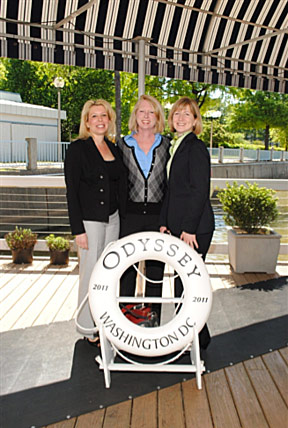
Photo of Linda Kiechlin, Liz Yost, and Nikki Haase at RightStar's Odyssey Cruise event

Linda Kiechlin, Liz Yost, and Nikki Haase of RightStar

Remedy version 8 will be available by mid-next year and will be a modernized Java based AR system with support for open systems. It will include a new service catalog lifecycle and USM uptake to automate service creation and maintenance. Remedy 8 will also support a Java CMDB.

Heidi Sanzari, BMC On-Demand Channel Director, described BMC’s SaaS offerings which include Remedy-on-Demand (RoD) and Remedyforce.  RoD offers the exact same functionality and software release cycle as Remedy except it is available as a SaaS offering. Remedyforce is BMC’s mid-level service management built on the force platform.  Heidi mentioned that Remedy force has evolved quickly from a simple incident and asset tracking system to a full-fledged ITSM system to include or soon include service level management, social media integration, service catalog, and release management.

RightStar’s Alan Shaeffer concluded by briefly discussing BMC ITBM, and BMC MarketZone offerings: enlyte and Matrix 42. He said that these products provide solutions to service costing/project portfolio management, data center management, and configuration management respectively. Alan wrapped up by saying that RightStar can provide the entire solution, from design to implementation to management.

Posted in RightStar | Leave a comment